☀️ B3 (MUST-DO): Dilemma - Akbar vs Aurangzeb
star
star
star
star
star
Last updated about 3 years ago
10 questions
Read about Akbar and Aurangzeb, two different rulers of the Mughal Empire, and answer the questions that follow.
Source: https://www.khanacademy.org/humanities/whp-1750/xcabef9ed3fc7da7b:unit-1-the-world-in-1750/xcabef9ed3fc7da7b:1-3-expanding-to-a-global-scale/a/read-mughal-empire-beta
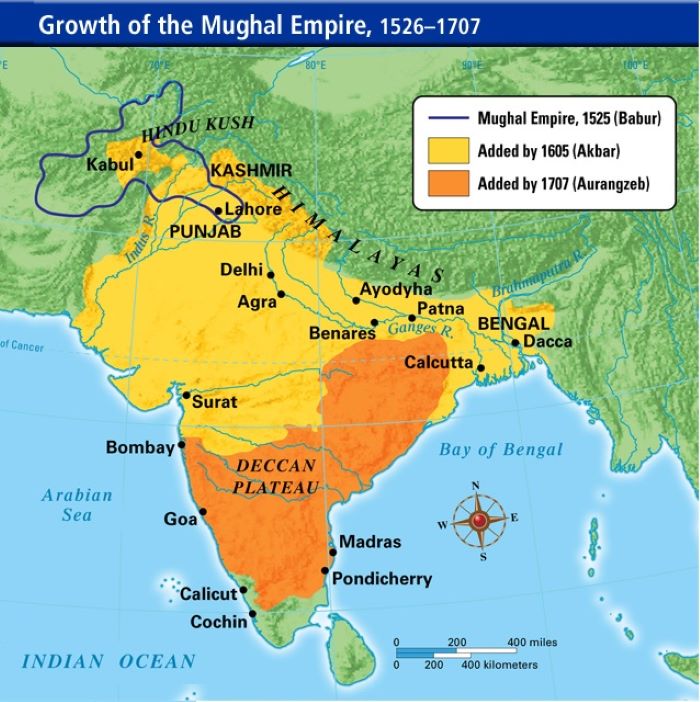
After the first 150 years of Mughal rule, under Emperors Jahangir and Shah Jahan, nobles became increasingly rich, emboldened by larger armies, and able to challenge the weak center in Delhi. Then, around 1700, the Mughal state reached the limits of territorial growth. When the state ran out of land, it was a lot like running out of money, since awarding land was how they bought the mansabdars' loyalty. Meanwhile, the mansabdars had grown extremely powerful. Imagine feeding your pet tiger kitten delicious meat until it grows to 500 pounds, then running out of meat. As the number of nobles, bureaucrats, and military commanders grew, the state feared those elites, some of whom could now maintain massive armies of 40,000 to 60,000. Factions rose and battles over succession for the imperial throne created political instability.
Required
1
As the Mughal Empire went on, the _______ became rich enough and powerful enough that they were able to challenge the weak center in Delhi.
Required
1
The Mughal nobles became powerful because they were backed by strong armies.
Required
1
Check off all of the following that were TRUE about the Mughal Empire once it reached its territorial limits (couldn't expand its borders any more).
Two more problems that emerged were the decline of religious tolerance and an era of continuous war in the late seventeenth century. The vast Mughal state had benefitted, both financially and culturally, from generations of leaders who were practical and tolerant with their diverse subjects. Then came Emperor Aurangzeb, a religious and military zealot. After taking power in 1658, he spent most of his 49 years of rule conquering territories, amassing armies, violently suppressing rebellions, and brutally punishing his enemies, both Hindu and Muslim. Peace was rare in these times. Millions died in combat, and millions more civilians died from drought, plague, and famine during these wars.
Required
1
As the Mughal Empire went on, the government became even more tolerant towards all religions.
Required
1
The Mughal Empire was in the middle of almost-constant _______ during the 17th century.
Required
1
Describe the way that Emperor Aurangzeb ruled the Mughal Empire. How did he treat people and why did so many people die?
Many different Europeans were aggressively seeking bits of land in South Asia in the eighteenth century, including the Dutch, French, and Portuguese. But it was the British who emerged dominant. They were represented by something they called the East India Company, a British private joint stock trading company that rose to prominence in the northeast province of Bengal in the mid-eighteenth century. Initially, they were content to be just like a mansabdar, working within the Mughal bureaucracy and acknowledging the emperor's authority—while making money, of course. Through treaty agreements, the Mughal state gave the Company the right to collect taxes on the lands they won by political and military intervention. The Company then began to expand beyond Bengal. The plan wasn't so much to conquer India as it was to slowly expand their commercial interests. Through carefully calculated maneuverings, they went province by province and made nice with different local factions. By allying with the various local power players who didn't like the Mughals and other Europeans, the British gradually beat out all other European rivals.
Europeans weren't the only outsiders challenging Mughal supremacy. By 1750, neighboring Afghan, Uzbek, and Persian states had pushed against the empire, often furiously. In 1759, the Persians even briefly occupied the capital in Delhi, claiming the famed gem-encrusted Peacock Throne. Meanwhile, internal division continued to crack the empire. Contests over the throne created particular challenges for the state, eating up all of the empire's budget with war costs.
Aurangzeb's cruelty produced a high death toll, and he destroyed many Hindu temples and Muslim holy places during military invasions. However, his failures cannot completely explain the decline of the empire. Personal bigotry aside, Aurangzeb also built Hindu temples and hired more Hindus into his bureaucracy than any previous Mughal ruler. Religious zealotry does not explain the end of the empire, which lingered on for another 150 years. But we might be able to trace the reasons for this empire's slow decline to the general costs of maintaining a medieval war state in modern times. At the same time, India's changing role in the global economy now introduced new Indian bankers, financers, foreign traders and investors of every kind, and that diverted money from the state. The system had evolved into something they simply could not afford. As Mughal power diminished, Europeans— especially British merchants—stepped in to reap the profits.
Required
1
The Mughal Empire had a very fast decline - as soon as Aurangzeb took over, it fell apart.
Required
1
The Mughal Empire system had evolved into something that the rulers simply _______.
Required
1
Who began to take more control in India as soon as the Mughal Empire started to decline?
Required
1
Why did these people care about India?
