1
Name of your Lab partner
Name of your Lab partner
Name of your Lab partner
Be sure to write thorough and detailed answers with complete thoughts. This will be good practice for writing at an AP level.
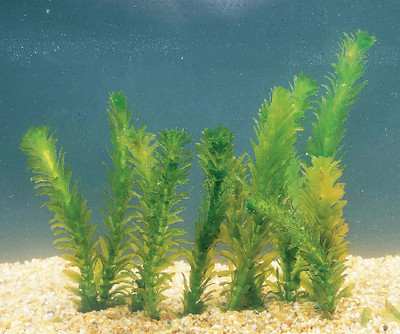
Most of the oxygen and biomass produced on Earth through photosynthesis comes from the ocean. Identify two organisms in the ocean that are producers
Identify two organimss that are producers in freshwater sources such as ponds, lakes, streams and rivers.
Idenitify four components of their environment that producers need to survive. For each component, describe why it is needed. HINT: Thank about the photosynthesis equation.
This lab is designed to teach you how to determine the net primary productivity of a species of aquatic plant by measuring its gross primary productivity and rate of cellular respiration.
Plants produce oxygen through photosynthesis. The amount of oxygen produced is proportional to the amount of carbon incorporated by the plant as carbohydrate (e.g., glucose, sucrose). The carbohydrate is either built into the plant’s biomass or used by the plant as fuel for respiration. During respiration, the plant consumes oxygen to break down carbohydrates into carbon dioxide and water, and release energy. Most of that energy is either released as heat or used to sustain the life of the plant. The amount of carbohydrate that remains and can be passed on to consumers that eat the producer is a producer’s net primary productivity.
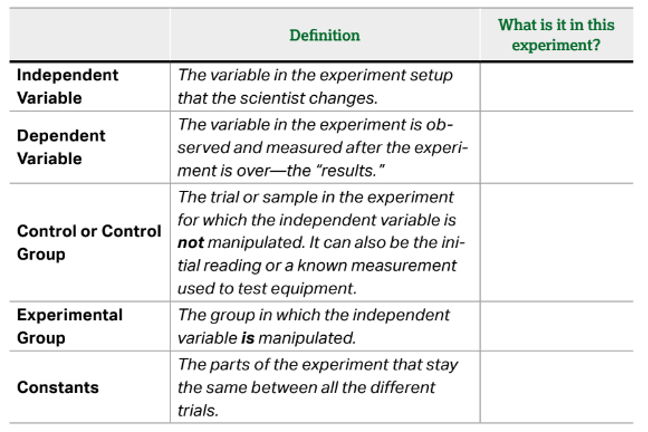
What would be a testable scientific question for this lab investigation?
Examine the water source. Do you think it has conditions for producers to capture and transform a lot of energy into a form that can be transferred to consumers? Why or why not? Be specific about the observed water conditions in your response.
Make Note of the initial dissolved oxygen from the source
Record observations for the Dark Bottle. Be sure to observe any air pockets or bubbles that have appeared.
Record observations for the light bottle. Be sure to observe any air pockets or bubbles that have appeared.
Initial Dissolved Oxygen
Final Dissolved Oxygen (Dark Bottle only)
Final Dissolved Oxygen (Light Bottle only)
Following the data collection from the Lab, answer the following questions with your partner
Interpreting Observations: What processes occurred in the dark bottle:
photosynthesis, cellular respiration, or both? What processes occurred in
the light bottle: photosynthesis, cellular respiration, or both? Explain how you arrived at your conclusion.
Calculating Respiration Rate: Respiration causes a decrease in dissolved oxygen (DO) over time. To determine the rate of respiration for your sample, subtract the DO measurement for the dark bottle from the initial DO measurement for the water source, and divide that difference by the elapsed time (usually measured in days). This will give an answer in mg O2/L/day. Use
the formula below to calculate the respiration rate of the primary producers in your dark bottle.
In a water solution, parts per million (ppm) is equivalent to mg/L.
In this lab, you measured the amount of oxygen that was produced through photosynthesis and showed that this amount is proportional to the amount of carbon that was incorporated into the biomass of the plant. Plants and other producers, however, must use some of that carbohydrate for respiration. The amount of carbohydrate that can be passed on to consumers that eat producers is the net primary productivity.
Answer the following questions with your lab partner.
Explain one way to modify this experiment to strengthen the validity of the results.
With your lab group, decide on a more specific question to test. Some ideas include productivity differences due to light intensity, temperature, source of water, or the amount of various nutrients.
Write a hypothesis for this experiment. Use precise language, such as increasing or decreasing.
Calculating Gross Primary Productivity: GPP is the total amount of carbon that was incorporated into tissues and body parts by organisms over a period of time. In this lab, GPP will be calculated as the mass of oxygen consumed per liter per hour.
In question 18 of the analysis, dissolved oxygen measurements
will be converted to grams of carbon. To determine the GPP for your sample, subtract the DO measurement for the dark bottle from the DO measurement
for the light bottle, and divide that difference by the elapsed time (usually measured in days).
Use the formula below to calculate the GPP of producers in your light bottle.
Calculating Net Primary Productivity: NPP is the total amount of carbon that was incorporated into tissues and body parts by organisms minus that used for respiration over a period of time. In this lab, NPP will initially be calculated as the mass of oxygen consumed per liter per hour.
You will convert dissolved oxygen measurements to grams of carbon in question 18. To determine this for
your sample, subtract the respiration rate from the GPP.
NPP = GPP - Respiration (R)
Alternative Method for Calculating NPP: You can also use the formula
below to calculate the NPP, because the DO measurement of the light bottle minus the initial DO measurement of the water source is a simplified form of the expression: GPP minus respiration rate. Recalculate the NPP using the
alternative formula below.
Write a conclusion that compares the NPP calculated using
the formula from Question 15 with the NPP calculated using the formula from Question 16.
Calculating Total Carbon Production: In aquatic environments, NPP is usually reported as the mass of carbon produced per unit of volume per unit of time.
Calculate the amount of carbon incorporated into the tissues of producers in your bottle during the lab by multiplying the NPP by 0.375 mg C/mg O2. Show
your work, with units.