10/1 Wednesday - PES Unit Test Mod
star
star
star
star
star
Last updated about 1 month ago
16 Nsɛmmisa
2
5-ESS1-1
2
5-ESS1-1
2
5-ESS1-1
2
5-ESS1-1
2
5-ESS1-2
2
5-ESS1-2
2
5-ESS1-2
2
5-PS2-1
2
5-PS2-1
2
5-PS2-1
2
5-PS2-1
Use the diagram below to answer question 1 .
Diagram 1. Distances to Stars in Orion’s Belt

Which star in the diagram is the closest star to Earth?
A. Mintaka
B. Alnilam
C. Alnitak
Use the data table below to answer question 2 .
Data Table 1. Distances to Stars

Which star(s) are in our solar system?
A. The sun, Mintaka, Alnitak, and Alniam
B. The sun and Alnitak
C. The sun
Why does the sun look bigger and brighter than all other stars in the sky?
A. The sun is closer to Earth than other stars.
B. The sun is bigger than other stars.
C. The sun is smaller than other stars.
Sam and Kasie are doing a demonstration to look at the size and distance of stars. Sam is holding a softball to represent Sirius and Kasie is holding a baseball to represent the Sun.

Sam takes the softball and moves 15 large steps backward away from the class, so that Kasie, holding the baseball, is closer to the class. Which answer describes a possible outcome for this demonstration?
A. The softball now appears bigger than it originally did
B. The baseball now has more weight than the softball
C. The softball now appears smaller than it originally did
This is a picture of the daytime portion of the artifact.

Claim: Short answer the question.
Evidence - Use evidence (numbers) from the data table below and explain what the numbers mean.

Reasoning - Write a new sentence to explain your claim (first sentence) with details.
Please use the artifact and what you’ve learned to answer the question one below.
“Why does the daytime section of the artifact show only the sun in the sky, but not other stars?”
Word Bank: day star sun Earth bright overwhelm
Claim (short answer): We don't see a lot of stars in the daytime because _________.
Evidence: In the data table, it shows _________, which means _________.
Reasoning (more details): The sun _________.
How long does it take for Earth to rotate around one time?
A. One hour
B. One day
C. One month
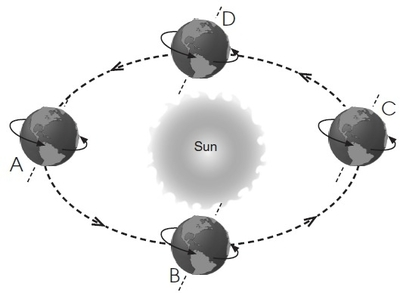
Use this diagram to answer question 7. It is showing Earth moving around the sun
How long would it take Earth A to orbit the sun one time?
A. One hour
C. One month
D. One year
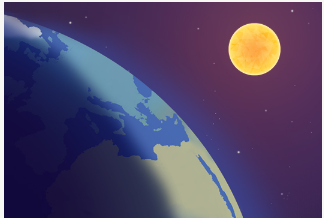
Use the information in this box to answer question 8. The picture is showing the daylight side of Earth.
The picture shows the daylight side of Earth. Which best describes why Earth has day and night?
A. The Moon rotates
B. Earth rotates
C. The Moon revolves around Earth.
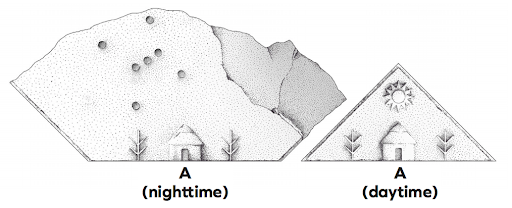
Use the sections of the artifact below to answer questions 9 and 10.

Each section of the artifact shows a different constellation in the sky
Scientists could see Constellation A in the sky on December 2017. When would you expect to see this constellation again?
A. Every day of the year.
B. Every 6 months.
C. On the same day every year.
Use the information in this box to answer question 11.
The nighttime and daytime portions of the artifact are pictured below.
Claim: Short answer the question.
Evidence: Use evidence from the simulation to support your answer.
Reasoning: Explain your answer with more details. Explain when we see the sun and why. Explain when we don't see the sun and why.
Images from PES simulation

PES Simulation https://learning.amplify.com/patternsofearthandsky/
Use the artifact and answer the following:
“The nighttime section of the artifact shows other stars, but not the sun.
Why is the sun up sometimes, but not other times?”
Word Bank: day pattern star sun daytime nighttime Earth
Claim (short answer): The sun is up sometimes, but not other times because __________.
Evidence: In the simulation , it shows __________
Reasoning (more details): We see the sun in the __________ because __________. We don't see the sun in the __________ because __________.
Use the information in this box to answer question 12
The team at the Museum of Archeology has questions for the scientists at the Dig Site. They (Museum of Archeology) can only call them (scientists at Dig Site) during the daytime.

Should they call the dig site right now? Why or why not?
A. Yes, they should call the dig site now, it is daytime there.
B. Yes, they should call the dig site now, the scientists have enough information to dig.
C. No, they should not call the dig site now, it is nighttime there.
Use the information in this box to answer questions 13-14.
The diagram shows a person standing near the Museum of Archaeology and another person standing near the dig site where the artifact was found.
Which diagram shows which direction is down for each person?

Claim: Short answer the question.
Evidence: Use evidence from the video to support your answer.
Reasoning: Explain WITH DETAILS why the person at the dig site doesn't fall of Earth and explain the direction with details.
Why doesn’t the person at the dig site fall off Earth?
Write a scientific explanation.
Word Bank: force down Earth
Claim (short answer): The person at the dig site doesn't fall off earth because __________.
Evidence: In the video, it shows __________.
Reasoning (more details):
Use the information in this box to answer question 15.
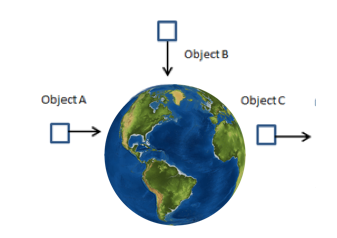
Archaeologists studied three different objects found at dig sites around the Earth.
Which arrow(s) correctly show how gravity pulls on these objects?
A. Object A
B. Object B
D. Object A and B
Phil was explaining to Alex that gravity pulls all objects towards the center of the Earth. He wanted to demonstrate his thinking- which demonstration would support Phil’s claim?
A. Throw different sized objects in the air and measure their masses before and after the fall
B. Kick two soccer balls from different distances and time how long it takes them to travel 100m
C. Throw two items in the air and record how they fall
Why does the sky look different in each nighttime section of the artifact?
A. The Earth spins on its axis, so we see different constellations every day.
B. The Earth orbits around the Sun, so we see different constellations throughout the year
C. The Earth does not move, but the constellations do move.