Log in
Sign up for FREE
arrow_back
Library

Period 2, Day 1 Classwork: Race, Slavery, and Colonization

star
star
star
star
star
Last updated almost 2 years ago
15 questions
Note from the author:
0
0
Required
1
Required
1
Required
1
Required
1
Required
1
Required
1
0
0
0
2
0
Content Objective: I will be able to determine the historical roots of race and racism.
Standard Objective: I will be able to identify explicitly stated central ideas or themes in text.

Absent? Just want to review the notes? Click here for the slides.
Content Objective: I will be able to determine the historical roots of race and racism.
Standard Objective: I will be able to identify explicitly stated central ideas or themes in text.

Absent? Just want to review the notes? Click here for the slides.

Warm Up: Please answer the following questions based on your understanding of last night’s EdPuzzle.

Question 1
1.

One interesting historical fact I learned is…

If you didn't do the EdPuzzle, come back to this question by the end of the lesson.
If you have any questions from the EdPuzzle, drop them under "Show Your Work."

Question 2
2.

Building Knowledge Together: Today we are going to learn from one another by doing a 4 Corners activity.

Question 3
3.

Question 4
4.

Question 5
5.

Question 6
6.

Question 7
7.

Question 8
8.

Question 9
9.

4 Corners Reflection: Please finish the following two sentences.
  • Before the activity, I thought...
  • After the activity, I thought...

Applying Knowledge: Let's find out how slavery originated from colonization and not the other way around!

1
Question 11
11.

Were you surprised by the answer to #11? Explain.

1
IICI.01
Question 13
13.
By 1444, the Portuguese brought _______ people from Africa to work on their sugar plantations off the coast of Morocco. The slave trade then expanded across the Atlantic Ocean as the _______ , Dutch, and _______ all followed the Portuguese in enslaving African people to support their _______ , which had an ever-increasing demand for free labor.

Exit Ticket: Please answer the following question in complete sentences based on today’s key takeaways.

Question 14
14.

Question 15
15.

Please rate how well you understood the EdPuzzle on a scale from 1 to 4
1 - I do not understand this yet.
2 - I need to re-watch.
3 - I can understand the EdPuzzle on my own.
4 - I can explain the EdPuzzle to someone else.
Based on your own experiences, label the following statement as true or false: Race is a real biological part of humanity
True
False
Based on your own experiences, label the following statement as true or false: Humans invented the idea of race only a few hundred years ago.
True
False
Based on your own experiences, label the following statement as true or false: Racism is very real and extremely powerful.
True
False
Based on your own experiences, label the following statement as true or false: Racism has been a major problem in the USA since the very beginning.
True
False
Based on your own experiences, label the following statement as true or false: The ignorance of American racism caused the evils of slavery.
True
False
Based on your own experiences, label the following statement as true or false: Racism is a natural part of human ignorance. Humans need to be educated so they lose their natural racism.
True
False
Question 10
10.

Question 12
12.

What is the relationship between race, racism, slavery, and colonization?
Colonization
Slavery
Race
Racism
Not a real thing
Came second [Effect]
Used to justify the Atlantic System
Came First [Cause]
Exit Ticket: Please evaluate how well you understood today’s lesson on a scale from 1 to 4 [circle one]:
1- I need to seek out extra help from someone else.
2 - I need to find resources and relearn on my own.
3 - I understood the lesson on my own, and should pass on the knowledge!
4 - I was able to successfully explain and help someone else’s understanding.
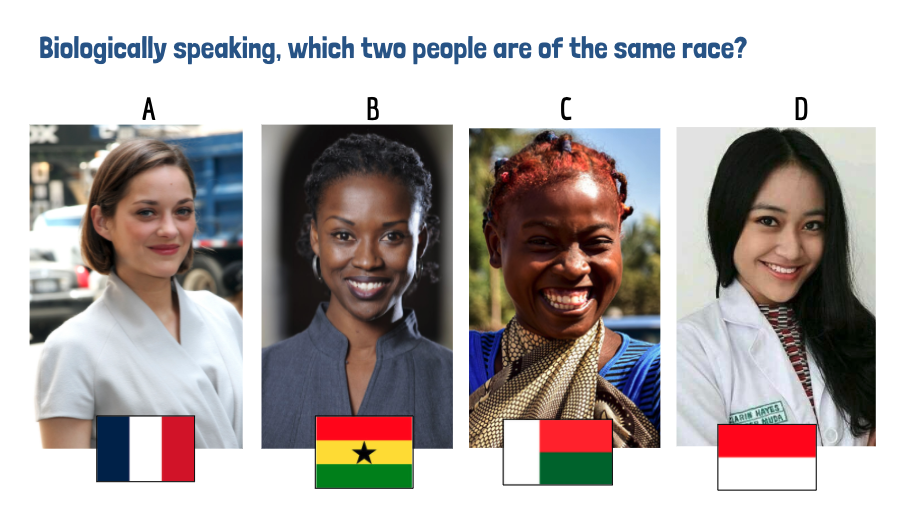
Make a Prediction: Biologically speaking, which two people are of the same race?

Explain your choice under "Show Your Work."
A
C
B
D
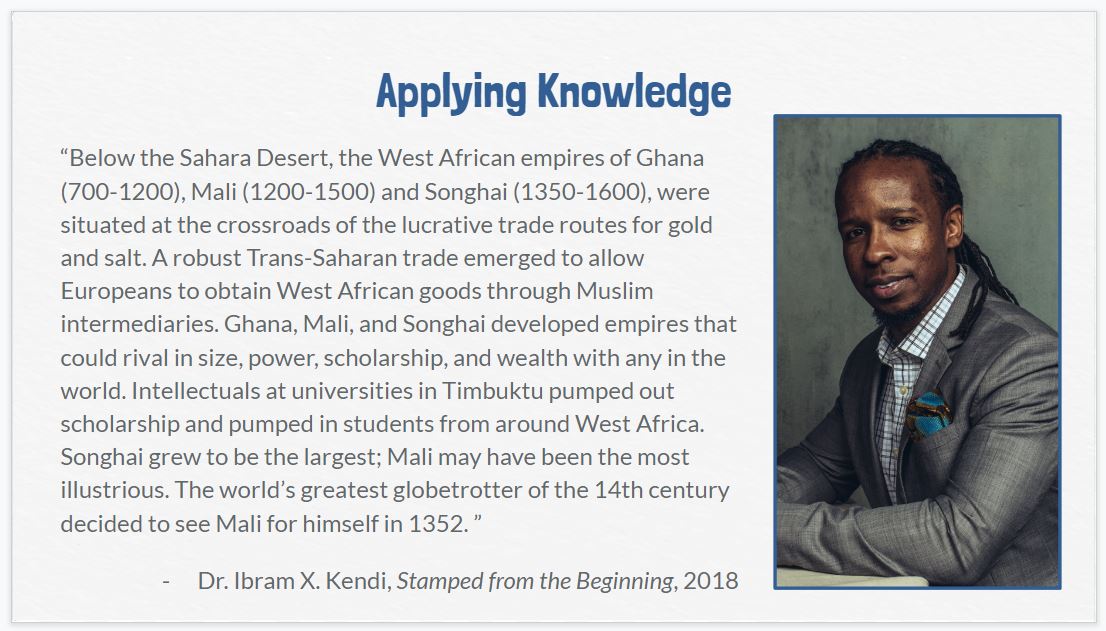
Which statement best expresses a central idea of the passage?
The wealth of flourishing African societies attracted European attention in 1352.
African countries participated in the Atlantic Slave Trade in the post-Columbian era.
Africa and Europe were in stiff competition for the best universities in the 14th century.
Although African trade was prosperous, many nations lacked high quality education.