Launch, Explore, Discuss
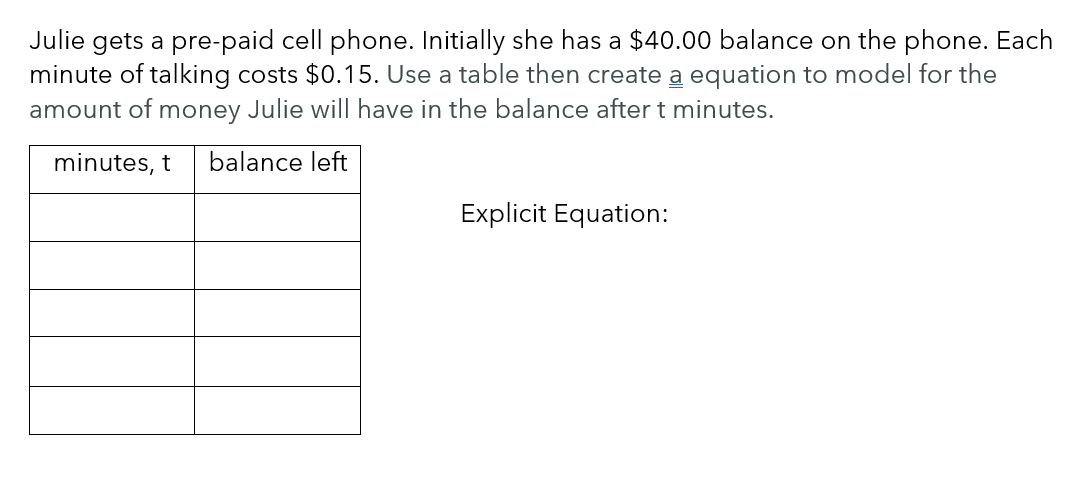
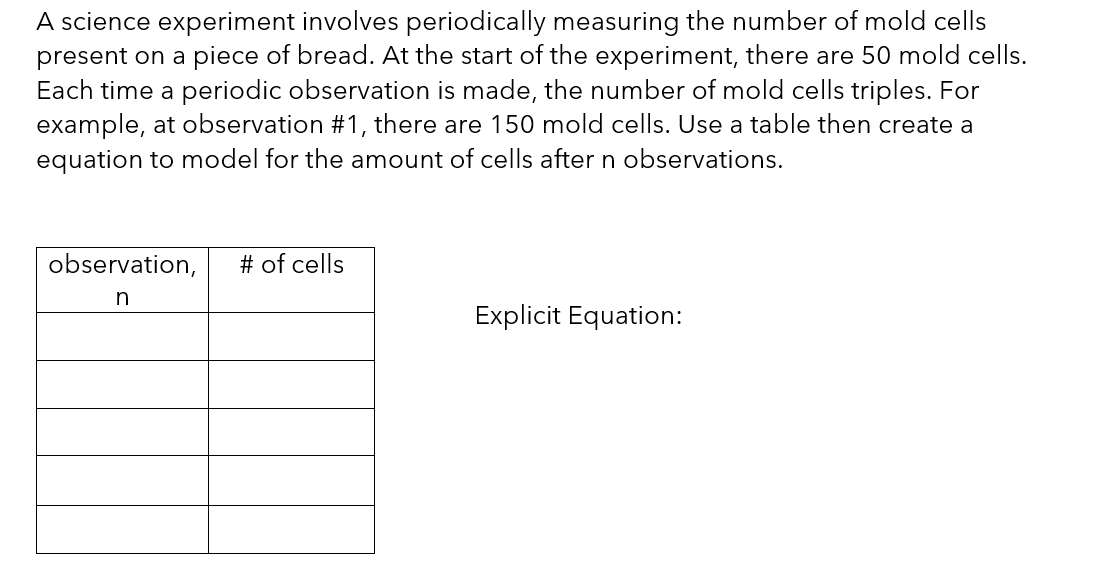
We are beginning on the guided notes paper. Problems 1-4.
Today's Learning Goal:
Surface the difference between a discrete and continuous model for a given context.
Introduce continuous exponential functions.
Recognize that arithmetic sequences are linear functions by examining the constant rate of change.
Recognize that geometric sequences are exponential functions by examining the constant ratio of values over equal intervals.
Introduce the concept of the domain of a function defining the possible input values.
Today's Materials:
Laptop
Pencil
Guided Note Sheet
Binder
Please complete the Jump Start (activator). This is independent it should be silent.
Describe what a discrete function would look like on a graph.
Describe what a continuous function would look like on a graph.
We are beginning on the guided notes paper. Problems 1-4.
Lets compare the problem 1-4 to find similarities and differences with each other.
Compare problems 1 and 2. What similarities do you see? What differences do you notice?
Similarites:
Both functions are
Both functions have a rate of change.
Differences:
Problem #1 is
Problem #2 is
Compare problems 1 and 3. What similarities do you see? What differences do you notice?
Similarites:
Both functions are
Both functions are
Differences:
Problem #1 is
Problem #3 is
Compare problems 3 and 4. What similarities do you see? What differences do you notice?
Similarites:
Both functions have a ratio between outputs.
Differences:
Problem #3 is
Problem #4 is
Problem #3 is
Problem #4 is
Lesson Summary:
In this lesson, we learned that the possible inputs for a function are called the domain. We found that some situations are best described using a discrete model and others are represented better with a continuous model. Arithmetic sequences are part of the linear family of functions and geometric sequences are part of the exponential family of functions.
Closure - Debreif: What is the mathematical reason that the dots are connected on some graphs and not on others?
Instructions:
Predict the next two terms in the sequence. State whether the sequence is arithmetic, geometric, or neither.
Predict the next two terms in the sequence.
Predict the next two terms in the sequence.
Instructions:
Identify whether the following statements represent a discrete or a continuous relationship.
The hair on your head grows 1/2 inch per month
The city of Buenos Aires adds 6,000 tons of trash to its landfills every day.
Instructions:
Show your work!
State whether the sequence is arithmetic, geometric, or neither.
State whether the sequence is arithmetic, geometric, or neither.
State whether the sequence is arithmetic, geometric, or neither.
Apples are on sale at the market at 4 pounds for $2.00. What is the price for 1 pound?
One dozen (12) eggs cost $1.98. How much does 1 egg cost? (Round to the nearest cent.)
Best Shoes had a back to school special. The total bill for 4 pairs of shoes came to $69.24 (before tax). What was the average price for each pair of shoes?