Log in
Sign up for FREE
arrow_back
Library

Period 3, Day 2 Classwork: The Spirit of the American Revolution

star
star
star
star
star
Last updated almost 2 years ago
11 questions
Note from the author:
0
1
0
Required
1
1
0
Content Objective: I will be able to make connections between a current event and an event from the American Revolution.
Standard Objective: I will be able to determine implicit relationships between and among individuals, events, or ideas.
Content Objective: I will be able to make connections between a current event and an event from the American Revolution.
Standard Objective: I will be able to determine implicit relationships between and among individuals, events, or ideas.

Warm Up: Please answer the following questions based on your understanding of last night’s pre-work.

Question 1
1.

Question 2
2.

Do you remember the Chicago Soda Tax of 2017? Why were Chicagoans so upset about a one-cent per ounce tax on soda and did you agree with them?

Question 3
3.

One interesting historical fact I learned from the pre-work is…

Required
1
Question 4
4.
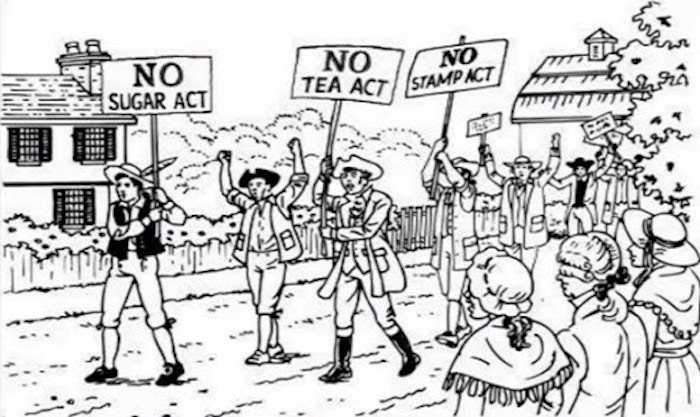
The American Revolution arose from growing tensions between Great Britain and residents of its 13 original colonies over the political and economic _______ of local colonial governments.

_______ the French and Indian War, or Seven Years’ War (1756-1763), the British government raised new _______ in an attempt to pay for the expensive conflict, - most notably the _______ Act of 1765, the Townshend Acts of 1767, and the _______ Act of 1773. Their attempt were met with heated protest among many colonists, who resented their lack of _______ in Parliament and demanded the same rights as other British subjects.
Question 5
5.

Required
1
Question 6
6.
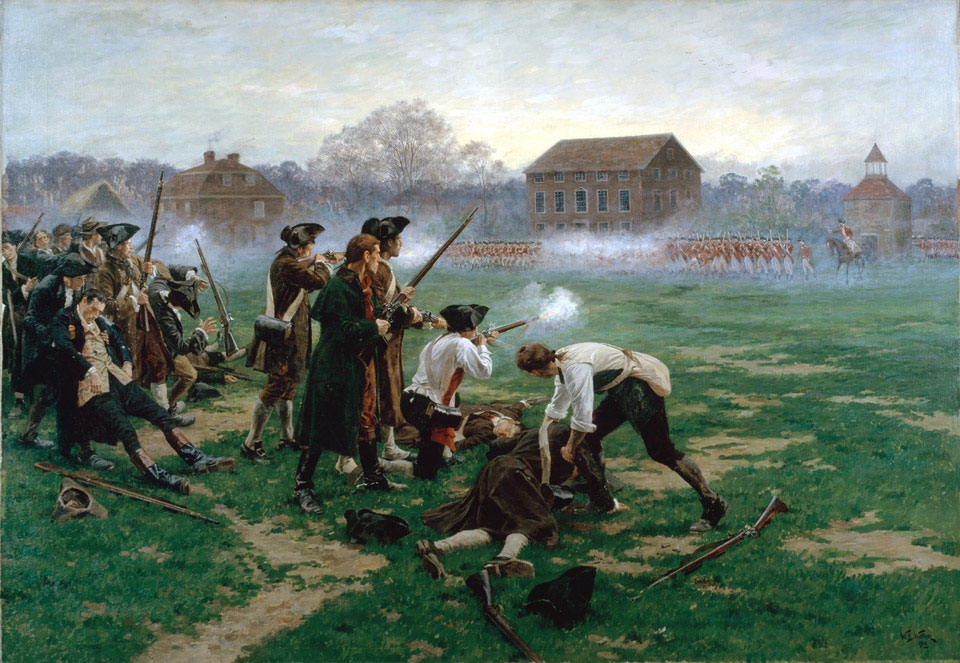
While rising tensions between the British and the colonists would lead to violence in the _______ Massacre and the destruction of property during the Boston _______ Party, American colonists did not officially declare _______ from Great Britain until _______ years after the Revolutionary War.

Even in the Second Continental Congress of 1775, which selected George _______ as the head of the army, colonists still had not defined colonial independence. In fact, King _______ III didn’t officially declare the colonists in _______ until after the Battle of Bunker Hill in June 1775.

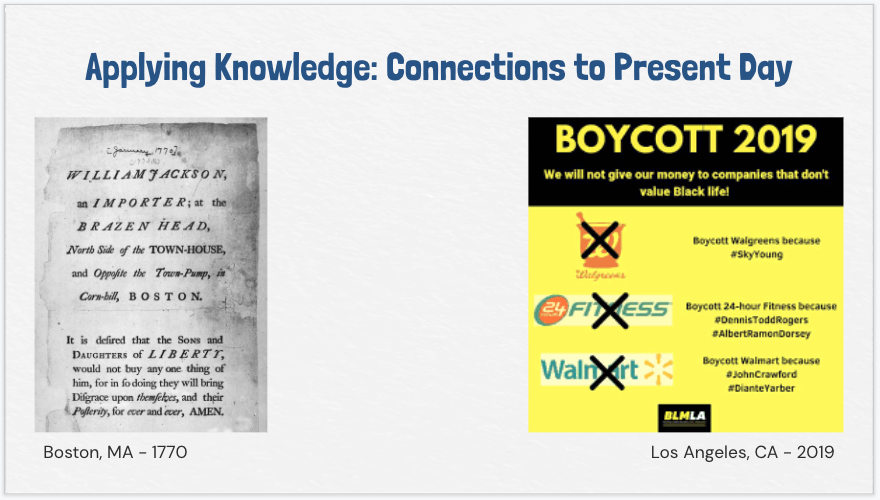
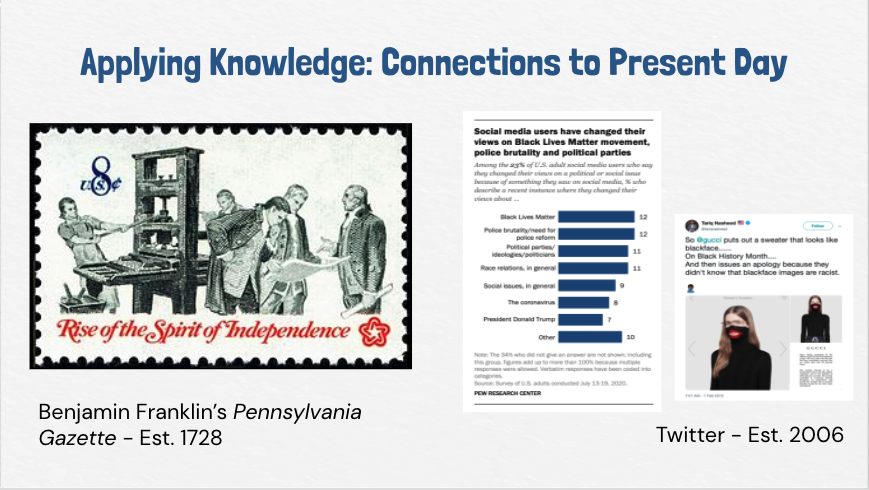
Applying Knowledge: Well done! In your table groups, consider each side-by-side comparison of the American Revolutionary spirit and determine the appropriate conclusion between past and present day.

Revolutionary Event #1: Boycotts as a form of protest by the Sons and Daughters of Liberty in the 1760s and 1770s to stop using British goods and in favor of products made in the colonies.
Required
1
Revolutionary Event #2: Benjamin Franklin’s Pennsylvania Gazette and the pivotal role of newspapers in the American Revolution.
Required
1
CCSS.ELA-LITERACY.RH.11-12.7
IIUR.01
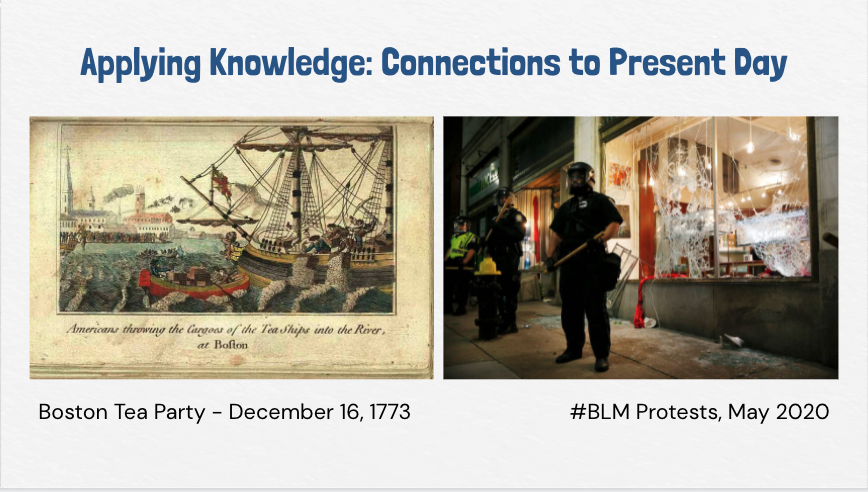
Revolutionary Event #3: On December 16, 1773, Patriots in the Boston Tea Party dressed up as Native Americans, boarded British ships, and dumped 342 chests of tea into Boston Harbor, which is nearly $1 million today.
Required
1
Question 10
10.

Exit Ticket: Have you learned about the American Revolution in the past? How did this activity change or add to your understanding of the American cause for independence?

Question 11
11.

Please rate how well you understood last night's reading on a scale from 1 to 4. If you have any questions, drop them in the "Show Your Work" area.
0 - I recognize that this is not a good start to the new Unit and will get caught up ASAP.
1 - I do not understand the pre-work yet.
2 - I need to review.
3 - I can understand the pre-work on my own.
4 - I can explain the pre-work to someone else.
Why did American colonists protest the new laws passed by the British Parliament?
American colonists felt like the British government was not giving their local governments enough support.
American colonists did not want to pay for something in which they had no say.
American colonists simply did not want to pay taxes because they were too expensive.
American colonists never supported the Seven Years War so they did not want to pay for it too.
Question 7
7.

Question 8
8.

Question 9
9.

Please evaluate how well you understood today’s lesson on a scale from 1 to 4:
1 - I need to seek out extra help from someone else.
2 - I need to find resources and relearn on my own.
3 - I understood the lesson on my own, and should pass on the knowledge!
4 - I was able to successfully explain and help someone else’s understanding.
The Revolutionary spirit of boycott is reflected in our lives today as both colonists and American citizens used this method to
organize large groups of people together to force the hand of powerful entities.
convince Americans that taxes are necessary for the greater good of society.
change the hearts and minds of government officials.
block drastic social change in favor of steady and gradual progress.
The Revolutionary spirit of the press is reflected in our lives today because colonial newspapers and social media both
discourage people from going to the library by providing relatively inexpensive reading materials.
enable companies to advertise their goods and services in order to gain investors from various parts of the world.
provide a public forum for the airing of grievances and rallying opposition against perceived injustices.
give news-hungry Americans with timely information on events from local areas and overseas.
The American spirit of protest reflected in our lives today as both American colonists and citizens
were unified in their attempts to spur social change using collective action.
utilized exisiting government systems in order to redress class differences.
were willing to sacrifice their private interests to the greater good of Mother England.
destroy property as a means of expressing their anger and dissatisfaction with the rate of change.