Log in
Sign up for FREE
arrow_back
Library

3.1 Credit Basics Due (10/7/22 SoC)

star
star
star
star
star
Last updated over 1 year ago
23 questions
Note from the author:
Required
10
Required
10
Required
10
Required
9
Required
9
Required
9
Required
9
Required
9
Required
9
Required
9
Required
10
Required
10
Required
10

In this lesson, you will learn to:

  • Correctly use fundamental vocabulary related to credit and lending
  • Explain how loan amortization and payments work
  • Understand how principal, interest rate, and term are critical components to evaluating credit options

In this lesson, you will learn to:

  • Correctly use fundamental vocabulary related to credit and lending
  • Explain how loan amortization and payments work
  • Understand how principal, interest rate, and term are critical components to evaluating credit options
Question 1
1.

Have you ever borrowed from or lent money to someone? (UCS)

Question 2
2.

Who did the loan involve?

Question 3
3.

Did it work out the way you anticipated? Were both people happy at the end? (UCS)

Banking Explained – Money and Credit

Publisher: In a Nutshell - Kurzgesagt
Required
10
Required
10

What is Credit? Loans, Mortgages, and Overdrafts explained

Watch this video and answer the questions on the right.
Required
15
Required
10
Required
10
Required
10

Understanding How Loan Payments Work

When loan payments are amortized, the total amount you owe every month remains constant
Required
10
Question 10
10.

Day 2

ANALYZE: Understanding Amortization


Part I: Categorize Different Types of Credit

Question 11
11.
Classify each Type of Credit. For each TYPE OF CREDIT listed in the first column, you’ll categorize it using the corresponding abbreviations.

TYPE OF CREDIT:


Auto Loan
Installment Loans vs Revolving Credit__________

Secured vs Unsecured Debt __________

Variable vs Fixed Rate __________
Question 12
12.
Classify each Type of Credit. For each TYPE OF CREDIT listed in the first column, you’ll categorize it using the corresponding abbreviations.

TYPE OF CREDIT:


Credit Card
Installment Loans vs Revolving Credit__________

Secured vs Unsecured Debt __________

Variable vs Fixed Rate __________
Question 13
13.
Classify each Type of Credit. For each TYPE OF CREDIT listed in the first column, you’ll categorize it using the corresponding abbreviations.

TYPE OF CREDIT:


Mortgage
Installment Loans vs Revolving Credit__________

Secured vs Unsecured Debt __________

Variable vs Fixed Rate __________
Question 14
14.
Classify each Type of Credit. For each TYPE OF CREDIT listed in the first column, you’ll categorize it using the corresponding abbreviations.

TYPE OF CREDIT:


Payday Loan
Installment Loans vs Revolving Credit__________

Secured vs Unsecured Debt __________

Variable vs Fixed Rate __________
Question 15
15.
Classify each Type of Credit. For each TYPE OF CREDIT listed in the first column, you’ll categorize it using the corresponding abbreviations.

TYPE OF CREDIT:


Personal loan (from a bank)
Installment Loans vs Revolving Credit__________

Secured vs Unsecured Debt __________

Variable vs Fixed Rate __________
Question 16
16.
Classify each Type of Credit. For each TYPE OF CREDIT listed in the first column, you’ll categorize it using the corresponding abbreviations.

TYPE OF CREDIT:


Small business loan (from a bank)
Installment Loans vs Revolving Credit__________

Secured vs Unsecured Debt __________

Variable vs Fixed Rate __________
Question 17
17.
Classify each Type of Credit. For each TYPE OF CREDIT listed in the first column, you’ll categorize it using the corresponding abbreviations.

TYPE OF CREDIT:


Student loan (Federal)
Installment Loans vs Revolving Credit__________

Secured vs Unsecured Debt __________

Variable vs Fixed Rate __________

Part II: Reflection

Question 18
18.

Why do people sometimes use credit to pay for items instead of just using cash?

Question 19
19.

When applying for credit, is it preferable to receive a low interest rate or a high interest rate?

Question 20
20.

Sometimes, lenders allow or require a downpayment before they extend you the loan. What would be the advantage to the lender? What would be the advantage to the borrower?

Exit Ticket

Required
3
Required
3
Required
3
Question 4
4.

What is the relationship between people who save money in banks and people who borrow money from banks? (UCS)

Question 5
5.

How does the bank make a profit? (UCS)

Question 6
6.
In your own words define:

credit: _______

principal: _______

interest: _______

term: _______


(UCS)
Question 7
7.

What are the main advantages to a secured vs. unsecured loan? (UCS)

Question 8
8.

What factors determine interest rates? (UCS)

Question 9
9.

What is a danger of taking a variable rate loan? (UCS)

Why does the amount of INTEREST you owe decrease every month? (UCS)
For each TYPE OF CREDIT listed in the first column, you’ll categorize it in the remaining three columns, using the following descriptions:
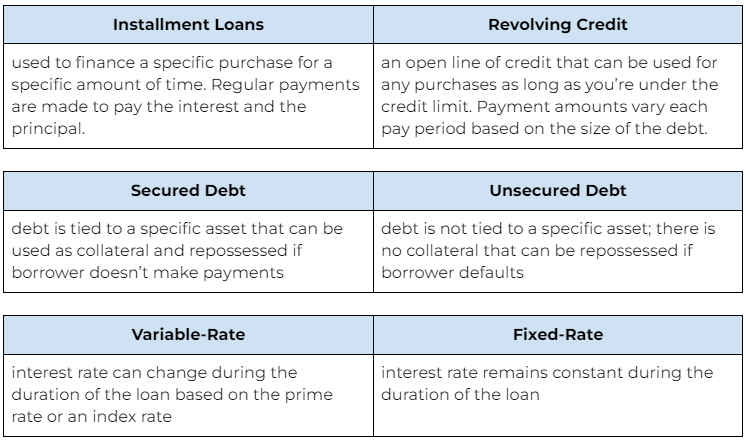

If you’re unsure where a type of credit belongs, you can use these links as a resource:
  • Types of Consumer Credit & Loans - Debt.org
  • The Difference Between Secured and Unsecured Debts - About Money
  • What Is the Difference Between Fixed- and Variable-Rate Financing? - CFPB
If you can’t find the answer using the links above, you can do your own internet search to help you complete the work.
Question 21
21.

Question 22
22.

Question 23
23.

What makes a loan be categorized as secured?
It is secured when the borrower receives the loan amount from the bank
It is secured because it is backed up with some form of collateral
It is secured when someone co-signs on the loan
It is secured after all payments are made
Which of the following is usually a secured debt?
Student loan
Personal loan
Auto loan
Credit card
Which of the following is a TRUE statement describing the benefits of an installment loan?
An installment loan allows you to make one large purchase, even if you don’t have all the money for it up front
An installment loan allows you to make many small purchases as you need them, as long as you’re under your credit limit
An installment loan does not require a credit check, so they are easy to obtain
An installment loan does not require monthly payments, so they can be paid back when the borrower is ready