Correctly use fundamental vocabulary related to credit and lending
Explain how loan amortization and payments work
Understand how principal, interest rate, and term are critical components to evaluating credit options
Correctly use fundamental vocabulary related to credit and lending
Explain how loan amortization and payments work
Understand how principal, interest rate, and term are critical components to evaluating credit options
Have you ever borrowed from or lent money to someone? (UCS)
Who did the loan involve?
Did it work out the way you anticipated? Were both people happy at the end? (UCS)
Publisher: In a Nutshell - Kurzgesagt
What is the relationship between people who save money in banks and people who borrow money from banks? (UCS)
How does the bank make a profit? (UCS)
Watch this video and answer the questions on the right.
In your own words define:
credit:
principal:
interest:
term:
(UCS)
What are the main advantages to a secured vs. unsecured loan? (UCS)
What factors determine interest rates? (UCS)
What is a danger of taking a variable rate loan? (UCS)
When loan payments are amortized, the total amount you owe every month remains constant
Why does the amount of INTEREST you owe decrease every month? (UCS)
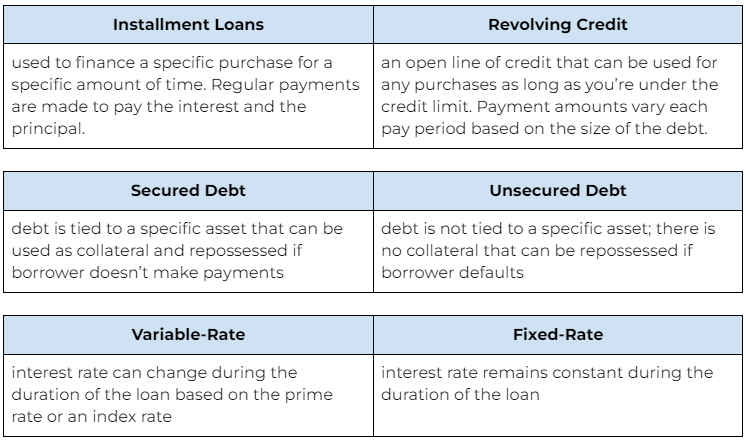
Classify each Type of Credit. For each TYPE OF CREDIT listed in the first column, you’ll categorize it using the corresponding abbreviations.
TYPE OF CREDIT:
Auto Loan
Installment Loans vs Revolving Credit
Secured vs Unsecured Debt
Variable vs Fixed Rate
Classify each Type of Credit. For each TYPE OF CREDIT listed in the first column, you’ll categorize it using the corresponding abbreviations.
TYPE OF CREDIT:
Credit Card
Installment Loans vs Revolving Credit
Secured vs Unsecured Debt
Variable vs Fixed Rate
Classify each Type of Credit. For each TYPE OF CREDIT listed in the first column, you’ll categorize it using the corresponding abbreviations.
TYPE OF CREDIT:
Mortgage
Installment Loans vs Revolving Credit
Secured vs Unsecured Debt
Variable vs Fixed Rate
Classify each Type of Credit. For each TYPE OF CREDIT listed in the first column, you’ll categorize it using the corresponding abbreviations.
TYPE OF CREDIT:
Payday Loan
Installment Loans vs Revolving Credit
Secured vs Unsecured Debt
Variable vs Fixed Rate
Classify each Type of Credit. For each TYPE OF CREDIT listed in the first column, you’ll categorize it using the corresponding abbreviations.
TYPE OF CREDIT:
Personal loan (from a bank)
Installment Loans vs Revolving Credit
Secured vs Unsecured Debt
Variable vs Fixed Rate
Classify each Type of Credit. For each TYPE OF CREDIT listed in the first column, you’ll categorize it using the corresponding abbreviations.
TYPE OF CREDIT:
Small business loan (from a bank)
Installment Loans vs Revolving Credit
Secured vs Unsecured Debt
Variable vs Fixed Rate
Classify each Type of Credit. For each TYPE OF CREDIT listed in the first column, you’ll categorize it using the corresponding abbreviations.
TYPE OF CREDIT:
Student loan (Federal)
Installment Loans vs Revolving Credit
Secured vs Unsecured Debt
Variable vs Fixed Rate
Why do people sometimes use credit to pay for items instead of just using cash?
When applying for credit, is it preferable to receive a low interest rate or a high interest rate?
Sometimes, lenders allow or require a downpayment before they extend you the loan. What would be the advantage to the lender? What would be the advantage to the borrower?
What makes a loan be categorized as secured?
Which of the following is usually a secured debt?
Which of the following is a TRUE statement describing the benefits of an installment loan?