Log in
Sign up for FREE
arrow_back
Library

Microbiology BM4 Microscope Lab

star
star
star
star
star
Last updated 24 days ago
8 questions
Note from the author:
RST 9-10.1,5, LS1.2 Systems, Structure/function. (LS1-A)
Free Response
15
7
5
Question 1
1.

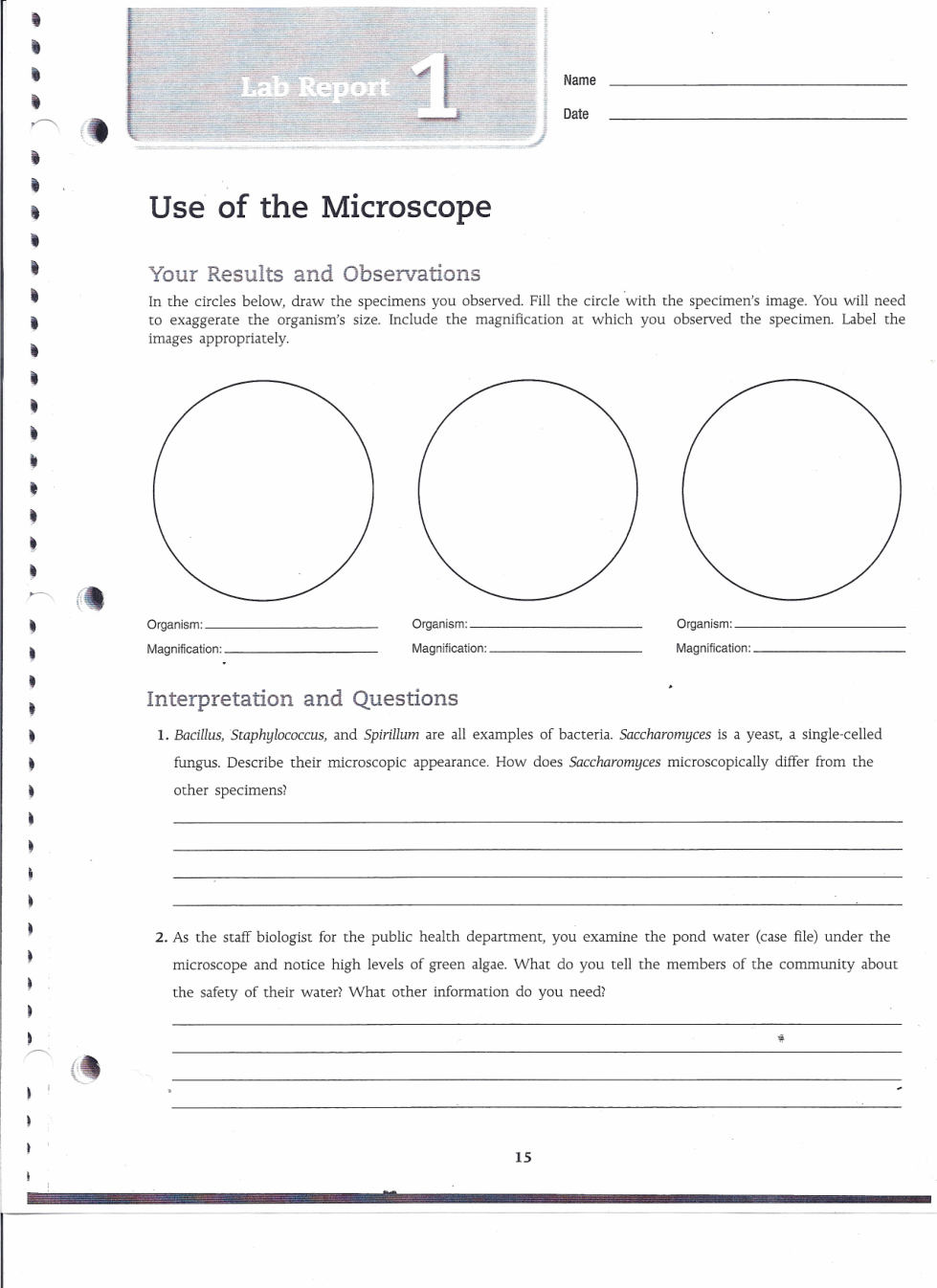
Your Results and Observations
In the circles below, draw the specimens you observed.

Fill the circle 'with the specimen's image.

You will need to exaggerate the organism's size. Include the magnification at which you observed the specimen.

Label the images appropriately.

5
Question 2
2.

Bacillus, Staphylococcus, and Spirillum are all examples of bacteria.

Saccharomyces is a yeast, a single-celled fungus. Describe their microscopic appearance.

How does Saccharomyces microscopically differ from the
other specimens?

5
5
Question 4
4.

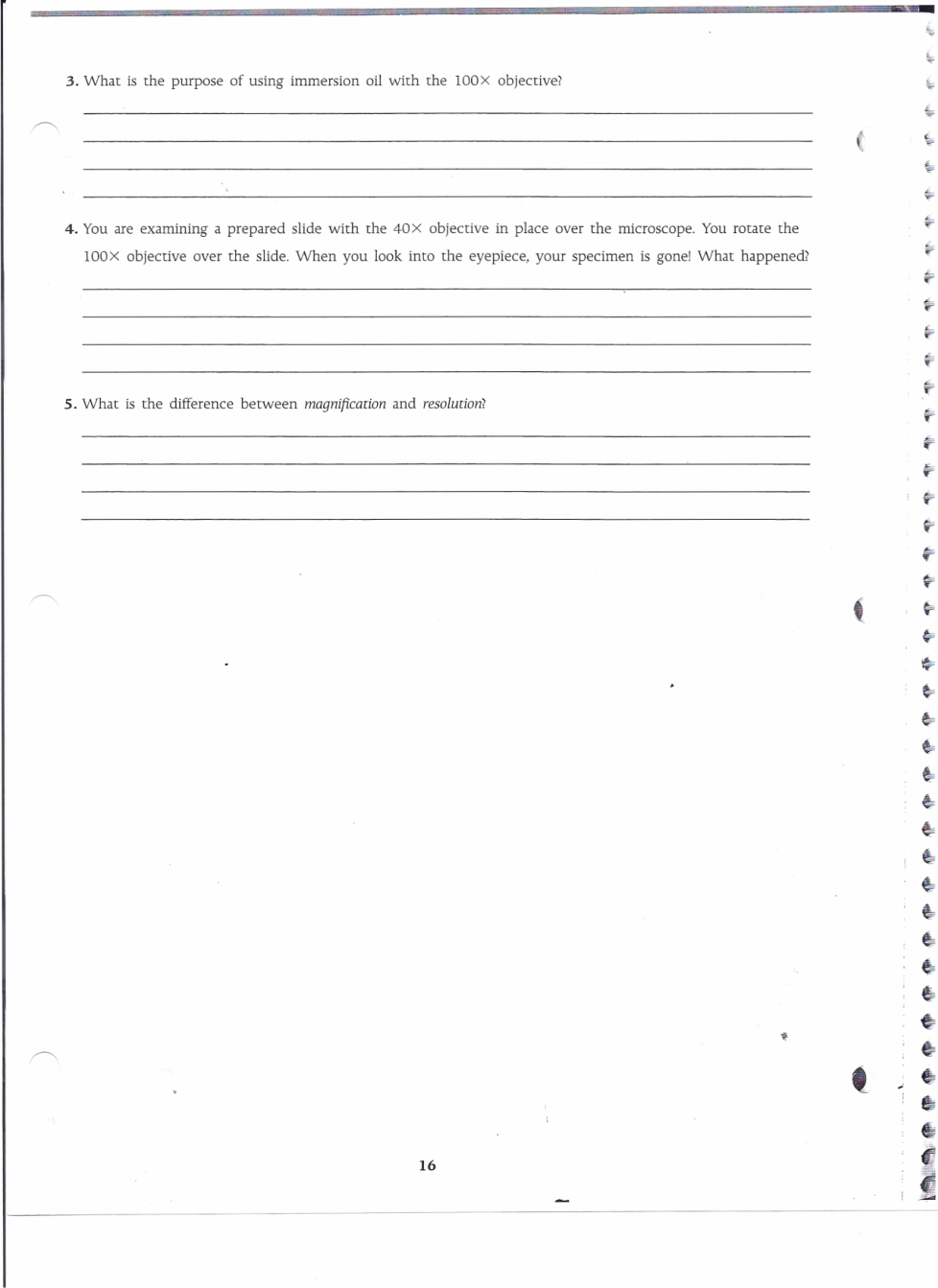
What is the purpose of using immersion oil with the lOOX objective?

5
Question 5
5.

You are examining a prepared slide with the 40X objective in place over the microscope. You rotate the lOOX objective over the slide.

When you look into the eyepiece, your specimen is gone! What happened?

5
Question 6
6.

What is the difference between magnification and resolution?

Question 7
7.

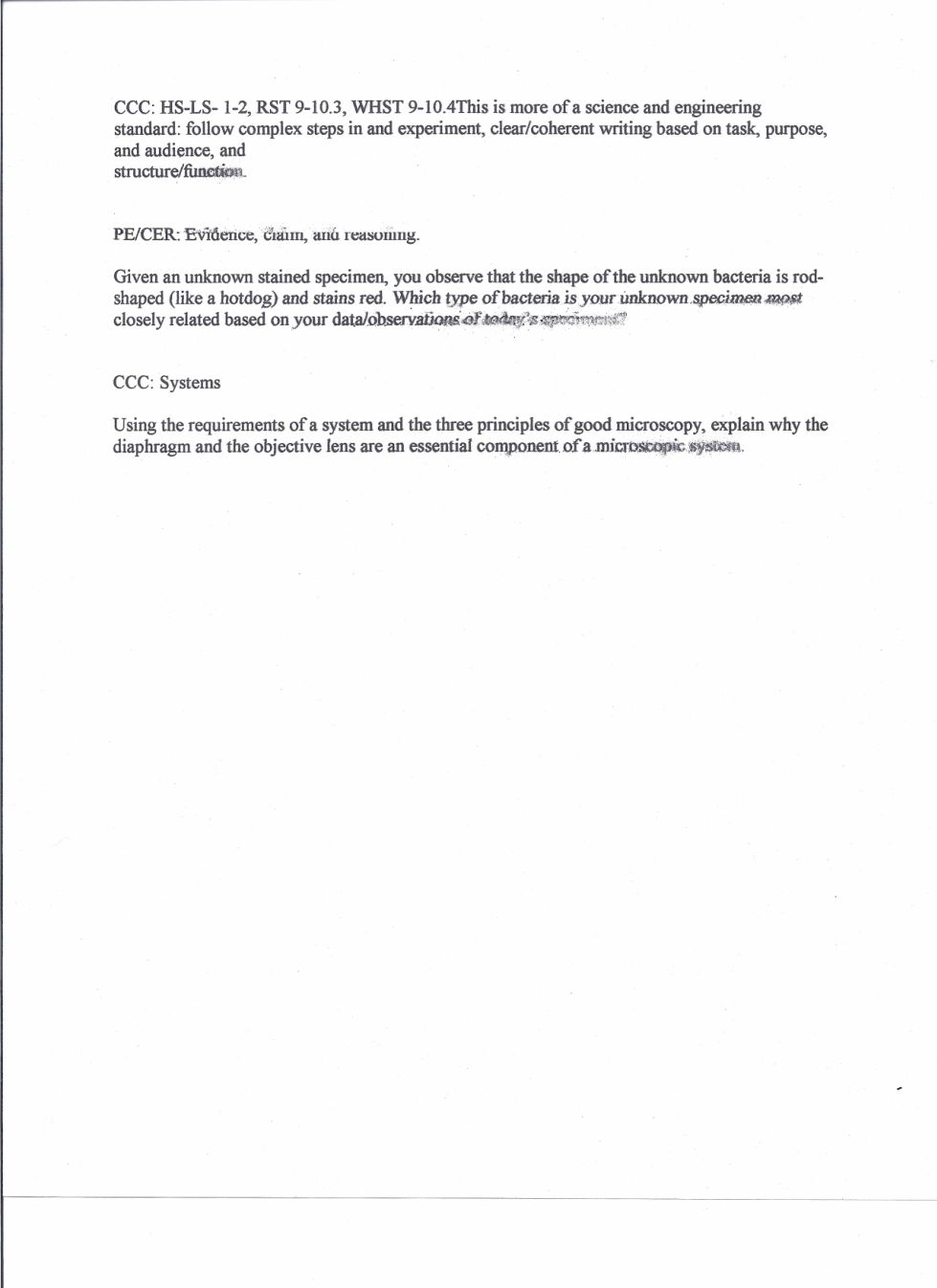
Based on a microscopic examination of an unknown stained specimen, you've recorded the following observations: the bacteria are rod-shaped and stain red. Construct a CER argument that identifies the unknown specimen.
  • Claim: What is the most likely classification of the unknown bacteria?
  • Evidence: What specific observations from the lab exercise support your claim?
  • Reasoning: Explain the scientific principles of Gram staining and bacterial morphology that connect your evidence to your claim.
See the rubric to ensure you get the greatest amount of points for your answer.

Question 8
8.

Explain how the diaphragm and the objective lens contribute to achieving the three principles of good microscopy: magnification, resolution, and contrast. In your answer, describe the role of each component and the specific principle it directly influences.

Question 3
3.

As the staff biologist for the public health department, you examine the pond water (case file) under the
microscope and notice high levels of green algae.

What do you tell the members of the community about the safety of their water?
What other information do you need?