Read the following stories about Kit Kats in Japan and other glocalization efforts, then answer the questions that follow.
Sources: https://www.latimes.com/world/asia/la-fg-japan-kitkat-20171211-story.html
https://blog.education.nationalgeographic.org/2017/12/13/whats-up-with-kitkat-in-japan/
KitKat’s history dates to the United Kingdom in 1935, when the York-based confectionery company Rowntree introduced the bar — originally called “Rowntree’s Chocolate Crisp” — as the perfect complement to a working man’s cup of tea. In 1937, the snack was renamed “Kit Kat Chocolate Crisp.”
In the 1950s, the bar arrived in Canada, South Africa, Ireland, Australia and New Zealand; in 1973, it finally made it to Japan. (The Swiss food and beverage giant Nestle acquired Rowntree in 1988. Eventually, Kit Kat became KitKat, and it is now sold in more than 100 countries. It is licensed by Hershey’s in the United States.)
Yet the story of how Japan made the snacking staple entirely its own begins in 1990, in Hokkaido, Japan’s northernmost main island, known for its skiing, hot springs and beer. KitKat’s marketing team believed the island’s souvenir shops — in fact, souvenir shops nationwide — could stand to diversify their snack offerings.
“Wherever you went, you could only find rice cakes,” said Takuya Hiramatsu, a spokesman for Nestle Japan. “But people got kind of bored with traditional rice cakes.”
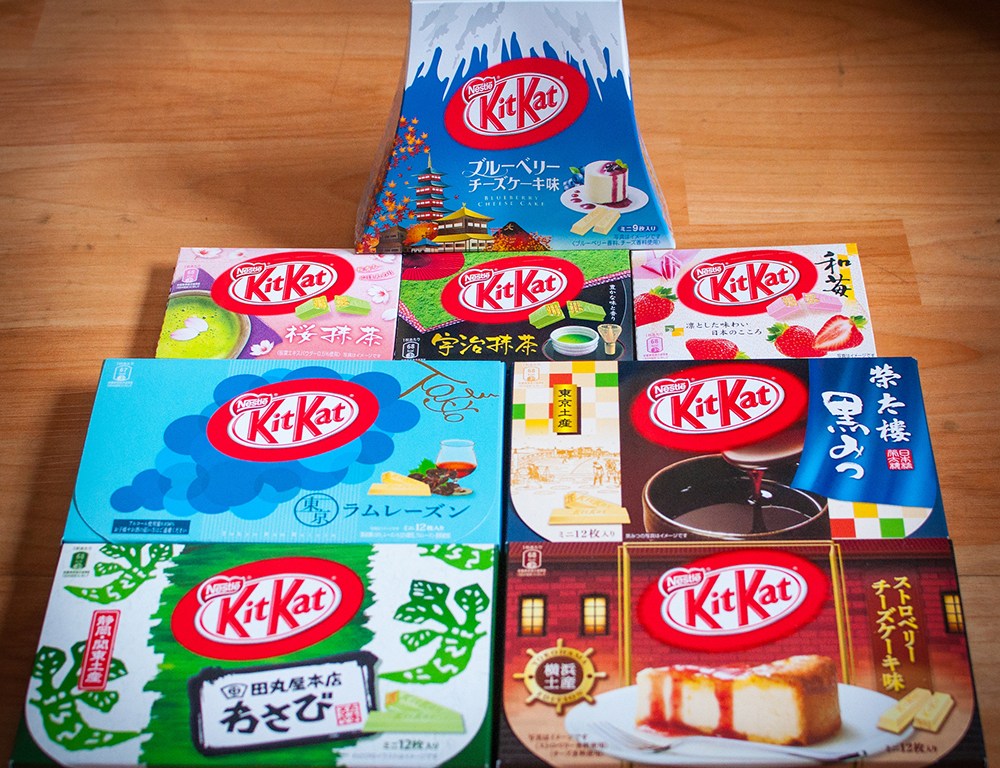
The company introduced a strawberry-flavored KitKat exclusively in Hokkaido — and after it took off, tried more limited-edition varieties. The more they introduced, the more popular the bars became. The KitKat makers leveraged local products into exotic flavors.
In time, exotic and strange KitKats began appearing all over, including on Honshu, the nation’s largest island. There, in Shizuoka prefecture, the candy-makers offered Tamaruya-Honten brand wasabi KitKats; in the Kanto region, adzuki bean sandwich KitKats; in Hiroshima, KitKats flavored like momiji manju, a locally produced pastry made of rice and buckwheat.
“I lived in Hiroshima when I was young,” Maki said. “So I knew people in Hiroshima love momiji manju so much — that it’s a soul food. I wanted to develop a business with that.”
Nestle gives several reasons for KitKat’s success in Japan. Giving sweets as gifts is a national custom, and the country has deep pride in its local culinary traditions and industries.
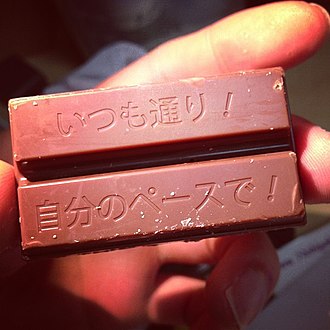
Not least, the chocolate bar’s English name is a cognate — it sounds like kitto kattsu, which means “you will surely win,” a sort of good luck blessing. Nestle leveraged the association into huge sales. In 2009, the company created “KitKat Mail,” a partnership with Japan’s postal service that allowed students to send KitKats as good luck charms before the country’s high-pressure January university entrance examination. Some KitKat wrappers contain blank spaces for students to scribble in heartwarming messages.
Nestle says KitKat sales in Japan have risen 50% between 2010 and 2016, and this August the company opened its first new manufacturing plant in Japan in 26 years to keep up with local demand. The company develops 20 new flavors every year, and replaces flavors on convenience store shelves every two months. “That’s how the cycle has been ever since strawberry,” Maki said.
New KitKat varieties, Maki said, take about six months to develop, from idea to shelf, which makes failures all the more disappointing. One of Maki’s greatest failures came about eight years ago — an assortment of cola- and lemonade-flavored KitKats. In 2009, “sports drink,” a citrusy concoction, also fell flat.
This August, KitKat released a “cough drop” flavor in support of a Japanese soccer team, assuming that fans would cheer till they were hoarse. Instead, the flavor left snackers, even those with scratchy throats, scratching their heads.
Based on this article and Wikipedia page, what do you think is the definition of the word "glocalization"?
Explain some of the reasons why Kit Kats have become so popular in Japan.
Which Japanese Kit Kat flavors would you definitely try and definitely not try?
Can you think of any other examples of glocalization? If so, what are they? If not, google it and write some examples of what you find.