Log in
Sign up for FREE
arrow_back
Library
History of Trick or Treating
By Regina McWhorter
star
star
star
star
star
Share
share
Last updated almost 3 years ago
8 questions
Add this activity
zoom_in
20
Question 1
1.
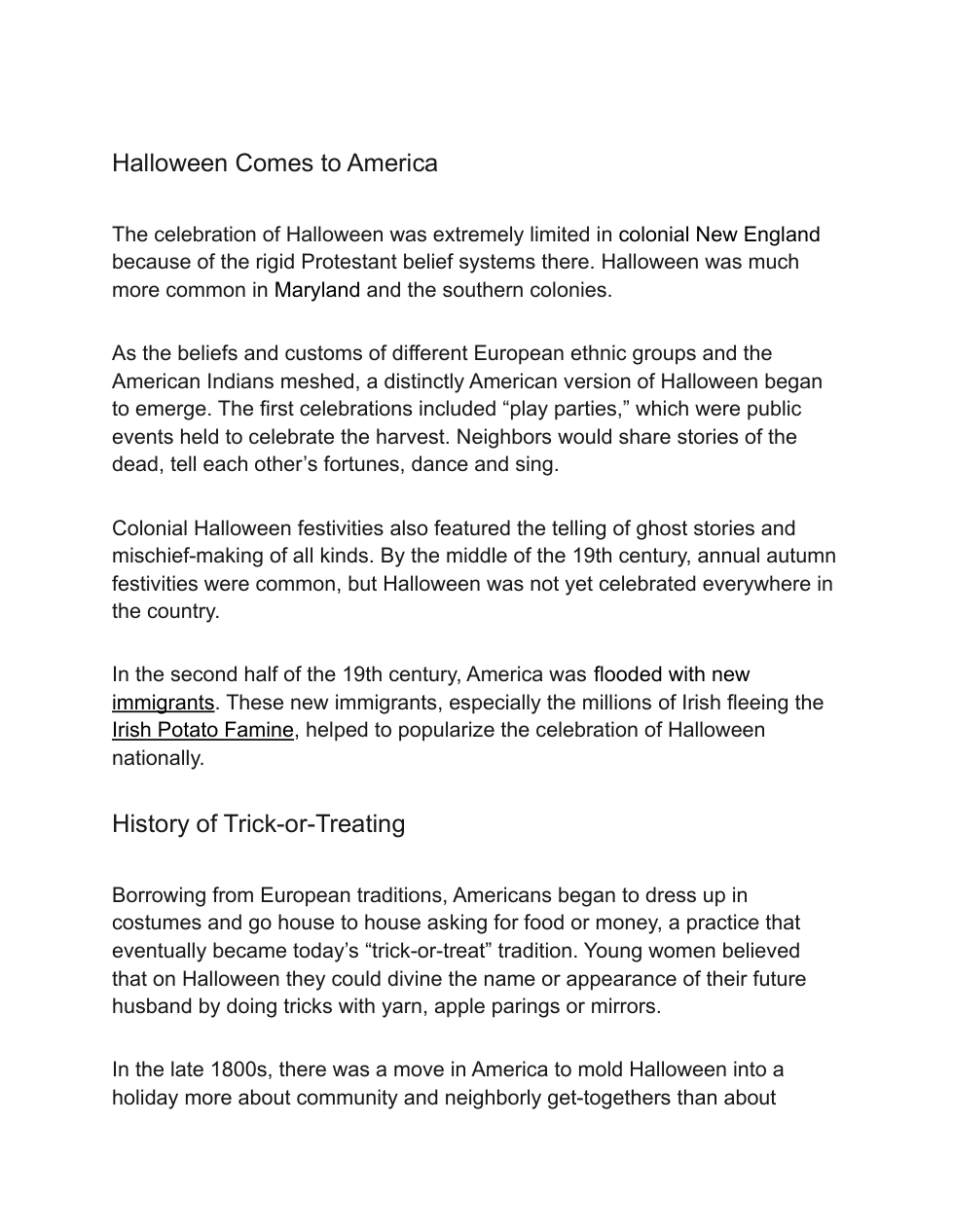
Write a summary of the section Halloween Comes to America.
10
10
10
zoom_in
10
10
Question 6
6.
Vandalism became popular in some community celebrations in the early days.
True
False
10
20
Question 2
2.
Using context clues, what does the word immigrants mean?
A. people that were native to America
B. people that came to America from other countries
C. someone that wears a costume
D. a popular person
Question 3
3.
Why did immigrants flood America?
A. They were fleeing a war in their own country.
B. They wanted to get free healthcare.
C. There was a famine in their country.
D. They were escaping a tyrannical oppressive leader in their country.
Question 4
4.
According to the text, what was included in the first celebrations of American Halloween?
A. "play parties", stories of the dead, fortune telling, singing, and dancing
B. Vandalism and trick-or-treating
C. dressing up in costumes
D. giving neighborhood children small treats
Question 5
5.
What is the main idea of the section History of Trick-or-Treating?
A. Americans created the Halloween we know today borrowing some traditions from Europe.
B. The Irish potato famine caused immigrants to flee to America.
C. Parents are encouraged to take out anything "frightening" or "grotesque" from their Halloween celebrations.
D. Halloween came from Europe.
Question 7
7.
Which line from the text supports the idea that Halloween has become an American tradition?
A. Despite the best efforts of many schools and communities, vandalism began to plague some celebrations in many communities during this time.
B. Trick or treating was a relatively inexpensive way for an entire community to share the Halloween celebration.
C. Thus, a new American tradition was born, and it has continued to grow.
D. Parents were encouraged by newspapers and community leaders to take anything "frightening" or "grotesque" out of Halloween celebrations.
Question 8
8.
Resequence the order.
Borrowing from European traditions, Americans began dressing up and going house to house asking for food or money.
As the beliefs of different European groups and the American Indians meshed, a distinctly American tradition of Halloween emerged.
A new American tradition was born, and it has continued to grow.
Halloween parties for both children and adults became the most common way to celebrate the day.