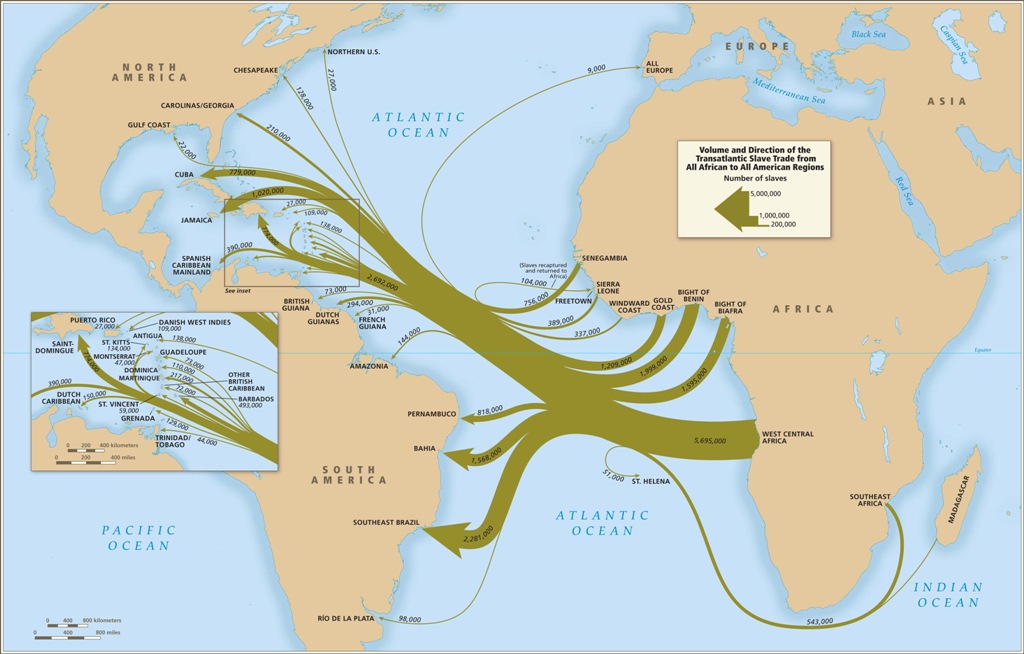
Answer the questions based on the map, reading, and images.
Source: https://www.khanacademy.org/humanities/ap-us-history/period-2/transatlantic-trade/a/transatlantic-trade
From which part of Africa did the majority of enslaved persons get taken from?
The vast majority of enslaved peoples were taken to the British colonies in North America.
Which of the following statements about the slave trade in Europe is true?
Because people in the northern U.S. hated slavery so much, no slaves were brought to the northern U.S. states.
The total volume of enslaved persons taken from Africa was in the
Mercantilism led to the emergence of what’s been called the “triangular trade”: a system of exchange in which Europe supplied Africa and the Americas with finished goods, the Americas supplied Europe and Africa with raw materials, and Africa supplied the Americas with enslaved laborers.
Match the product that was supplied by each location in the Triangular Trade system.
| Draggable item | arrow_right_alt | Corresponding Item |
|---|---|---|
Americas | arrow_right_alt | Finished Goods |
Africa | arrow_right_alt | Raw Materials |
Europe | arrow_right_alt | Enslaved Laborers |
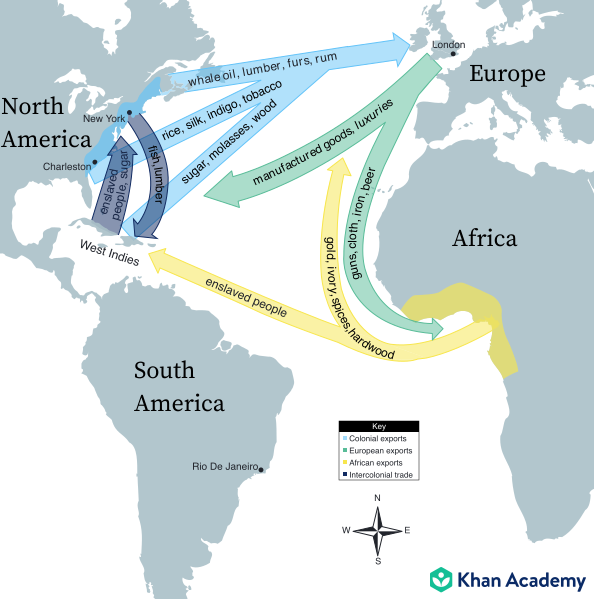
This entire Atlantic economy depended on the unpaid toil and unparalleled human misery of enslaved laborers, who worked on plantations growing cash crops. Unable to compel a sufficient number of Europeans (who refused to accept brutal working conditions) or Native Americans (who escaped captivity or died from European-borne diseases) to work on New World plantations, Europeans purchased enslaved laborers from slave traders on the coast of Africa.
Which of the following is NOT a reason why European colonizers ultimately relied on the labor of enslaved Africans to make a profit?
After a grueling Middle Passage by boat in which about one-third of captives died, most enslaved laborers arrived in the Caribbean to work on the sugar islands, like Barbados and Jamaica. Some of those who survived the harsh conditions growing and processing sugar would be sold north to Virginia or Carolina, where they worked growing tobacco or rice. Although few enslaved people worked in the New England colonies, those colonies propped up the colonial system of slavery by sailing Middle Passage ships and selling provisions to enslavers.
Most enslaved Africans ultimately ended up in the New England colonies.
Because so many people in New England hated slavery, they refused to participate in any activity that supported slavery.
The Atlantic highway
In the colonial era, the Atlantic Ocean served as a highway between Europe, Africa, and the Americas, tying together a network of people, raw materials, finished goods, merchants, and sailors that brought wealth to colonial empires.
Generating wealth for the mother country was first and foremost among the reasons for European colonization in the Americas. During this era, the economic theory of mercantilism suggested that a nation’s power relied on a favorable balance of trade: that is, exporting more than it imported.
Establishing colonies promoted mercantilist goals in two ways: first, the colonies ensured the mother country had a cheap supply of raw materials (timber, sugar, tobacco, furs, just to name a few), and second, the colonies served as a captive market for finished goods (furniture, guns, metal implements). In other words, colonies existed to sell things to the mother country and to buy things from it, and the government made its profit by taxing and imposing customs duties on trade.
Check off the three main locations that were connected by the Atlantic Ocean during the colonial era.
The only things that were traded across the Atlantic Ocean in the colonial era were enslaved persons and raw materials.
Generating
What do you think the term "mother country" means?
During the colonial era, countries wanted to make money by exporting more goods than they imported.
European colonizers always tried to make sure that they had a
Where did European colonizers get most of their cheap raw materials?
One of the main reasons why Europeans established colonies was so they could force the people living in their colonies to purchase finished goods from them.
European colonizers made a lot of money by taxing goods that were being traded.