Log in
Sign up for FREE
arrow_back
Library
Egypt Test 2022-23 (TCI L7-9)
By Janifer A Douglas
star
star
star
star
star
Share
share
Last updated over 3 years ago
33 questions
Add this activity
1
1
1
1
1
1
1
1
1
1
1
1
1
1
1
1
1
1
1
1
1
1
Question 1
1.
Which of these was part of the topography of ancient Egypt?
a river valley
a mountain range
a hot, dry climate
a long growing season
Question 2
2.
Because this physical feature was so important to people's lives, most ancient Egypt settlements were...
on hills
in a desert
near a river
around trees
Question 3
3.
How did the deserts help the people of Egypt?
It had fertile land for crops.
It made trade and travel easy.
It was grassy for grazing sheep.
It gave protection from invaders.
Question 4
4.
One of the ways settlers used the Mediterranean Sea was for...
catching fish.
watering cattle.
irrigating their crops.
getting drinking water.
zoom_in
1
1
1
zoom_in
1
Question 8
8.
How did the yearly flooding of the Nile River affect the people of Egypt?
It isolated the settlements.
It left silt that improved the soil.
It spread diseases that destroyed whole empires.
It attracted hunters and gatherers looking for wildlife.
zoom_in
1
Question 9
9.
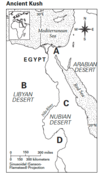
Look a the map to help you. Which two areas provided the most natural protection from invaders?
A and B
B and C
C and D
A and D
Question 10
10.
Why is King Tut one of the most well-known pharaohs?
Tut lived and ruled for more than 70 years.
Amazing artifacts were found in Tut's tomb.
Tut was the first woman to claim power over Egypt.
Trade expeditions helped Tut learn about faraway lands.
Question 11
11.
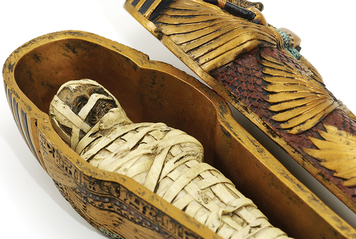
Why did the ancient Egyptians make mummies?
to decorate palaces of the pharaohs
to preserve dead bodies
to transport goods up and down the Nile
to educate and protect the royal children
zoom_in
1
Question 12
12.
What was a major purpose for building the pyramids?
temples for religious worship
storehouses for reserves of grain
homes for the pharaohs' servants
tombs for pharaohs when they died
Question 13
13.
What is one characteristic for which Egypt’s Middle Kingdom is especially famous?
reunification
the greatest pharaohs
widespread wars
military conquests
Question 14
14.
Which period is often called the Golden Age, a time when Egypt had reached the height of its power?
the Old Kingdom
the Middle Kingdom
the New Kingdom
after the New Kingdom
Question 15
15.
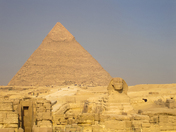
It was built from more than 2 million stone blocks. It had tunnels inside. What was it?
the Sphinx
the White Chapel
the temple at Abu Simbel
the Great Pyramid at Giza
Question 16
16.
Why did archaeologists reconstruct the White Chapel?
It offered tourists shade while they waited for a guide.
It gave the scientists a place to study what they dug up.
It was an experiment to learn old construction methods.
It was built by Senusret I but had been taken apart by a later ruler.
Question 17
17.
Hatshepsut was one of the first pharaohs who was...
a god
a child
a priest
a woman
zoom_in
1
Question 18
18.
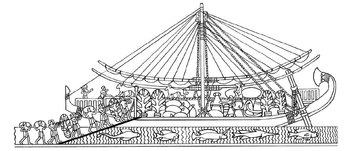
Look at this picture. Under which of these pharaohs did this large trade expedition most likely take place?
Khufu
Senusret I
Ramses II
Hatshepsut
zoom_in
1
Question 19
19.
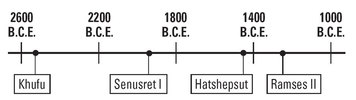
Look at the timeline. In which time period did Egypt have a pharaoh who was especially known for building the Great Pyramid?
between 2600 and 2500 B.C.E.
between 2000 and 1900 B.C.E.
between 1500 and 1400 B.C.E.
between 1300 and 1200 B.C.E.
zoom_in
1
Question 20
20.
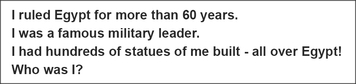
Answer the riddle.
Khufu
Senusret I
Ramses II
Hatshepsut
Question 21
21.
Who signed the world’s first peace treaty between Egypt and the Hittites?
Khufu
Senusret I
Hatshepsut
Ramses II
zoom_in
1
Question 22
22.
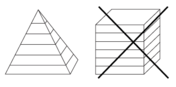
Why are the social classes of ancient Egypt described by the shape at the left, rather than the shape at the right?
The triangle represented the three seasons of the Nile.
Most people were in the bottom classes, and the fewest people were at the top.
Scientists like to use a pyramid to keep the layers apart.
Many structures of that design were built in the desert
Question 23
23.
Who built the giant temples of the pharaohs?
scribes who kept poor records
government officials out of favor
peasant farmers during the flood season
priests hoping to get jobs at the temples
Question 24
24.
How did most government officials get their jobs?
They attended school to learn how to govern.
Popular elections showed the vote of the people.
Priests relied on signs from the gods to choose them.
They inherited the position from a family member.
Question 25
25.
What was an important duty of the vizier?
to collect taxes
to lead the army
to decide court cases
to farm the crops
zoom_in
1
Question 26
26.
Why did Egyptians bury some bread with their dead?
to show earthly love
to avoid the risk of poison
to feed them in the afterlife
to perform a sacrifice to the gods
Question 27
27.
What was one of the few ways that a boy from a peasant family could rise to a higher social class?
store a lot of grain
attend scribe school
help build a pyramid
take care of a temple
Question 28
28.
Why did it take many years to become a scribe?
Papyrus was very difficult to write on.
There were hundreds of hieroglyphs to learn.
Students had to save money to buy a position.
Teachers were so harsh that students ran away.
Question 29
29.
Skilled scribes wrote on papyrus, which was made from...
a plant.
soft clay.
cotton rags.
animal skins.
Question 30
30.
Of these four groups, which one had the lowest social status?
priests
scribes
artisans
government officials
Question 31
31.
In the life of a peasant, which season came next after the flooding season?
the festival season
the harvest season
the planting season
the building season
Question 32
32.
Most peasants lived in...
rafts in the river.
camel-skin tents.
caves in the cliffs.
mud-brick houses.
Question 33
33.
In what form did many farmers pay their taxes?
grain
paper money
copper coins
music at banquets
Question 5
5.
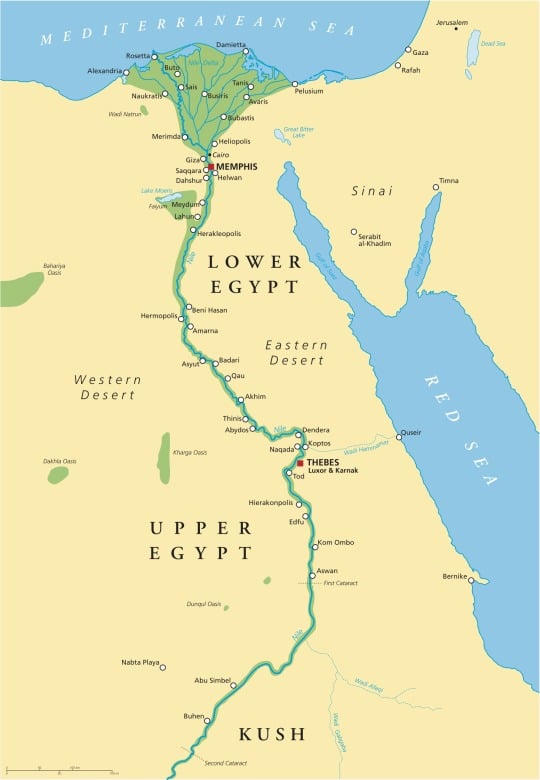
Study the map. What direction does the Nile River flow?
north
east
south
west
Question 6
6.
What larger body of water does the Nile River flow to?
Red Sea
Mediterranean Sea
Atlantic Ocean
Pacific Ocean
Question 7
7.
Which most accurately describes where the Nile Delta is located?
Lower Egypt
Upper Egypt
Western Desert
Red Sea