Salem Witch Trials
star
star
star
star
star
Last updated almost 4 years ago
8 Nsɛmmisa

In the 1970s, a college student named Linda Caporael was studying and saw a link between the strange things happening in Salem. She noticed that many of the symptoms were the same as the effects of drugs like LSD, which allows people to hallucinate, or see things that aren’t really there. LSD can be found in a fungus called ergot. Ergot poisoning had played a role in other outbreaks of weird behavior, so this did not seem like too crazy of an idea.
But was ergot actually able to wreak havoc in Salem? Well, ergot poisoning can be found in crops like rye, wheat, and other grains. These crops were very popular in Salem. When poisoned ergot is consumed, it can cause muscle spasms, confusion, impaired speech and thoughts, and even hallucinations.
Scientists now know that eating food with poisoned ergot can lead to these symptoms, and Linda Caporael realized that they were the same symptoms mentioned during the Salem Witch Trials. Ergot thrives in warm, damp, rainy Springs and summers. When Linda Caporael read through Salem’s journals, she found that those were the exact same conditions in 1691. Most of the accusers lived in Salem Village, which is very swampy.
Also, the next summer was much more dry, and this was around the time that the witch symptoms came to an end. These and other clues made a good case that Linda Caporael found impossible to ignore.
What type of food is ergot poisoning found on?
Name two main crops found in Salem in 1691.
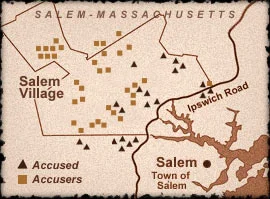
In 1692, Salem was divided into two parts: Salem Town and Salem Village. Salem Village was actually a part of (inside) Salem Town, but they were seperated by economy, class, and character. People in Salem Village were mainly poor farmers. People in Salem Town were more wealthy people who traded.
For many years, Salem Village tried to become independent. But Salem Town depended on Salem Village's farmers for food. Salem Town also decided on crop prices and collected taxes from the village.
Salem Village was also divided. If you lived closer to Salem Town, you were more likely to make money. If you lived further from the Town, you felt threatened by the Town’s success. One of the families that felt threatened was the Putnams. They were actually one of the main people who began accusing others of witchcraft.
Things got worse in Salem Village when Reverend Samuel Parris became the new minister. Parris was very strict in his Puritan beliefs and also felt threatened by the wealth of the people of Salem Town. His sermons created a strong rivalry between the Village and Town.
It is very possible that this tension played a major role in the witch trials. Most of the people accused of witchcraft lived in Salem Town while most of the accusers lived in Salem Village. It’s not surprising that Reverend Parris was such a supporter of the witch trials.
Match each description to either Salem Town or Salem Village, based on the text.
Mainly poor farmers
Wealthy traders
More successful
Where most people accused of witchcraft lived
Where most people who accused others lived
Salem Village
Salem Town
In 1692, children were expected to behave just like adults - doing chores, attending church, and saying no to their own desires (things that give them happiness). If they showed any emotions like excitement, fear, or anger, they would be severely punished. Children rarely played, and there were not a lot of toys and games for them to play with. Puritans thought of these as sinful distractions.
Young boys had different ways to use their imagination. They often worked outside the home on things like carpentry or crafts. They were also allowed to hunt and fish outdoors. On the other hand, girls were expected to work in the house, helping their mothers cook, wash, clean, and sew. Young Puritan girls had very few chances to use their imaginations.
Many children learned to read, but most households only owned the Bible and other religious books - including a few that described evil spirits and witchcraft in great detail.
In the long, dark winter of 1692, many girls were amazed by magical stories and fortune-telling games, but they were not allowed, which must have made the girls feel very guilty. This may have been one reason for their hysterical behavior. Many historians think that because they weren’t allowed to play games, that they were more likely to act out. Many people saw this as threatening. The girls may have sparked the witch hunt, but it was the adults who set the wheels into motion.
How were boys and girls treated differently in Salem?
Drag each item to "Boys" or "Girls" based on the text.
Hunt and fish outdoors
Were not allowed to play games
Worked outside the home
Work in the house
Carpentry or craft skills
Very few chances to use their imagination
Help mothers cook, wash, clean, and sew
Boys
Girls
Church was very important in New England in the 1600s. Most people in Massachusetts were Puritans (colonists who left England looking for religious freedom). But the law did not give people many freedoms. It was against the law to not attend church. At church, men and women sat on opposite sides. Outside of church, the Puritans were expected to work very hard and not show emotions or speak their thoughts. If you felt differently about something with someone, it was frowned upon. Even the sad and dark clothing style was forced by the church.
Since Puritans had to follow strict rules, they believed that all sins (even sleeping in church and stealing food) should be punished. They also believed that God would punish bad behavior. If someone was sick, Puritans saw it as God punishing them for sinning at some point in their life.
Puritans also were very afraid of the Devil. They believed that Satan would choose the weakest people (like women and children) to carry out his work. Those who followed Satan were seen as witches. Witchcraft was one of the biggest crimes a person could commit, and the punishment was often death.
The first “witches” were seen as different in Puritan society:
Tituba: a slave
Sarah Good: homeless
Sarah Osborne: sick and old. Married her servant.
Fear of magic and witchcraft were very common in New England. Over 100 “witches” were hanged in New England during the 1600s, but the hangings in 1692 Salem would be the last ones in America.
How did Satan play a role in Puritan religion?
Select the symptoms that people experienced based on this excerpt.
Do you think the girls were trying to act out on purpose? Why do you think they did?
What freedoms did Puritans have in Salem?
Select all that apply.