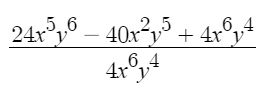
Simplify:
Divide to find the quotient:
(do not put parentheses around your denominator in your remainder)
Divide to find the quotient:
(do not put parentheses around your denominator in your remainder)
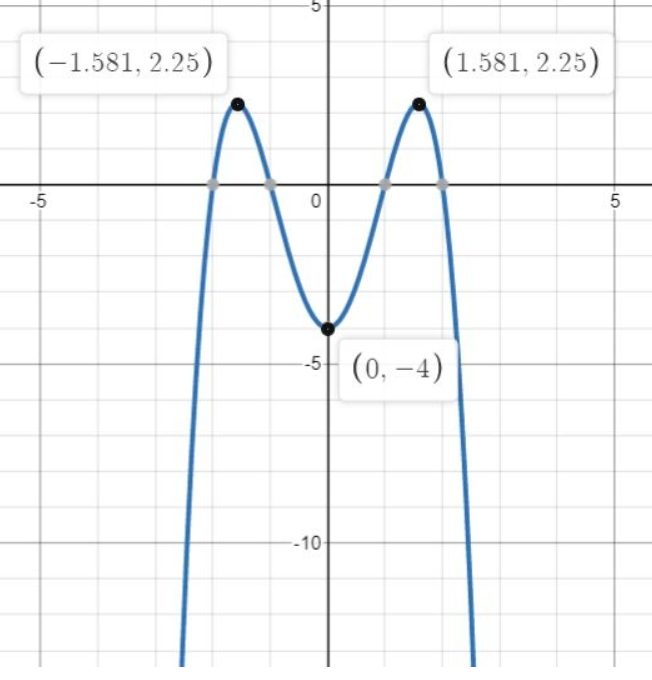
Given the function, what's the degree?
Given the function, what are the maximum turns?
Given the function, what is the y-intercept?
What is the sign of the leading coefficient?
What describes the degree of this polynomial?
Describe the end behavior of this polynomial:
Describe the end behavior of this polynomial:
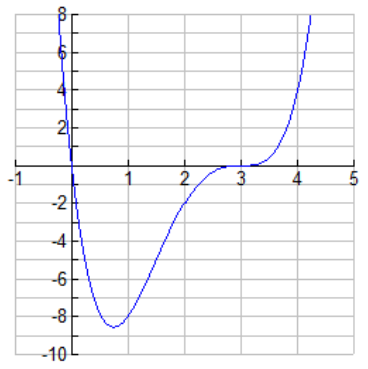
What are the increasing intervals? (no spaces please...if there is a zero in front of a decimal, include it in your answer)
What are the decreasing intervals? (no spaces please...if there is a zero in front of a decimal, include it in your answer)
What is the solution set of the above polynomial function? (use { } to describe your set)
Write the equation of the above polynomial function in FACTORED FORM using the appropriate leading coefficient and multiplicities for each root. (input your answer using f(x)= )
Given the solutions set (which include the multiplicities): {-2, -2, 5, 6, 6, 6} with the sign of it's leading coefficient positive, write the equation of this polynomial in factored form. (use f(x)= in your answer)
Which of the following graphs could be a function of the form:
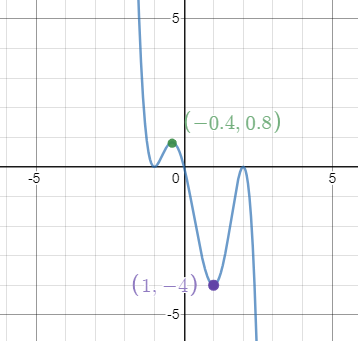
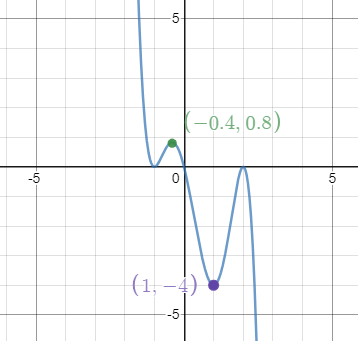
Write the equation in FACTORED FORM of the function graphed above. (use f(x)= in your answer)
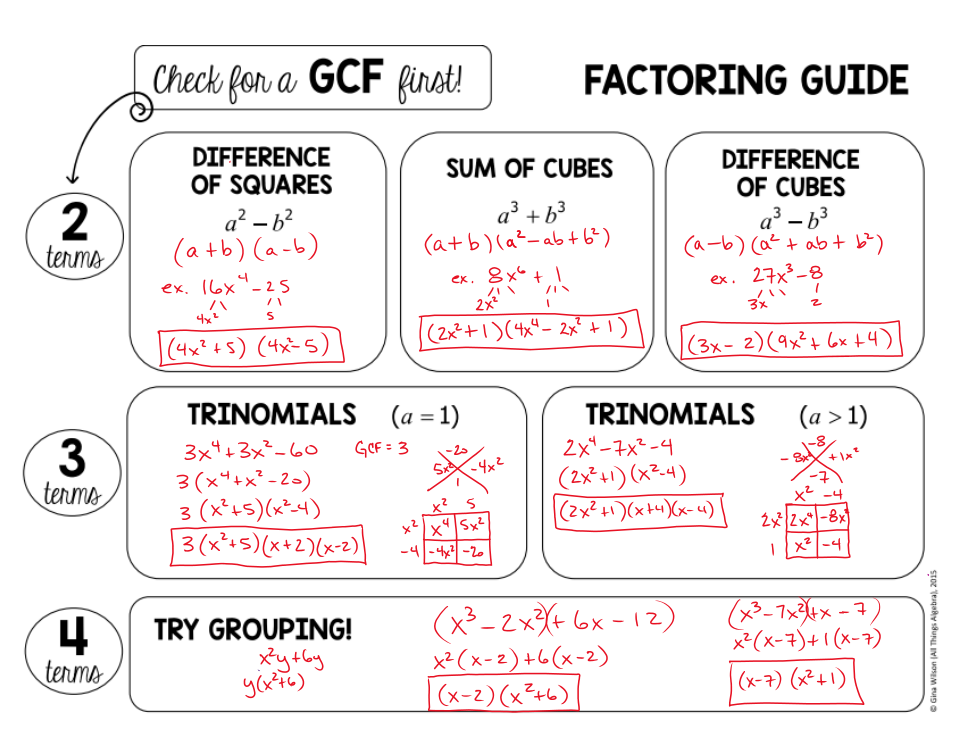
Factor completely.
Factor completely.
Factor completely.
Factor completely.
Solve. Input your answer in set notation with complex numbers at the back of the set using { }. No spaces.
Given your answer from the previous question, which describes the number and type of roots of the equation:
Solve. Input your answer in set notation with complex numbers at the back of the set. No spaces.
Solve. Input your answer in set notation with complex numbers at the back of the set. No spaces.
upload your pages of work here--page 1
upload your pages of work here--page 2
upload your pages of work here--page 3
upload your pages of work here--page 4