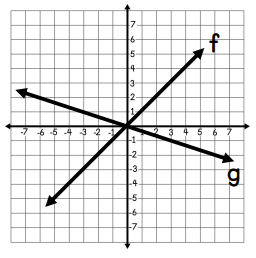
Functions f and g are shown below. Choose all of the transformations that happened to change f to g.
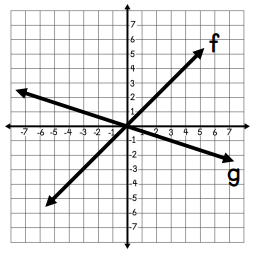
Functions f and g are shown below. Choose all of the transformations that happened to change f to g.
The parent function f(x) = x was shifted 7 units downt to create function b. Which represents function b?
Van graphed f(x) = x and h(x) = f(x - 10) on the same grid. Which is not a true statement about the graphs of the functions?
The parent function f(x) = x will be transformed using af(x). Which value of "a" woud result in a line that is less steep than the parent function?
Rudy graphed f(x) = x and n(x) = f(5x) on the same grid. Which is a true statement about the graphs of the functions?
Functions f and g are shown below. Choose all of the transformations that happened to change f to g.
The function f and g are shown below. Which best represents function g?
Gabi will graph these two functions:
Complete the following sentences correctly.
The slope of m(x) will be than f(x). The y-intercept of m(x) will be as f(x).
Dharma graphed the parent function f(x) = x and h(x) on the same grid. If h(x) is steeper than the parent function and shifted to the right, choose the correct items to correctly represent h(x)?
h(x) = f
Andre graphed the parent function f(x) and a new line d(x). If d(x) will have a slope that is less steep by 1/4 and has been shifted up 9 units fill in the blanks below to complete the function.
d(x) =
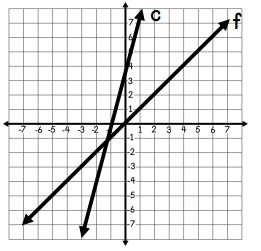
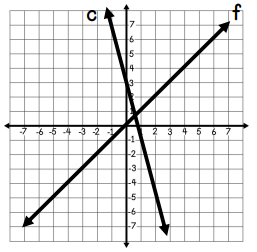
Students tried to identify the function that represents c(x). Drag the students' name and their function under their corresponding graph of c(x). One of the names will not be used.
Cole
Erika
Landry