Log in
Sign up for FREE
arrow_back
Library

Earth, Moon, and Sun Pre-Assessment

star
star
star
star
star
Last updated over 3 years ago
18 questions
Required
1
Required
1
Required
1
Required
1
Required
1
Question 1
1.

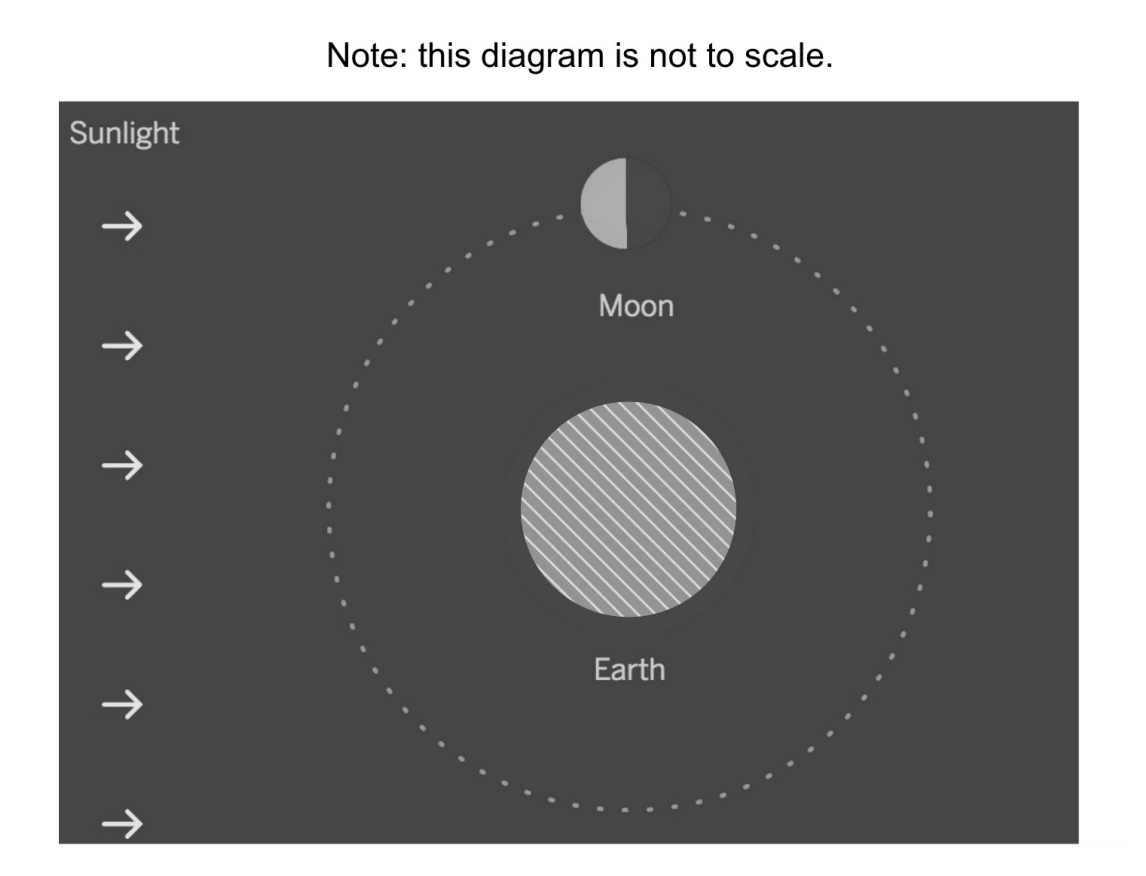
Leticia is a space scientist who made this diagram of the Moon and Earth as seen from above (top view), with sunlight coming from the left, as shown by the arrows. Why does Leticia’s diagram show that it’s brighter on the left half of the Moon?
Required
1
Question 2
2.

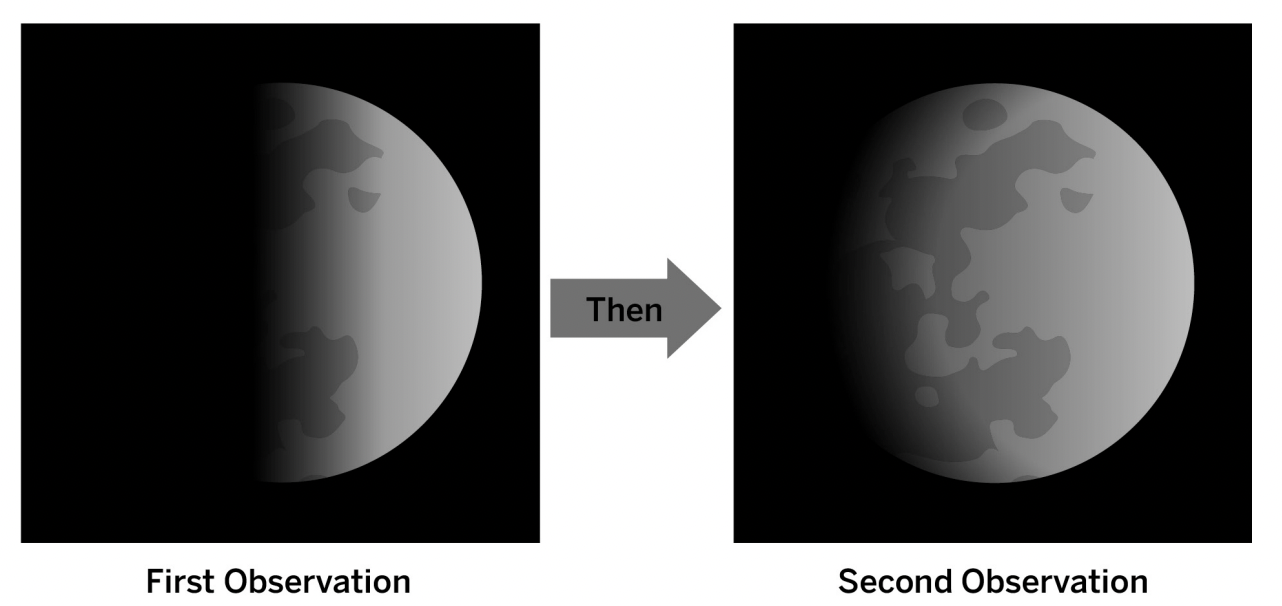
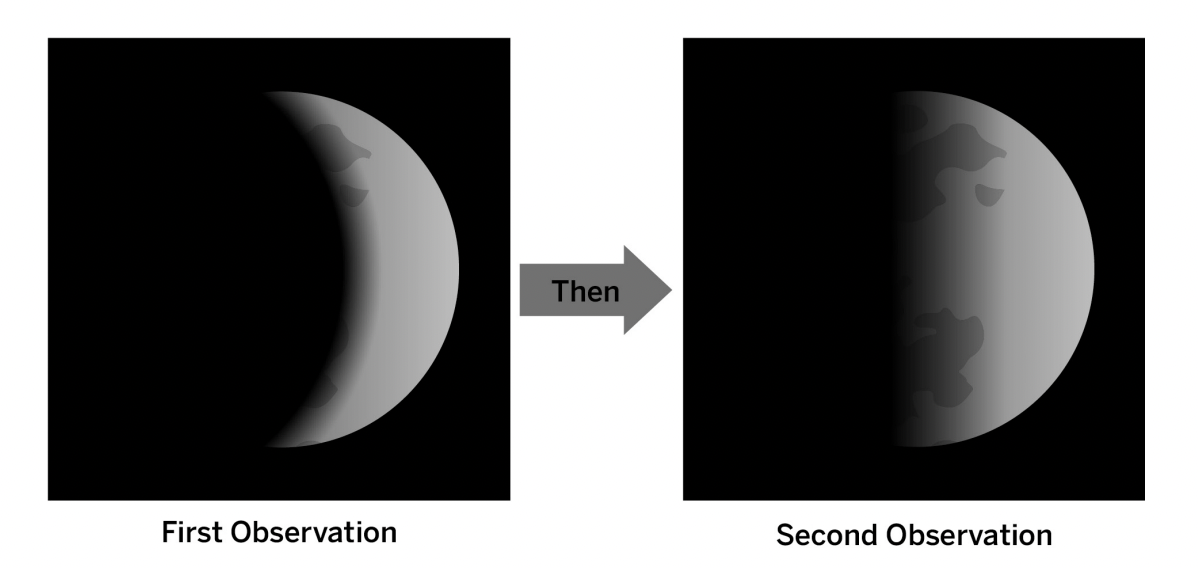
Tania went outside and made two observations of the Moon that were several days apart. Her observations are shown in the diagram above. The light part of the Moon appeared to get larger over time. Why did this happen?

Required
1
Question 3
3.

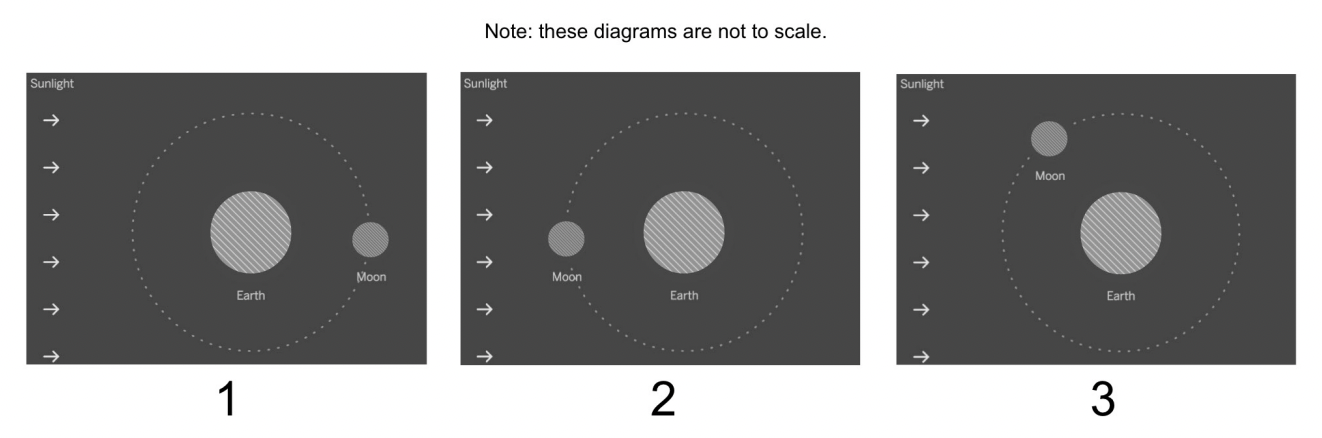
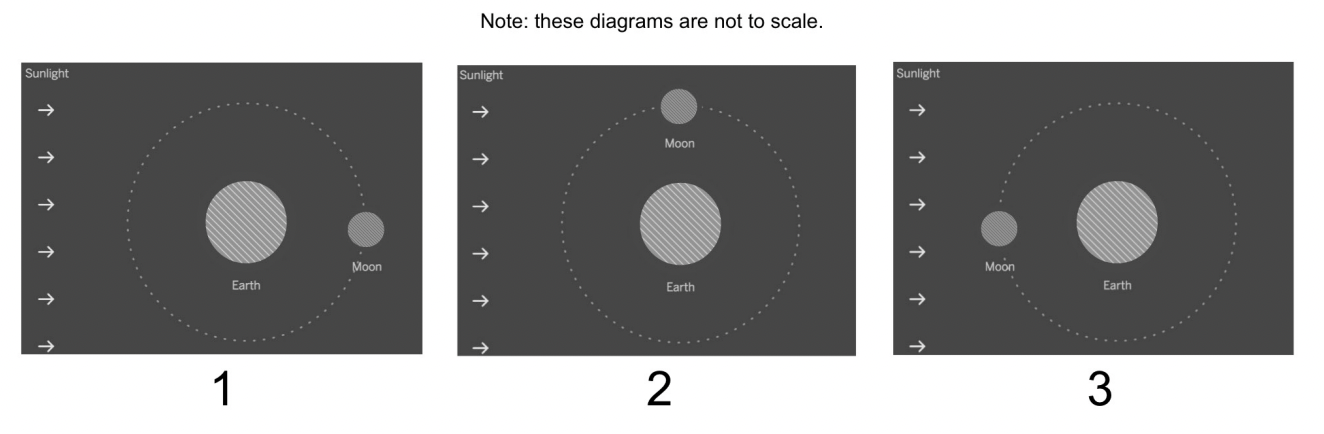
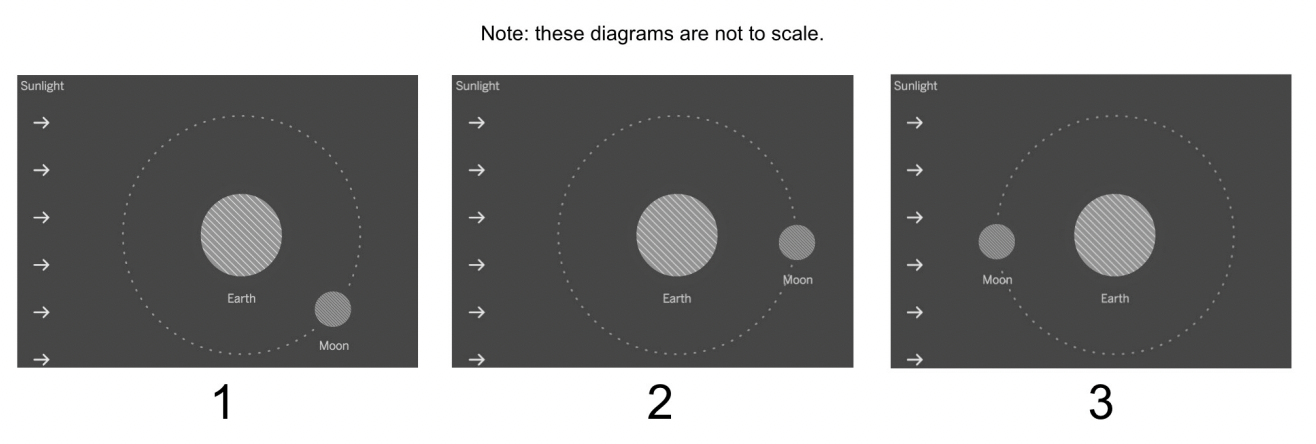
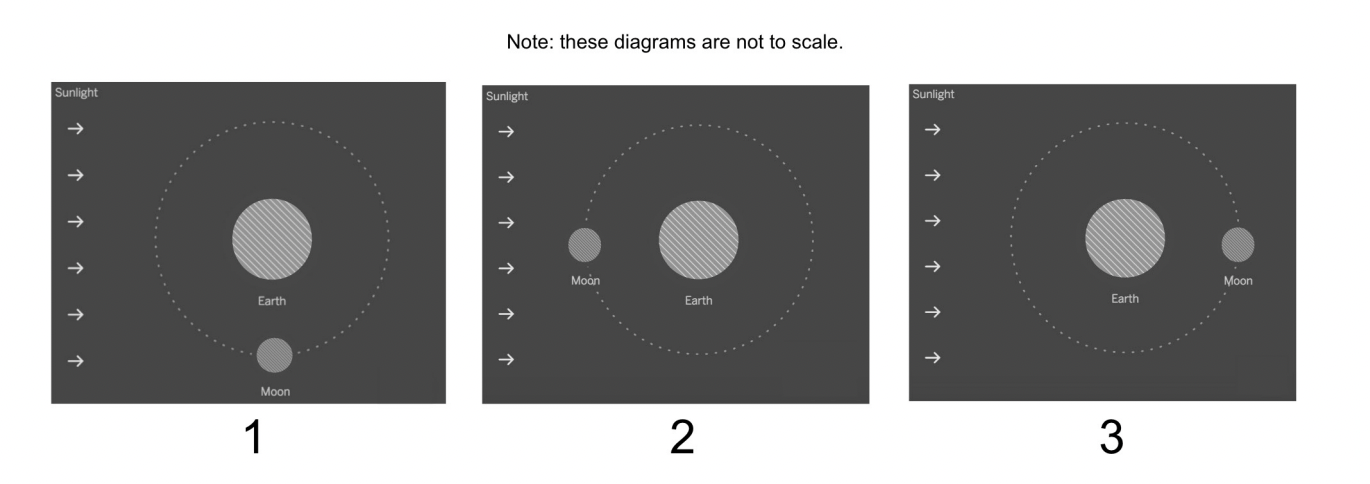
The diagrams above show Earth and the Moon in different positions, as seen from above (top view). Sunlight is coming from the left, but these diagrams do not show what parts of Earth or the Moon are light or dark. Could the half of the Moon that faces Earth ever be completely dark in any of these diagrams?

Question 4
4.

How does light travel?

Question 5
5.

Shira looked up one night and saw a full moon. How long will it be before she can see a full moon again?

Required
1
Question 6
6.

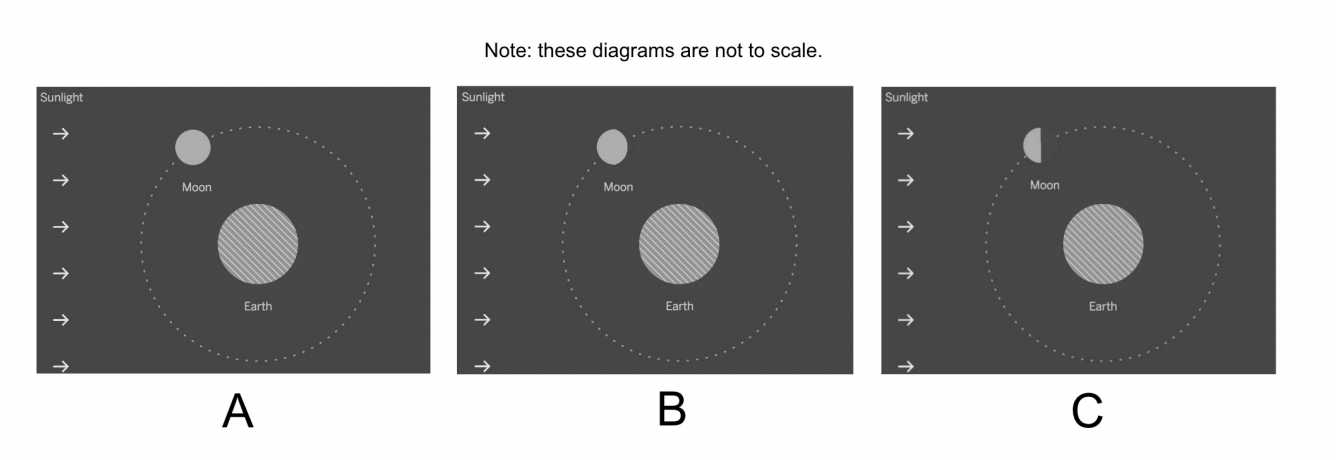
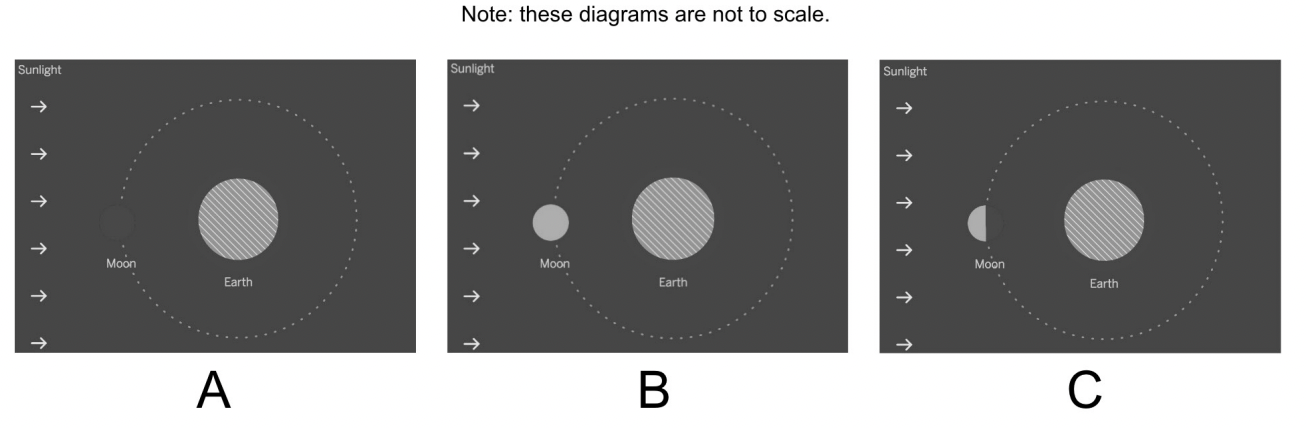
Three students made the diagrams above to show what they think the Moon looks like when it is seen from above (top view). In these diagrams, the sunlight is coming from the left, as shown by the arrows. Which diagram is accurate and why?

Required
1
Question 7
7.

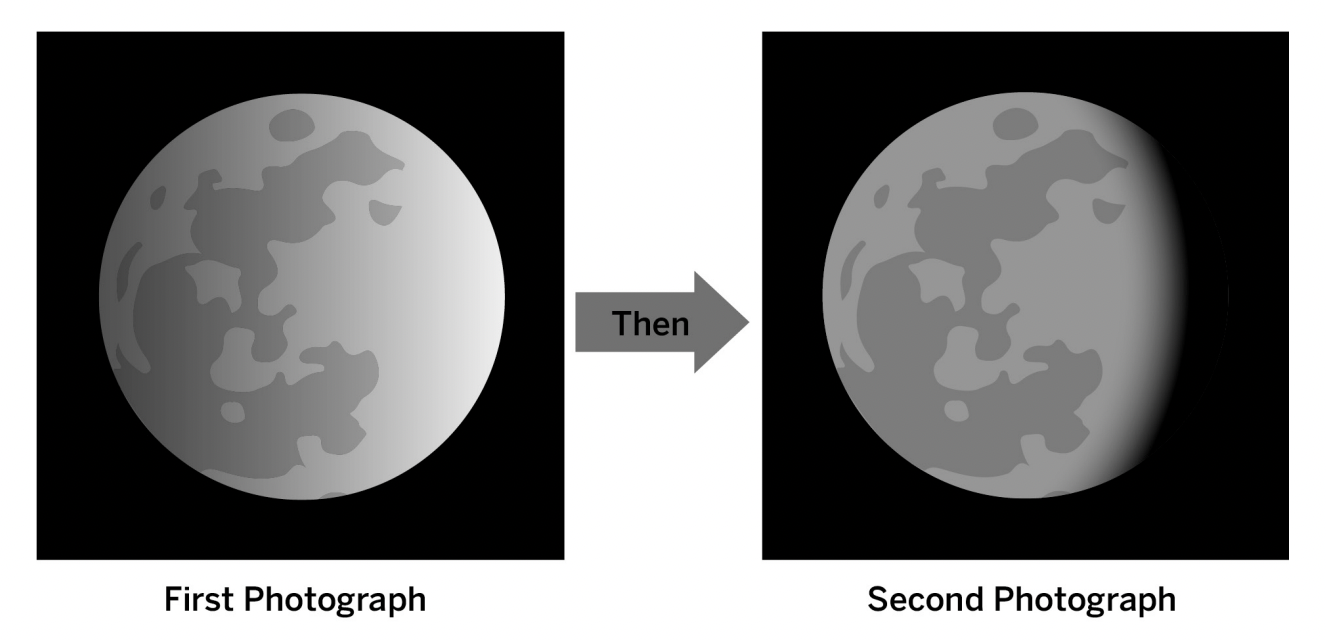
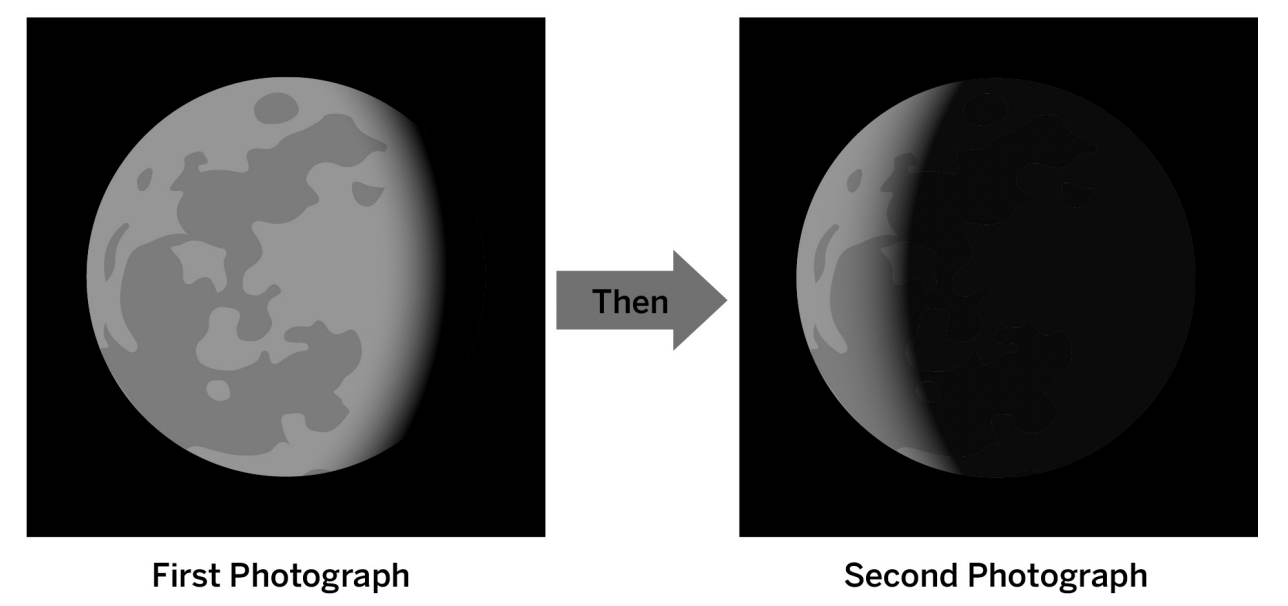
A student astronomer went out and took photographs of the Moon that were several days apart. Images that look like her photographs are shown above. The light part of the Moon appeared to get smaller over time. Why did this happen?

Required
1
Question 8
8.

The diagrams above show Earth and the Moon in different positions, as seen from above (top view). Sunlight is coming from the left, but these diagrams do not show what parts of Earth or the Moon are light or dark. Could the half of the Moon that faces Earth ever be completely dark in any of these diagrams?

Question 9
9.

Which of these things is true about the Moon?

Question 10
10.

Someone said that light bent around a corner to reach an object. Is this possible?

Required
1
Question 11
11.

Three student astronomers made the diagrams above to show what they think the Moon looks like when it is seen from above (top view). In these diagrams, the sunlight is coming from the left, as shown by the arrows. Which diagram is accurate and why?

Required
1
Question 12
12.

Astronomers made two observations of the Moon that were several days apart. Their observations are shown in the diagram above. The light part of the Moon appeared to get larger over time. Why did this happen?

Required
1
Question 13
13.

The diagrams above show Earth and the Moon in different positions, as seen from above (top view). Sunlight is coming from the left, but these diagrams do not show what parts of Earth or the Moon are light or dark.

Could the half of the Moon that faces Earth ever be completely dark in any of these diagrams?

Required
1
Question 14
14.

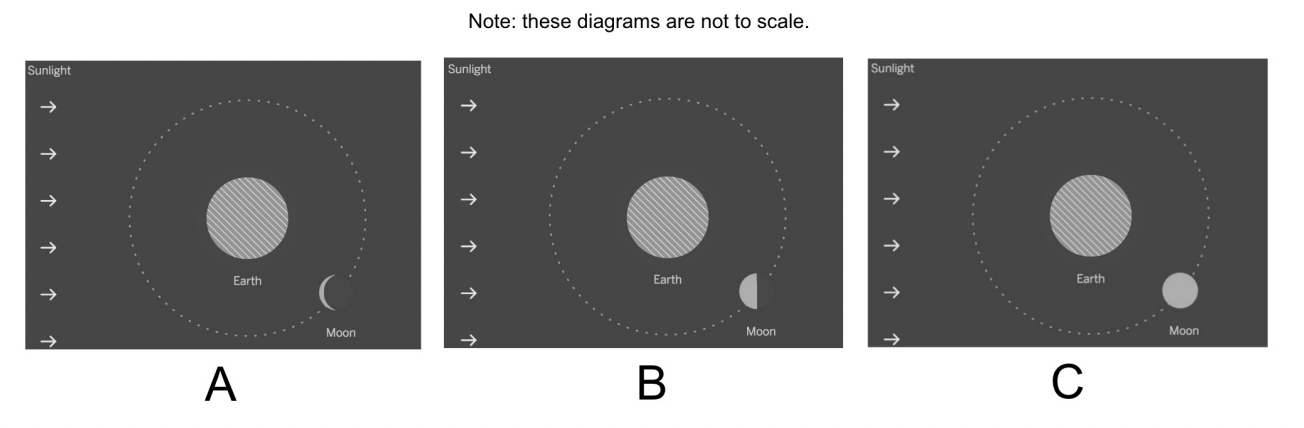
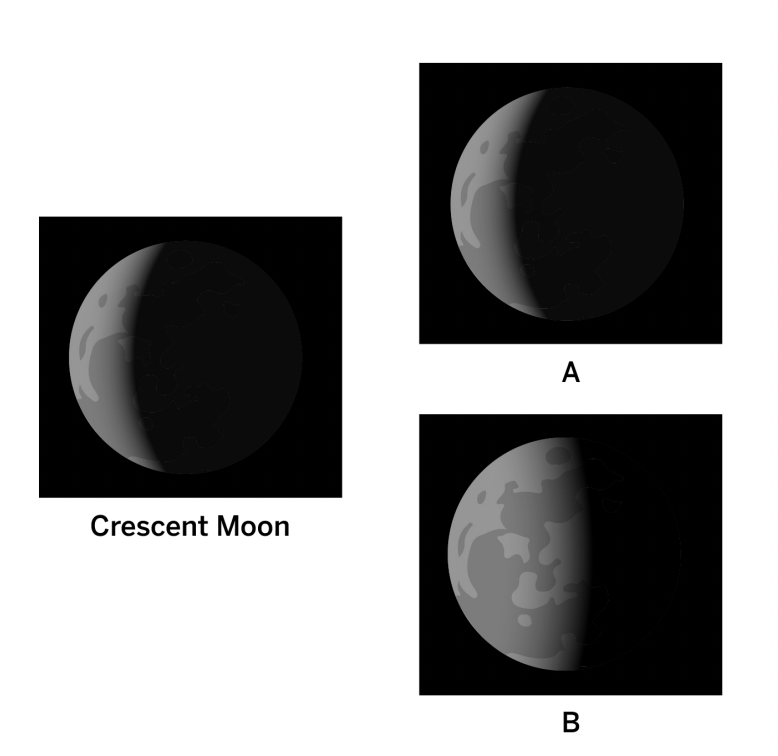
Suki looked up one night and saw a crescent moon.

If Suki looks for the Moon again in one month, what will he see?

Required
1
Question 15
15.

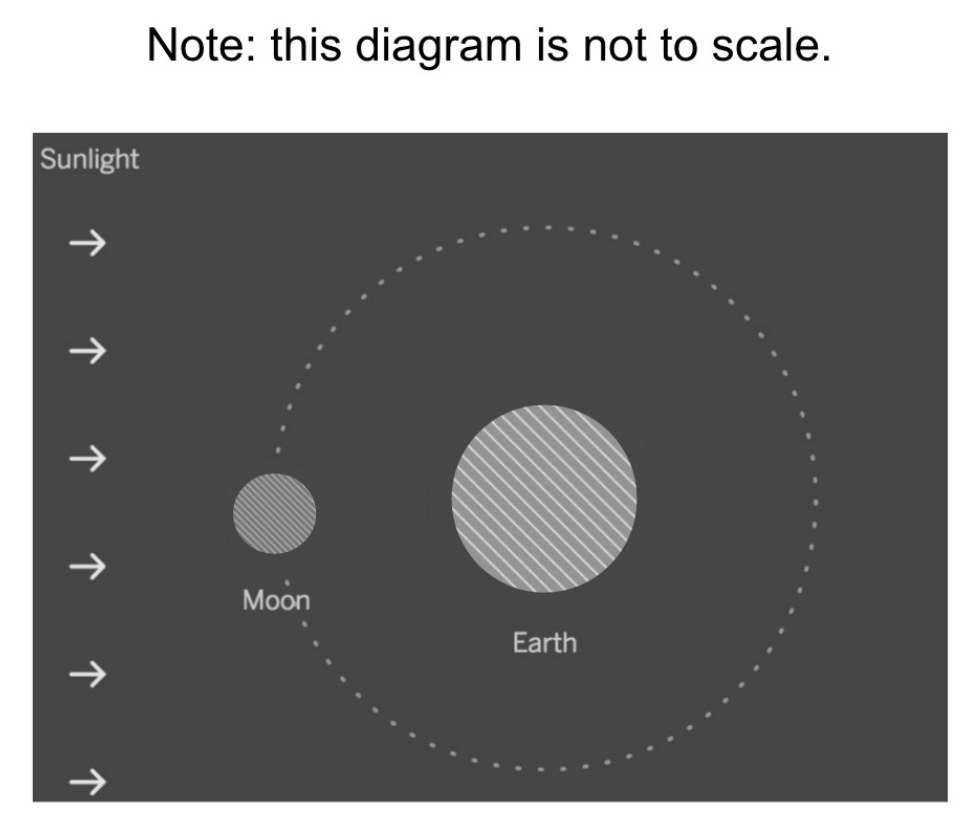
The diagram above shows Earth and the Moon from above (top view). Why is there a dotted circle drawn in this diagram?

Required
1
Question 16
16.

Three students made the diagrams above to show what they think the Moon looks like when it is seen from above (top view). In these diagrams, the sunlight is coming from the left, as shown by the arrows. Which diagram is accurate and why?

Required
1
Question 17
17.

An artist took two photographs of the Moon that were several days apart. Images that look like his photographs are shown above. The light part of the Moon appeared to get smaller over time. Why did this happen?

Required
1
Question 18
18.

The diagrams above show Earth and the Moon in different positions, as seen from above (top view). Sunlight is coming from the left, but these diagrams do not show what parts of Earth or the Moon are light or dark.

Could the half of the Moon that faces Earth ever be completely dark in any of these diagrams?

Because Leticia’s diagram is showing that the half of the Moon that is facing the sun is lit by the sun, and the other half is dark.
Because the Moon has some lighter-colored rock and some darker-colored rock, and Leticia’s diagram is showing that the half of the Moon with the lighter-colored rock has rotated to the left.
Because as the Moon gets closer to the sun more of it is lit by the sun, so Leticia’s diagram is showing sunlight on half of the Moon.
Because there is a shadow from Earth falling on half of the Moon, and Leticia’s diagram is showing that shadow on the right half of the Moon.
Between the first observation and the second observation, the Moon moved so that Tania was able to see more of the half that faces the sun.
Between the first observation and the second observation, the Moon moved closer to the sun so more sunlight reached the Moon’s surface.
Between the first observation and the second observation, the Moon rotated so that more of the light-colored rock on the Moon’s surface faced Earth.
Between the first observation and the second observation, Earth’s shadow moved and was blocking less of the Moon so Tania was able to see more of it.
No, the Moon is always lit by the sun.
Yes, always in Diagrams 2 and 3, but never in Diagram 1.
Yes, always in Diagram 2, but never in Diagrams 1 or 3.
Yes, always in Diagram 2 and sometimes in Diagram 3.
Diagram A is accurate because the whole Moon is bright as long as there are no shadows covering parts of it.
Diagram B is accurate because the Moon is almost as close as it can be to the sun, so the Moon is almost fully lit by the sun.
Diagram C is accurate because the half of the Moon that is facing the sun is lit by the sun, and the other half is dark.
All three diagrams are sometimes accurate because the Moon has some lighter-colored rock and some darker-colored rock, and the half of the Moon with the lighter-colored rock rotates to face different directions.
Between the first photograph and the second photograph, the Moon moved farther away from the sun so less sunlight reached the Moon’s surface.
Between the first photograph and the second photograph, Earth moved so its shadow was blocking more of the Moon so the student astronomer was able to see less of it.
Between the first photograph and the second photograph, the Moon rotated so that less of the light-colored rock on the Moon’s surface faced Earth.
Between the first photograph and the second photograph, the Moon moved so that the student astronomer was able to see less of the half that faces the sun
No, the Moon is always lit by the sun.
Yes, always in Diagrams 1 and 2, but never in Diagram 3.
Yes, always in Diagram 2, but never in Diagrams 1 or 3.
Yes, always in Diagram 2 and sometimes in Diagram 1.
Diagram A is accurate because the Moon is almost as far as it can be from the sun, so almost none of the Moon is lit by the sun.
Diagram B is accurate because the half of the Moon that is facing the sun is lit by the sun, and the other half is dark.
Diagram C is accurate because the whole Moon is bright as long as there are no shadows covering parts of it.
All three diagrams are sometimes accurate because the Moon has some lighter-colored rock and some darker-colored rock, and the half of the Moon with the lighter-colored rock rotates to face different directions.
Between the first observation and the second observation, the Moon rotated so that more of the light-colored rock on the Moon’s surface faced Earth.
Between the first observation and the second observation, the Moon moved so that the astronomers were able to see more of the half that faces the sun.
Between the first observation and the second observation, the Moon moved closer to the sun so more sunlight reached the Moon’s surface.
Between the first observation and the second observation, Earth’s shadow moved and was blocking less of the Moon so the astronomers were able to see more of it.
No, the Moon is always lit by the sun.
Yes, always in Diagrams 1 and 3, but never in Diagram 2.
Yes, always in Diagram 3 and sometimes in Diagram 1.
Yes, always in Diagram 3, but never in Diagrams 1 or 2.
Suki will see a crescent moon again, like Diagram A.
Suki will see a quarter moon, like Diagram B.
Suki could see either a crescent or a quarter moon; it depends on the time of year.
There’s no way to tell because the Moon’s pattern is always changing.
To show the locations of satellites that are in Earth’s atmosphere.
To show the way that the Moon can move back and forth across Earth’s sky.
To show the locations where the sun’s light can reach the Moon.
Diagram A is accurate because sometimes the whole Moon is dark if shadows are covering it. b  Diagram B is accurate because the Moon is as close as it can be to the sun, and so all of the Moon is lit by the sun. c  Diagram C is accurate because the half of the Moon that is facing the sun is lit by the sun, and the other half is dark. d  All three diagrams are sometimes accurate because the Moon has some lighter-colored rock and some darker-colored rock, and the half of the Moon with the lighter-colored rock rotates to face different directions.
Diagram B is accurate because the Moon is as close as it can be to the sun, and so all of the Moon is lit by the sun.
Diagram C is accurate because the half of the Moon that is facing the sun is lit by the sun, and the other half is dark.
All three diagrams are sometimes accurate because the Moon has some lighter-colored rock and some darker-colored rock, and the half of the Moon with the lighter-colored rock rotates to face different directions.
Between the first photograph and the second photograph, the Moon rotated so that less of the light-colored rock on the Moon’s surface faced Earth.
Between the first photograph and the second photograph, Earth’s shadow moved and was blocking more of the Moon so the artist was able to see less of it.
Between the first photograph and the second photograph, the Moon moved so that the artist could see less of the half that faces the sun.
Between the first photograph and the second photograph, the Moon moved farther away from the sun so less sunlight reached the Moon’s surface.
No, the Moon is always lit by the sun.
Yes, always in Diagrams 2 and 3, but never in Diagram 1.
Yes, always in Diagram 3 and sometimes in Diagram 2.
Yes, always in Diagram 3, but never in Diagrams 1 or 2.