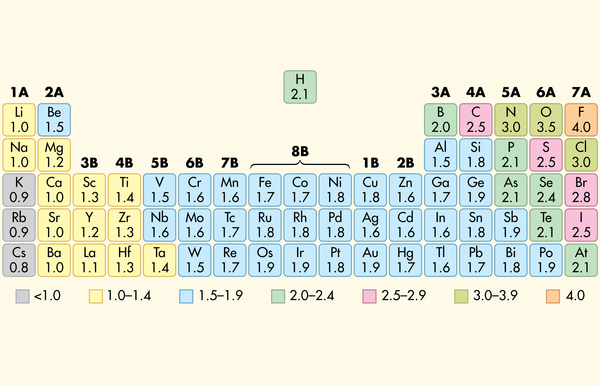
Given their electronegativity values shown in the periodic table, which pair of atoms form a covalent bond?
Given their electronegativity values shown in the periodic table, which pair of atoms form a covalent bond?
When two atoms share four electrons with one another, what type of bond do they form?
A student states that non-metal atoms share their core electrons when they form covalent bonds. What is wrong with this statement?
What type of compound is composed of covalently bonded atoms and has a high melting point?
Explain why noble gases, like Neon, are considered nonreactive.
Which of the following substances would you expect to have a low melting point?
Draw the Lewis dot structure for a molecule of ethyne, C₂H₂.
How many electrons are shared when two atoms form a triple bond?
Given their electronegativity values shown in the periodic table, which pair of atoms form a covalent bond?
A student states that nonmetal atoms form covalent bonds by gaining electrons until they have eight valence electrons. What is wrong with this statement?
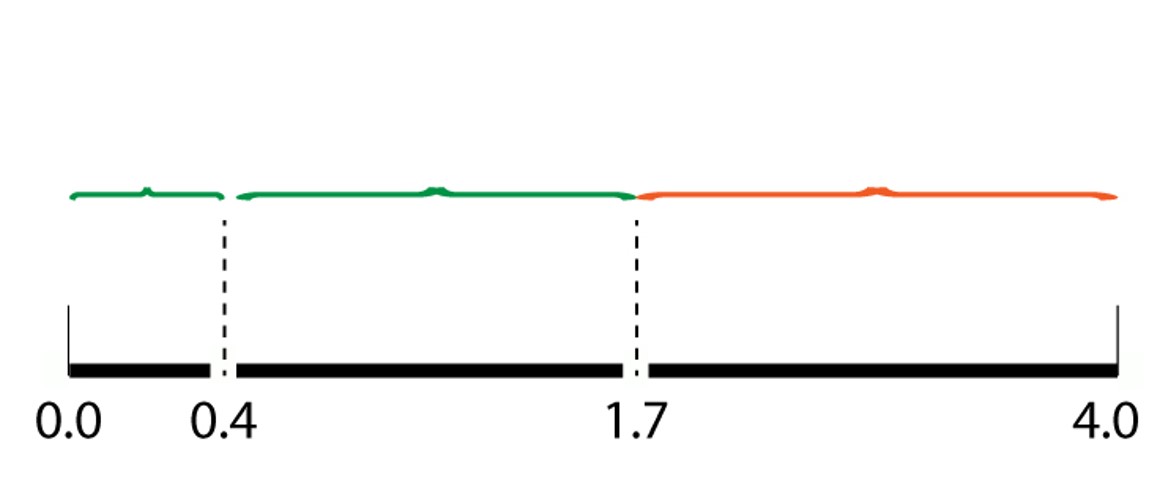
Label each section on this electronegativity chart.
One way that atoms can join to form compounds is through the formation of covalent bonds.
Identify the type of element whose atoms tend to form covalent bonds.
Describe what happens to electrons during the formation of covalent bonds.
State the octet rule.
Draw a Lewis structure for a molecule of oxygen difluoride, OF2OF2, and explain how the covalent bonds in the molecule relate to the octet rule.