Log in
Sign up for FREE
arrow_back
Library
(U2) L1-L2 Review - Piggy Bank Savings Plan
By JAMES TAYLOR
star
star
star
star
star
Share
share
Last updated almost 3 years ago
15 questions
Add this activity
Piggy Bank Savings
Take your time to answer each question in complete sentences. Read carefully.
You will work independently, but you may ask for help from a peer or myself quietly.

5
6
7
8
zoom_in
Required
1
Required
1
Required
1
Required
1
Required
1
Required
1
Required
1
Required
1
9
10
11
12
13
title
zoom_in
Required
1
Required
1
Required
1
Required
1
Required
1
Required
1
Required
1
Question 1
1.
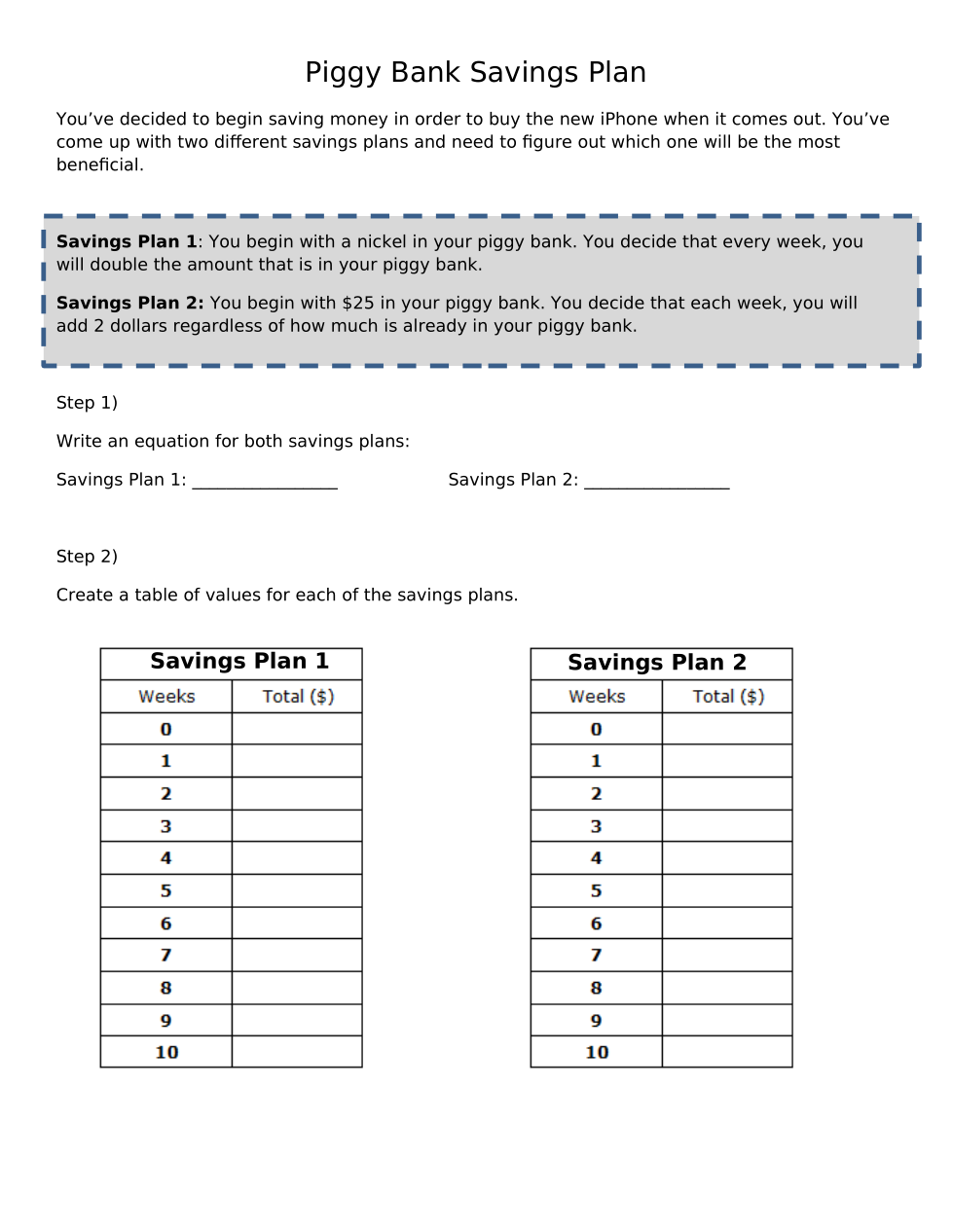
Click to highlight the important mathematical infomation in Savings Plan 1:
You begin with a nickel in your piggy bank. You decide that every week, you will double the amount that is in your piggy bank.
Question 2
2.
Saving Plan 1 represents what type of functon and why?
Linear, the constant rate of change (common difference)
Exponential, the constant rate of change (common difference)
Linear, the constant ratio/factor (common ratio)
Exponential, the constant ratio/factor (common ratio)
Question 3
3.
Click to highlight the important mathematical infomation in Savings Plan 2:
You begin with $25 in your piggy bank. You decide that each week you will add $2 regardless of how much is already in your piggy bank.
Question 4
4.
Saving Plan 2 represents what type of functon and why?
Linear, the constant rate of change (common difference)
Exponential, the constant rate of change (common difference)
Linear, the constant ratio/factor (common ratio)
Exponential, the constant ratio/factor (common ratio)
Question 5
5.
Write the equation for savings plan 1. (Explicit)
Question 6
6.
Write the equation for savings plan 2. (Explicit)
Question 7
7.
Savings Plan 1 table and graph:
visibility
View drawing
Question 8
8.
Savings Plan 2 table and graph:
visibility
View drawing
Question 9
9.
Question 10
10.
Question 11
11.
Question 12
12.
Question 13
13.
Question 14
14.
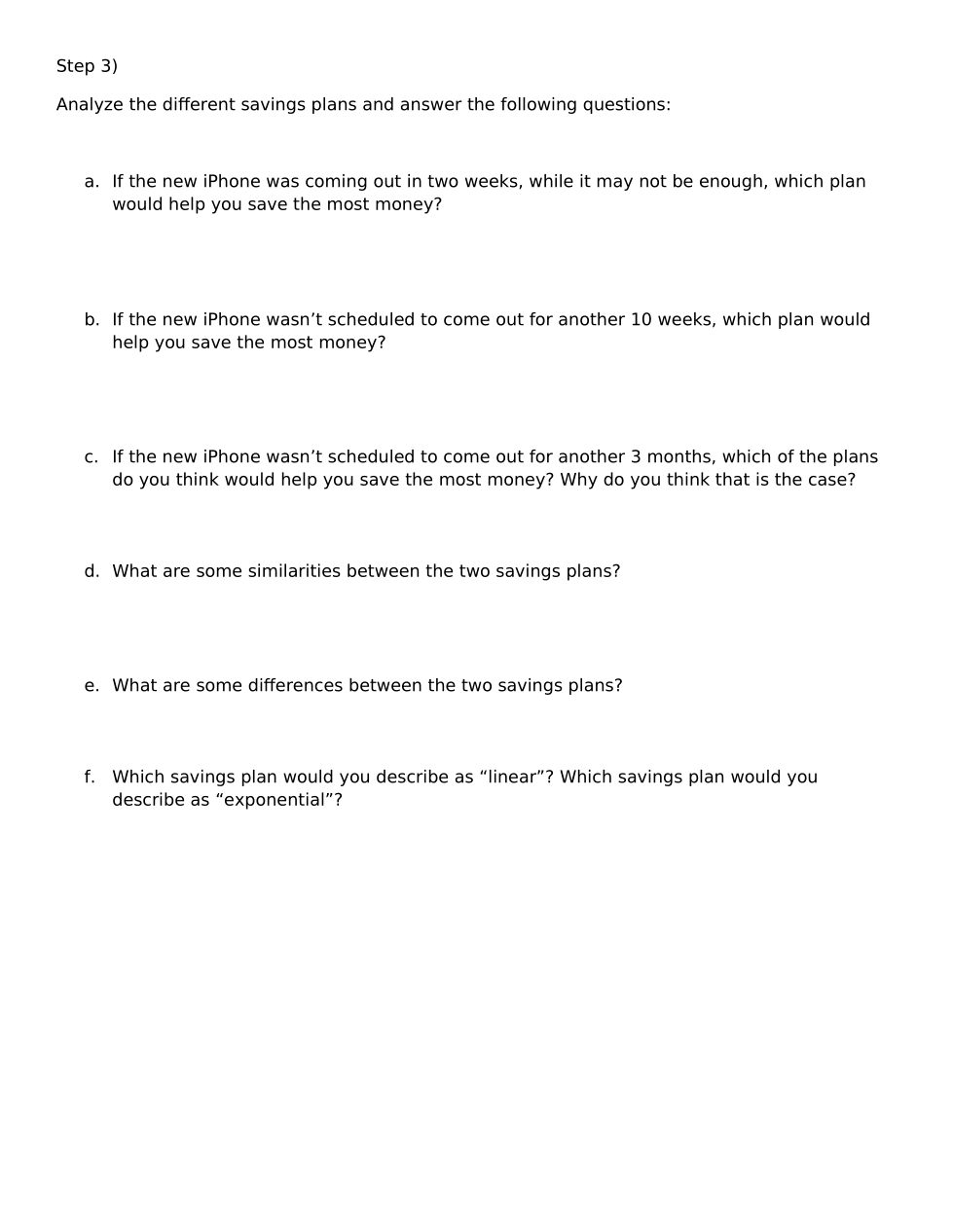
For both savings plans, is this an example of discrete or continuous data?
Discrete
Continuous
Question 15
15.
Explain your answer from #14.
You do not have to answer this question again you should have in #2 and 4.