B3 - Pedigree Charts

Last updated 11 months ago
24 questions
Note from the author:
https://www.khanacademy.org/science/ap-biology/heredity/non-mendelian-genetics/a/hs-pedigrees-review
1

What represents males on a pedigree?

1

What represents females on a pedigree?

1

Which is dominant?

1

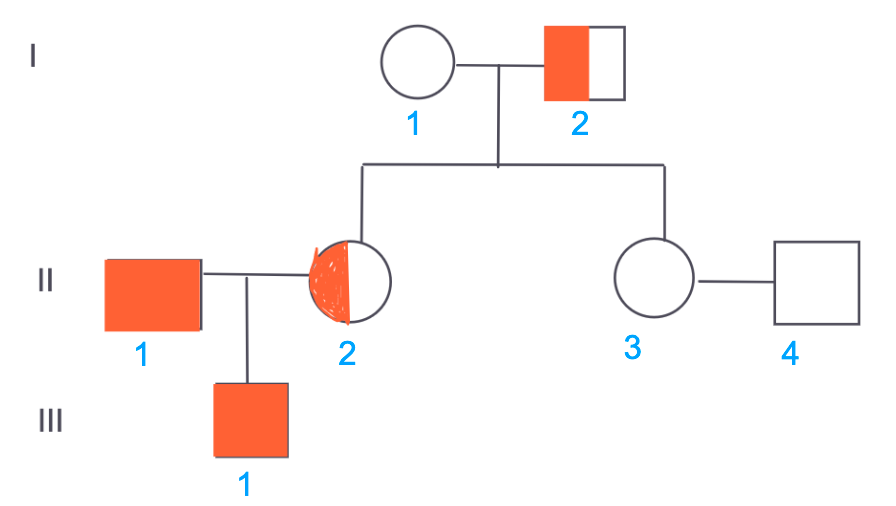
Why is the male square shaded half way?

1

Why was the wife of the male shaded in her circle completely?

1

The first born male has a completely shaded square. What does that mean?

1

The daughter and son in law are shaded half way. What does that mean?

1

What is the most accurate depiction of the alleles for the grandkids?

1
1

Carries are heterozygous and have one dominant and one

1

A carrier is represented by a

1

Recessive genes are signified by

1

Match the following terms with their meanings

Draggable itemCorresponding Item
Genotype
The genetic makeup of an organism (ex: TT)
Dominant allele
The physical characteristics of an organism (ex: tall)
Recessive allele
Allele that is phenotypically expressed over another allele (it dominates it)
Phenotype
Allele that is only expressed in absence of a dominant allele
1

Matche the following

Draggable itemCorresponding Item
Homozygous
Having two identical alleles for a particular gene
Heterozygous
Having two different alleles for a particular gene


Pedigrees are used to analyze the pattern of inheritance of a particular trait throughout a family. Pedigrees show the presence or absence of a trait as it relates to the relationship among parents, offspring, and siblings.

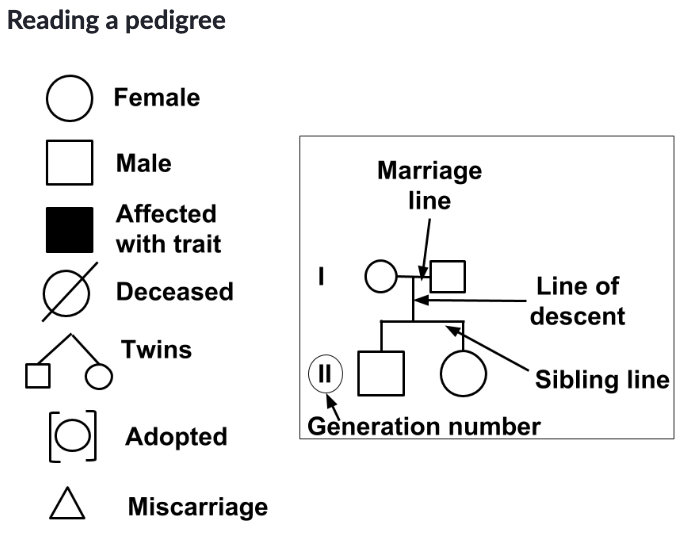
Pedigrees represent family members and relationships using symbols.

By analyzing a pedigree, we can determine genotypes, identify phenotypes, and predict how a trait will be passed on in the future. The information from a pedigree makes it possible to determine how certain alleles are inherited: whether they are dominant, recessive, autosomal, or sex-linked.
1
1

By analyzing a pedigree we can..

To start reading a pedigree:
  1. Determine whether the trait is dominant or recessive. If the trait is dominant, one of the parents must have the trait. Dominant traits will not skip a generation. If the trait is recessive, neither parent is required to have the trait since they can be heterozygous.
  2. Determine if the chart shows an autosomal or sex-linked (usually X-linked) trait. For example, in X-linked recessive traits, males are much more commonly affected than females. In autosomal traits, both males and females are equally likely to be affected (usually in equal proportions).
1
1

An affected male is represented by...

1
An affected female is represented by...

4
In this pedigree the recessive gene is "pimples on your back" represented by p.
The dominant gene is "no pimples on your back" represented by P.

Answer the following questions.
A) How many kids did I-1 and I-2 have? _______
B) Which is a carrier of "pimples on their back", I-1 or I-2? _______
C) Which family member from generation 2 has "pimples on their back", II-1, II-2, II-3, or II-4? _______
D) Does the child in generation III have pimples on his back or not? _______

The diagram shows the inheritance of freckles in a family. The allele for freckles (F) is dominant to the allele for no freckles (f).

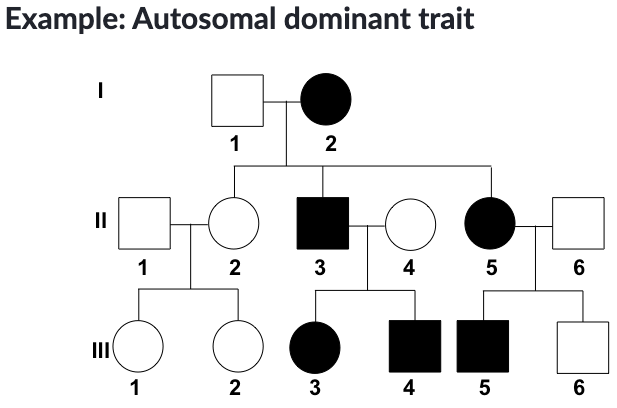
At the top of the pedigree is a grandmother (individual I-2) who has freckles. Two of her three children have the trait (individuals II-3 and II-5) and three of her grandchildren have the trait (individuals III-3, III-4, and III-5).
1
1

What is the genotype of individual I-2?

The diagram shows the inheritance of colorblindness in a family. Colorblindness is a recessive and X-linked trait Xb.

The allele for normal vision is dominant and is represented by XB

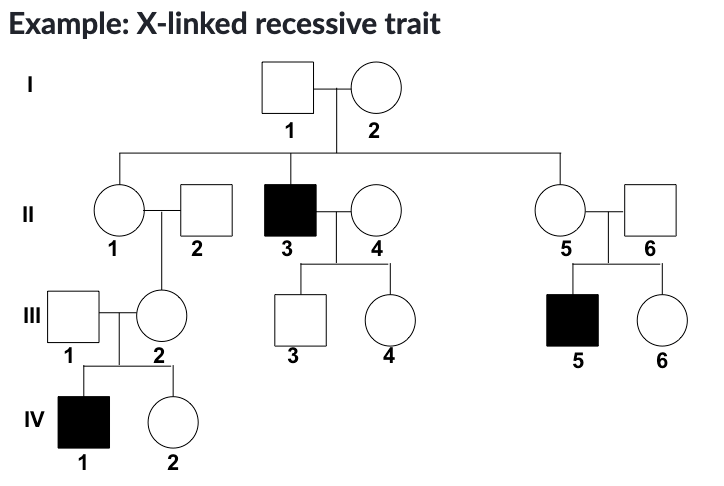
In generation I, neither parent has the trait, but one of their children (II-3) is colorblind. Because there are unaffected parents that have affected offspring, it can be assumed that the trait is recessive. In addition, the trait appears to affect males more than females (in this case, exclusively males are affected), suggesting that the trait may be X-linked.
1
1

What is the genotype of individual III-2?