Log in
Sign up for FREE
arrow_back
Library

AP Biology Benchmark #8 Cellular Respiration

star
star
star
star
star
Last updated 23 days ago
17 questions
1
1
1
1
1
2
1
Select the best answer.
Question 1
1.

Which metabolic pathway is common to both fermentation and cellular respiration of a glucose molecule?

Question 2
2.

Select the best explanation for why the eventual reoxidation of NADH and FADH2 is crucial for the continuation of the citric acid (Krebs) cycle.
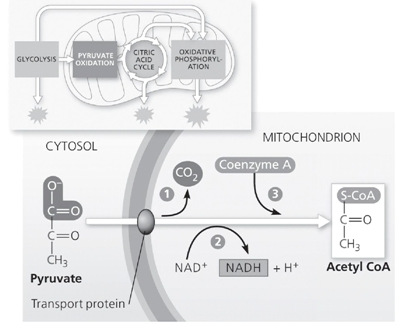
The oxidation of glucose in the presence of oxygen involves glycolysis, pyruvate oxidation, and the citric acid cycle (Krebs cycle). Some energy is captured in glycolysis when glucose is converted to pyruvate (pyruvic acid). In the citric acid cycle (Krebs cycle), more energy is captured in the form of reduced electron carriers, NADH and FADH2.
Question 3
3.

Which kind of metabolic poison would most directly interfere with glycolysis?

Question 4
4.

The free energy for the oxidation of glucose to CO2 and water is -686 kcal/mol, and the free energy for the reduction of NAD+ to NADH is +53 kcal/mol. Why are only two molecules of NADH formed during glycolysis when it appears that as many as a dozen could be formed?

Question 5
5.

Which of the following statements accurately describes the function of a metabolic pathway involved in cellular respiration?

Question 6
6.

Identify all correct statements about the basic function of fermentation.

Question 7
7.

Which of the following statements best describes the primary role played by oxygen in cellular respiration?

1
1
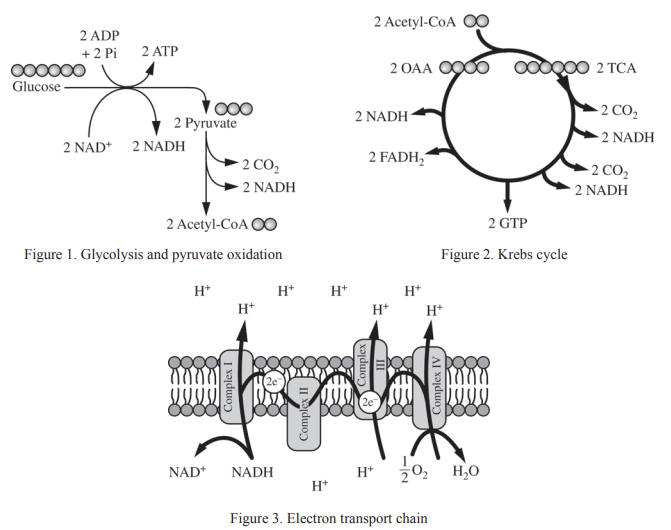
Cellular respiration includes the metabolic pathways of glycolysis, the Krebs cycle, and the electron transport chain, as represented in the figures. In cellular respiration, carbohydrates and other metabolites are oxidized, and the resulting energy-transfer reactions support the synthesis of ATP.
3
Question 10
10.

Using the information above, describe ONE contribution of each of the following in ATP synthesis.
  • Catabolism of glucose in glycolysis and pyruvate oxidation
  • Oxidation of intermediates in the Krebs cycle
  • Formation of a proton gradient by the electron transport chain

3
3
Question 12
12.

A researcher estimates that, in a certain organism, the complete metabolism of glucose produces 30 molecules of ATP for each molecule of glucose. The energy released from the total oxidation of glucose under standard conditions is 686 kcal/mol. The energy released from the hydrolysis of ATP to ADP and inorganic phosphate under standard conditions is 7.3 kcal/mol. Calculate the amount of energy available from the hydrolysis of 30 moles of ATP. Calculate the efficiency of total ATP production from 1 mole of glucose in the organism. Describe what happens to the excess energy that is released from the metabolism of glucose.

1
Researchers hypothesize that the plant compound resveratrol improves mitochondrial function. To test this hypothesis, researchers dissolve resveratrol in dimethyl sulfoxide (DMSO). The solution readily passes through cell membranes. They add the resveratrol solution to mammalian muscle cells growing in a nutrient-rich solution (culture medium) that contains glucose. They measure ATP production at several time points after the addition of the resveratrol solution and find an increase in ATP production by the muscle cells.
1
Question 14
14.

Describe the primary advantage for a mammalian muscle cell in using aerobic respiration over fermentation.

1
Question 15
15.

Identify an appropriate negative control for this experiment that would allow the researchers to conclude that ATP is produced in response to the resveratrol treatment.

1
Question 16
16.

Predict the effect on short-term ATP production when resveratrol-treated mammalian muscle cells are grown in a culture medium that lacks glucose or other sugars.

1
Question 8
8.

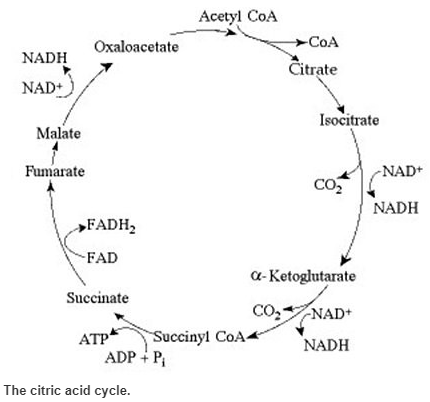
Starting with citrate, which of the following combinations of products would result from three acetyl CoA molecules entering the citric acid cycle?

Question 9
9.

If pyruvate oxidation is blocked, what will happen to the levels of oxaloacetate and citric acid in the citric acid cycle shown in the accompanying figure?

Question 11
11.

Use each of the following observations to justify the claim that glycolysis first occurred in a common ancestor of all living organisms.
  • Nearly all existing organisms perform glycolysis.
  • Glycolysis occurs under anaerobic conditions.
  • Glycolysis occurs only in the cytosol.

Question 13
13.

The enzymes of the Krebs cycle function in the cytosol of bacteria, but among eukaryotes the enzymes function mostly in the mitochondria. Pose a scientific question that connects the location of the enzymes in the Krebs cycle to the evolution of eukaryotes.

Question 17
17.

The researchers find that resveratrol stimulates the production of components of the electron transport chain. The reserachers claim that treatment with resveratrol will also increase oxygen consumption by the cells if glucose is not limiting. Justify the claim.