Log in
Sign up for FREE
arrow_back
Library

AP Biology Benchmark #6 Cell Membranes

star
star
star
star
star
Last updated 23 days ago
20 questions
1
1
1
1
1
1
1
Question 1
1.

According to the fluid mosaic model of cell membranes, phospholipids _____.

Question 2
2.

A phospholipid bilayer with equal amounts of saturated and unsaturated fatty acids displays a specific permeability to glucose. What effect will increasing the proportion of unsaturated fatty acids in the bilayer have on the membrane's permeability to glucose?

Question 3
3.

Water passes quickly through cell membranes because

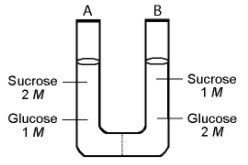
The solutions in the two arms of this U-tube are separated by a membrane that is permeable to water and glucose but not to sucrose. Side A is half filled with a solution of 2 M sucrose and 1 M glucose. Side B is half filled with 1 M sucrose and 2 M glucose. Initially, the liquid levels on both sides are equal.

1
1
Question 6
6.

When a cell is in equilibrium with its environment, which of the following processes occurs for substances that can diffuse through the plasma membrane?

Question 7
7.

Cell membranes have distinct inside and outside faces. Which of the following statements is the most likely explanation for the membrane's asymmetrical nature?

Question 8
8.

A research team is working on the design of a new drug for the treatment of lung cancer. To be most effective, this drug must specifically enter the cytoplasm of lung cells while not entering the cells of other tissues. Which of the following characteristics would likely enhance the specificity of this drug?

Question 9
9.

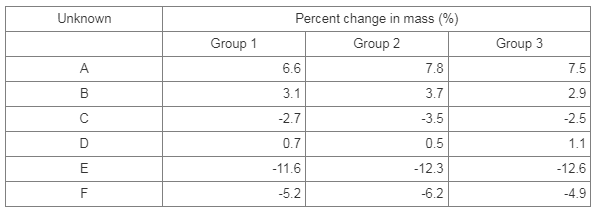
Three lab groups carried out an experiment to identify the correct molarities for five solutions. Each unknown contained one of the following sucrose concentrations: 0.0 M, 0.2 M, 0.4 M, 0.6 M, 0.8 M, and 1.0 M. Each data entry represents the average of 3 sample replications of 1 cm3 sweet potato cubes expressed as percent change in mass after an overnight (24 hr) soak in the unknown solutions. From the data given, which statement most accurately describes what is occurring in response to a particular unknown solution.


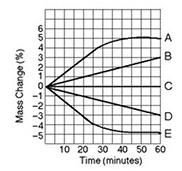
Five dialysis bags, constructed of a type of membrane that is permeable to water and impermeable to sucrose, were filled with various concentrations of sucrose and then placed in separate beakers containing an initial concentration of 0.6 M sucrose solution. At 10-minute intervals, the bags were massed (weighed), and the percent change in mass of each bag was graphed.


1
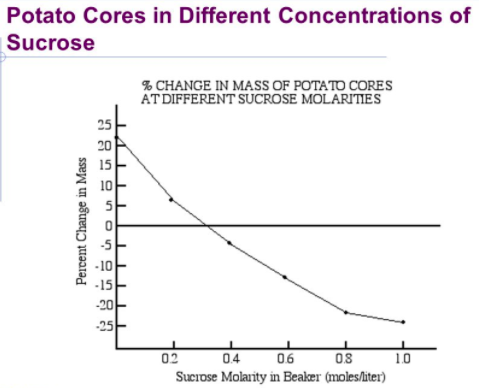
Given: Potato cores are placed in sucrose solutions with various molar concentrations, and the percent change in calculated for each solution. The data is graphed. From this data, it is determined that the molar concentration of the potato is 0.32.

What you know:
  • The initial pressure potential = 0 (since we are doing the experiment in normal conditions with an open container)
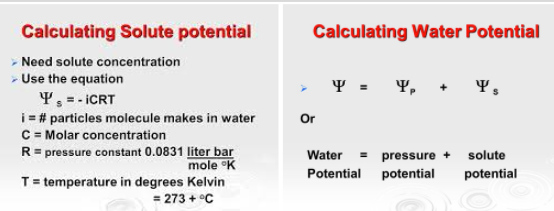
  • Solute potential =-iCRT
  • The ionization constant (i) for sucrose: sucrose does not ionize in water
  • The experiment is assumed to be conducted at room temperature, 22 degrees celsius.

1
Question 11
11.

What is the solute potential of the sucrose in the potato?

1
Question 12
12.

What is the overall water potential of the potato?

1
Question 13
13.

Make a claim about what would happen to a plant that is watered using a 0.5 M sodium chloride solution instead of pure water.

2
Question 14
14.

Use evidence from the graph to support your claim. What solution shows a result similar to this scenario?

2
Question 15
15.

Provide reasoning for your claim. Use appropriate vocabulary terms.

An experiment is designed to study the mechanism of sucrose uptake by plant cells. Cells are immersed in a sucrose solution, and the pH of the solution is monitored. Samples of the cells are taken at intervals and their sucrose concentration is measured.

Initially, there is no change in the sucrose concentration inside of the cell. Then, the pH of the solution is observed to decrease until it reaches a steady, slightly acidic level. The sucrose concentration inside of the cell then begins to increase. The pH of the solution continues to remain at the slightly acidic level.
2
Question 16
16.

Evaluate these results and propose a general hypothesis to explain them.

6
Question 17
17.

Support your hypothesis by explaining the structures and concentrations involved in these results.

2
Question 18
18.

Predict what would happen if an inhibitor of ATP regeneration by the cell were added to the beaker once the pH was at the steady, slightly acidic level. Explain your answer.

1
Question 19
19.

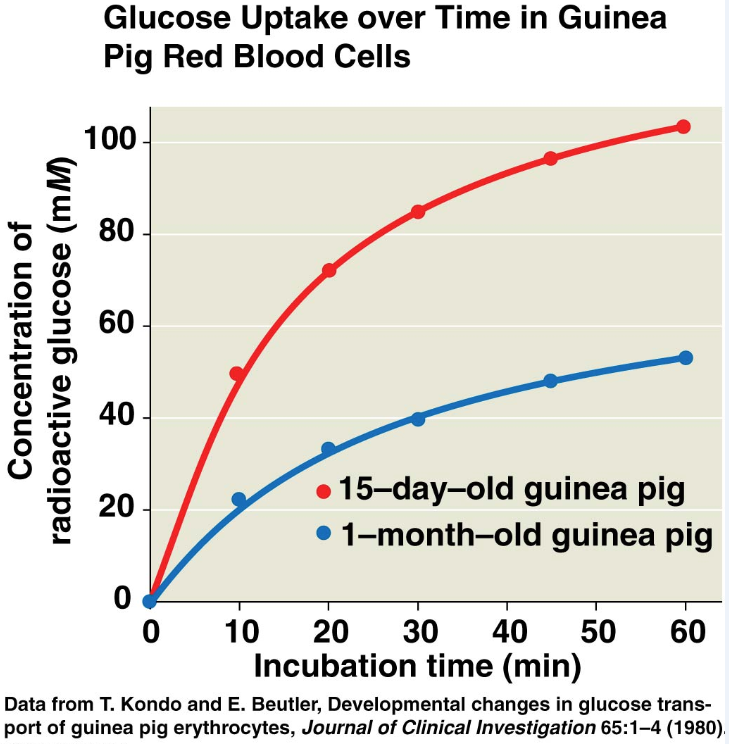
Describe the pattern of glucose uptake over time in guinea pig red blood cells.

1
Question 20
20.

Propose a reasonable hypothesis to explain the difference in glucose uptake over time between the 2 guinea pigs in the experiment.

Question 4
4.

Initially, in terms of tonicity, the solution in side A with respect to that in side B is

Question 5
5.

After the system reaches equilibrium, what changes are observed?

Question 10
10.

Which line in the graph represents the bag that contained a solution isotonic to the 0.6 M solution at the beginning of the experiment?