Log in
Sign up for FREE
arrow_back
Library

AP Biology Benchmark #9 Photosynthesis

star
star
star
star
star
Last updated 23 days ago
17 questions
For multiple choice questions: Select the best answer.
1
1
1
1
1
1
1
1
1
Question 1
1.

In a plant cell, where are the ATP synthase complexes located?

Question 2
2.

Use the following figure to answer the question.
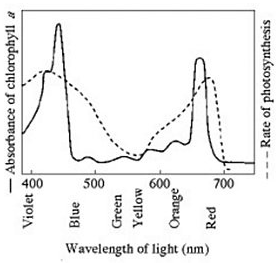
The figure shows the absorption spectrum for chlorophyll a and the action spectrum for photosynthesis. Why are they different?
Theodor W. Engelmann illuminated a filament of algae with light that passed through a prism, thus exposing different segments of algae to different wavelengths of light. He added aerobic bacteria and then noted in which areas the bacteria congregated. He noted that the largest groups were found in the areas illuminated by the red and blue light.
1
1
Question 5
5.

Which of the following sequences correctly represents the flow of electrons during photosynthesis?

Question 6
6.

Which of the following statements is a correct distinction between autotrophs and heterotrophs?

Question 7
7.

Which of the following does not occur during the Calvin cycle?

Question 8
8.

The mechanism of photophosphorylation is most similar to which of the following processes?

Question 9
9.

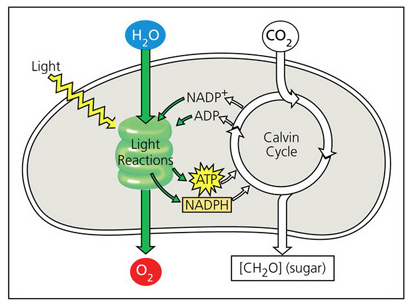
Select the most accurate statement describing the basic function of the light reactions of photosynthesis.

Question 10
10.

Which of the following statements best describes the relationship between photosynthesis and cellular respiration?

Question 11
11.

Which of the following processes would be most directly affected if a thylakoid membrane is punctured so that the interior of the thylakoid is no longer separated from the stroma?

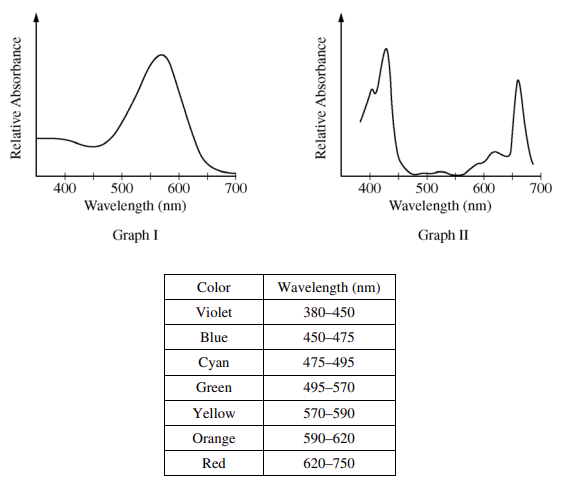
An absorption spectrum indicates the relative amount of light absorbed across a range of wavelengths. The graphs above represent the absorption spectra of individual pigments isolated from two different organisms. One of the pigments is chlorophyll a, commonly found in green plants. The other pigment is bacteriorhodopsin, commonly found in purple photosynthetic bacteria. The table above shows the approximate ranges of wavelengths of different colors in the visible light spectrum.
3
Question 12
12.

Identify the pigment (chlorophyll a or bacteriorhodopsin) used to generate the absorption spectrum in each of the graphs above. Explain and justify your answer.

6
Question 13
13.

In an experiment, identical organisms containing the pigment from Graph II as the predominant lightcapturing pigment are separated into three groups. The organisms in each group are illuminated with light of a single wavelength (650 nm for the first group, 550 nm for the second group, and 430 nm for the third group). The three light sources are of equal intensity, and all organisms are illuminated for equal lengths of time. Predict the relative rate of photosynthesis in each of the three groups. Justify your predictions.

2
Question 14
14.

Bacteriorhodopsin has been found in aquatic organisms whose ancestors existed before the ancestors of plants evolved in the same environment. Propose a possible evolutionary history of plants that could have resulted in a predominant photosynthetic system that uses only some of the colors of the visible light spectrum.

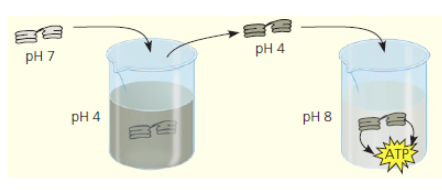
The following diagram represents an experiment with isolated thylakoids. The thylakoids were first made acidic by soaking them in a solution at pH 4. After the thylakoid space reached pH 4, the thylakoids were transferred to a basic solution pH 8. The thylakoids then made ATP in the dark.


5
Question 15
15.

Draw an enlargement of part of the thylakoid membrane in the beaker with the solution at pH 8. Draw ATP synthase. Label the areas of high H+ concentration and low H+ concentration. Show the direction protons flow through the enzyme, and show the reaction where ATP is synthesized.

2
Question 16
16.

State whether ATP would end up in the thylakoid or outside of it. Explain why this the location of ATP creation is important for photosynthesis in a normal chloroplast.

2
Question 3
3.

What did Engelmann conclude about the congregation of bacteria in the red and blue areas?

Question 4
4.

Which of the following statements describes a relationship that Engelmann's experiment helped to determine?

Question 17
17.

Explain why the thylakoids in the experiment were able to make ATP in the dark.