Log in
Sign up for FREE
arrow_back
Library

AP Biology Benchmark #5 Cell Structures and Function

star
star
star
star
star
Last updated 23 days ago
21 questions
1
1
1
1
1
1
1
1
1
1
1
1
1
1
1
2
3
3
3
Question 1
1.

Which of the following is the most common pathway taken by a newly synthesized protein that will be secreted by a cell?

Question 2
2.

Which of the following statements correctly describes some aspect of protein secretion from prokaryotic cells?

Question 3
3.

Suppose a young boy is always tired and fatigued, suffering from a metabolic disease. Which of the following organelles is most likely malfunctioning in this disease?

Question 4
4.

Where are proteins produced other than on ribosomes free in the cytosol or ribosomes attached to the endoplasmic reticulum?

Question 5
5.

Gaucher disease is the most common of lipid storage diseases in humans. It is caused by a deficiency of an enzyme necessary for lipid metabolism. This leads to a collection of fatty material in organs of the body including the spleen, liver, kidneys, lungs, brain, and bone marrow. Using your knowledge of the structure of eukaryotic cells, identify the statement below that best explains how internal membranes and the organelles of cells would be involved in Gaucher disease.

Question 6
6.

Cyanide binds to at least one molecule involved in producing ATP. If a cell is exposed to cyanide, most of the cyanide will be found within the

Question 7
7.

Which statement correctly describes an endomembrane function?

Question 8
8.

Select the correct statement describing cellular structure or function.

Question 9
9.

The development of electron microscopy has provided key insights inot many aspects of cellular sturture and function, which had previously been too small to seen. Which of the following would require the use of electron microscopy for visualizaiton?

Question 10
10.

The Rough Endoplasmic Reticulum (RER) is characterized by ribosomes bound to its surface, while the Smooth Endoplasmic Reticulum (SER) lacks them. This structural difference accounts for which primary functional distinction between the two?

Question 11
11.

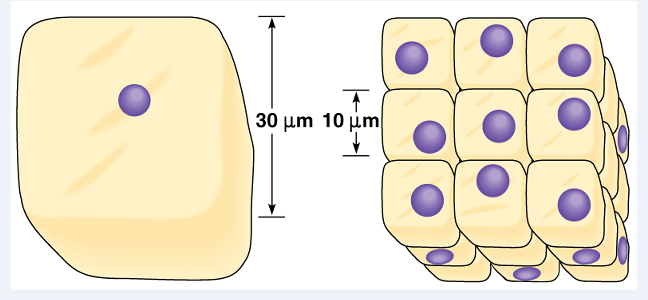
You have a cube of modeling clay in your hands. Which of the following changes to the shape of this cube of clay will decrease its surface area relative to its volume?

Question 12
12.

A biologist ground up some plant leaf cells and then centrifuged the mixture to fractionate, or separate, the organelles. Organelles in one of the heavier fractions could produce ATP in the light, while organelles in the lighter fraction could produce ATP in the dark. The heavier and lighter fractions are most likely to contain, respectively,

Question 13
13.

Mitochondria and chloroplasts share several key characteristics that support the Endosymbiotic Theory. Which of the following is NOT one of these shared characteristics?

Question 14
14.

Cells come in a variety of shapes and sizes. Lymphocytes are spherical, red blood cells disc-shaped, wan muscle and nerve cells are cylindrical. Which of the following correctly matches a cell type with an advantage of its shape?

2
Question 15
15.

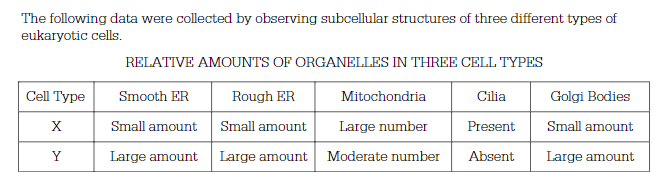
Based on an analysis of the data, make a claim about the likely primary function of each cell type.

2
Question 16
16.

Clearly explain your reasoning of how the data supports the identification of each cell type.
Question 17
17.

Surface Area (SA) of a cube = 6 x side length x side length
Volume = side length x side length x side length

Calculate the surface area/volume ratio for a cube shaped cell with the length of a side of 1cm.

Question 18
18.

Starting with your calculated surface area/volume ratio for a 1 cm cell, draw a graph that predicts the surface area/volume ratio for cells with the length of a side 1 - 10 cm.

Question 19
19.

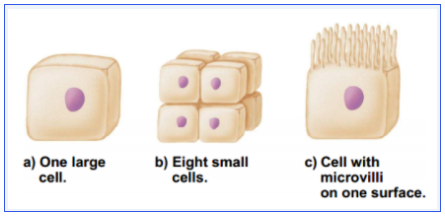
Redraw your graph. Looking at the cells below, assume that cell 'a' has a side length of 9 cm. Assume cell 'b' has a length of 4 cm. Indicate on your graph where cell 'c' could be. Is it located on your predicted line? Why or why not? Explain your answer.


Question 20
20.

Evolution has favored the division of cells once they become too large.
Explain how this could improve a multicellular organism's fitness.
Describe 2 additional requirements for multicellular organisms to maintain fitness that contain many smaller cells like in the diagram below.


Question 21
21.

Both eukaryotic cells and prokaryotic cells send chemical signals in the form of protein to the outside environment. Prokaryotes can complete this faster than eukaryotic cells. Explain how is this possible? (Multiple reasons.)