At which bond would water need to be added to achieve hydrolysis of the peptide, back to its component amino acid?
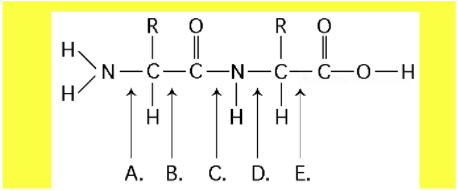
At which bond would water need to be added to achieve hydrolysis of the peptide, back to its component amino acid?
Why does ice float in liquid water?
Which of the following best summarizes the relationship between dehydration reactions and hydrolysis?
At which bond would water need to be added to achieve hydrolysis of the peptide, back to its component amino acid?
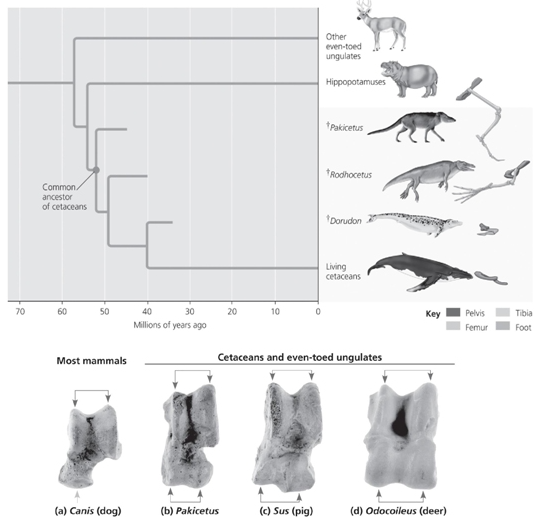
Modern cetaceans, the taxonomic group that includes whales, dolphins, and porpoises, evolved from land mammals. However, it has only been within the past few decades that transitional fossils have been found that have shed light on cetacean hindlimb reduction. DNA data suggest that cetaceans are most closely related to Hippos, which are even-toed ungulates. Other even-toed ungulates include deer, pigs, camels, and cows. Which statement describes most accurately how the early cetacean,Pakicetus, fossil ankle bones shown in the figure supports the hypothesis that cetaceans are closely related to even-toed ungulates?
Why does testosterone, a lipid-soluble signaling molecule that crosses the membranes of all cells, affect only target cells?
An animal cell with an internal osmolarity of 300 mOsm/L is placed in a solution with an osmolarity of 500 mOsm/L. Which of the following best predicts the outcome?
The following diagram shows energy transformations within a cell. Each form of energy is represented by the symbols E I–E IV. Two cellular organelles are represented by the letters A and B. Answer the following questions about the various processes depicted in the diagram and about the cell in which they are occurring.
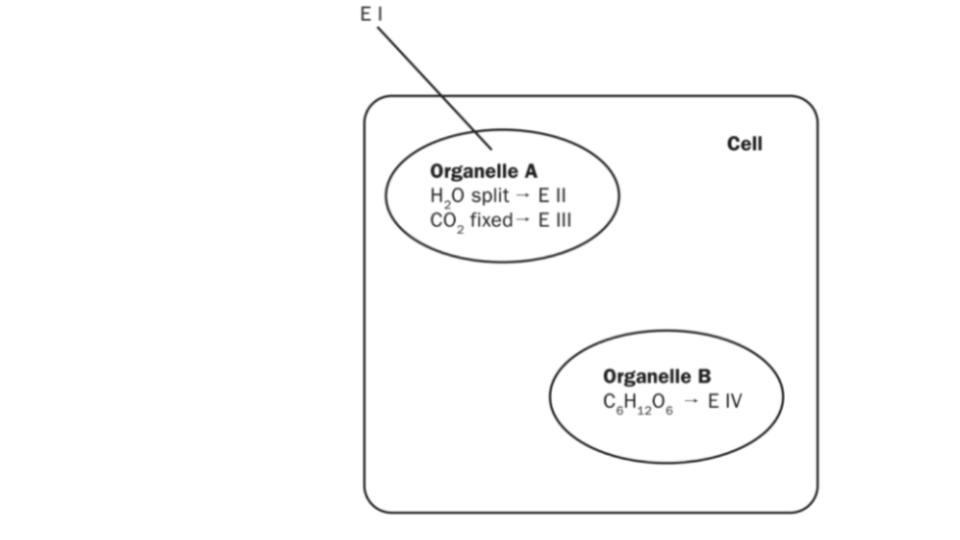
If the transformation depicted in organelle B requires oxygen, what form of energy is represented by E IV?
Density-dependent inhibition is a phenomenon in which crowded cells stop dividing at some optimal density and location. This phenomenon involves binding of a cell-surface protein to its counterpart on an adjoining cell's surface. A growth inhibiting signal is sent to both cells, preventing them from dividing. Certain external physical factors can affect this inhibition mechanism. Select the statement that makes a correct prediction about natural phenomena that could occur during the cell cycle to prevent cell growth.
Which of the following sequences correctly represents the flow of electrons during photosynthesis?
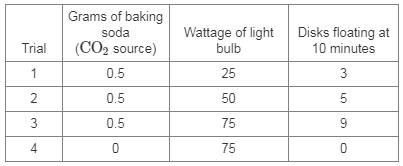
Use your knowledge of the mechanism of photosynthesis and the data presented in the chart to determine which of the statements below is a correct explanation for the student's data.
Students conducted an experiment to determine the effect of light intensity on the rate of photosynthesis. They punched 40 leaf disks from spinach leaves and used a syringe partially filled with water to pull the gases from the leaf disks so that all leaf disks sunk to the bottom of the syringe. Ten (10) leaf disks from the syringe were placed in each of four cups and covered with 50 ml of the solutions as indicated below. All leaf disks were resting on the bottom of the cups when the experiment began. The volume of liquid in each cup and the temperature of the solutions were held constant. All cups were placed 0.5 meters from the designated light source. A large beaker of water was placed between the light and the cups to act as a heat sink to prevent a change in temperature. At the end of 10 minutes, the number of disks floating in each cup was recorded.
Which metabolic pathway is common to both fermentation and cellular respiration of a glucose molecule?
If an enzyme in solution is saturated with substrate, the most effective way to obtain a faster yield of products is to
Characterization of the complete three-dimensional structure of a newly purified protein suggests that it catalyzes the breakdown of a large substrate. The protein consists of a single polypeptide chain. It has a large pocket that appears to be the binding site for the substrate and a smaller indentation that appears to be the binding site for a regulatory molecule. What do these structural observations suggest about the mechanism by which the activity of this protein is likely regulated?
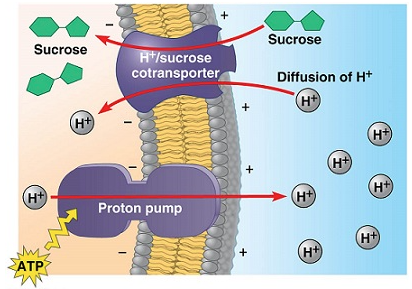
Based on the figure below, which of these experimental treatments would increase the rate of sucrose transport into the cell?
Which of the following factors would tend to increase membrane fluidity?
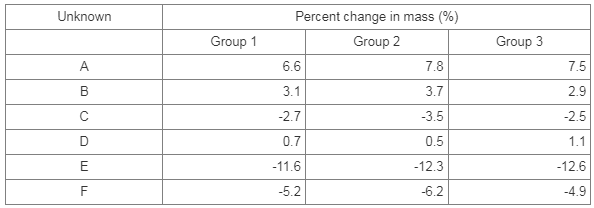
Three lab groups carried out an experiment to identify the correct molarities for five solutions. Each unknown contained one of the following sucrose concentrations: 0.0 M, 0.2 M, 0.4 M, 0.6 M, 0.8 M, and 1.0 M. Each data entry represents the average of 3 sample replications of 1 cm3 sweet potato cubes expressed as percent change in mass after an overnight (24 hr) soak in the unknown solutions. From the data given, which statement most accurately describes what is occurring in response to a particular unknown solution.
The loss of water from a plant by transpiration cools the leaf. Movement of water in transpiration requires both adhesion to the conducting walls and wood fibers of the plant and cohesion of the molecules to each other. A scientist wanted to increase the rate of transpiration of a crop species to extend its range into warmer climates. The scientist substituted a nonpolar solution with an atomic mass similar to that of water for hydrating the plants. What do you expect the scientist's data will indicate from this experiment?
Bird guides once listed the myrtle warbler and Audubon's warbler as distinct species. Recently, these birds have been classified as eastern and western forms of a single species, the yellow-rumped warbler. Which of the following pieces of evidence, if true, would be cause for this reclassification?
Males of different species of the fruit fly Drosophila that live in the same parts of the Hawaiian Islands have different elaborate courtship rituals. These rituals involve fighting other males and making stylized movements that attract females. What type of reproductive isolation does this represent?
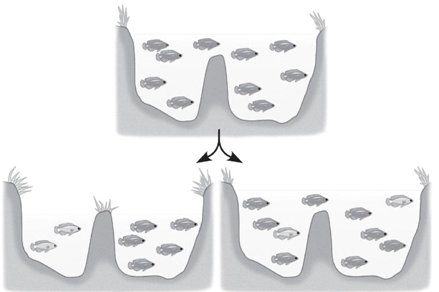
In the accompanying diagram, the original population of a species of fish in a small lake that lacks predators is shown at the top. After separation by a land mass, the figure at the bottom left of the diagram shows the resulting change. Each color represents a different species. Allopatric speciation occurs when gene flow is disrupted through physical isolation of the original population. Although generally less common, sympatric speciation can occur among individuals in a population living in the same area, such as seen in the bottom right of the figure. Which of the following scenarios would most likely cause sympatric speciation to occur?
The upper forelimbs of humans and bats have fairly similar skeletal structures, whereas the corresponding bones in whales have very different shapes and proportions. However, genetic data suggest that all three kinds of organisms diverged from a common ancestor at about the same time. Which of the following is the most likely explanation for these data?
Which of the following observations helped Darwin shape his concept of descent with modification?
The pyruvate dehydrogenase complex (PDC) catalyzes the conversion of pyruvate to acetyl-CoA, a substrate for the Krebs (citric acid) cycle. The rate of pyruvate conversion is greatly reduced in individuals with PDC deficiency, a rare disorder.
Identify the cellular location where PDC is most active.
Make a claim about how PDC deficiency affects the amount of NADH produced by glycolysis AND the amount of NADH produced by the Krebs (citric acid) cycle in a cell. Provide reasoning to support your claims based on the position of the PDC-catalyzed reaction in the sequence of the cellular respiration pathway.
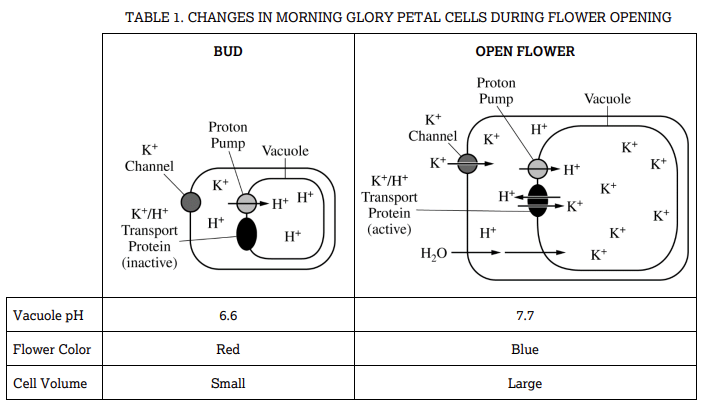
The petal color of the Mexican morning glory (Ipomoea tricolor) changes from red to blue, and the petal cells swell during flower opening. The pigment heavenly blue anthocyanin is found in the vacuole of petal cells. Petal color is determined by the pH of the vacuole. A model of a morning glory petal cell before and after flower opening is shown in Table 1.
Identify the cellular component in the model that is responsible for the increase in the pH of the vacuole during flower opening AND describe the component’s role in changing the pH of the vacuole.
A researcher claims that the activation of the K / H transport protein causes the vacuole to swell with water. Provide reasoning to support the researcher’s claim.
Cystic fibrosis is a genetic condition that is associated with defects in the CFTR protein. The CFTR protein is a gated ion channel that requires ATP binding in order to allow chloride ions (CL-) to diffuse across the membrane.
In the provided model of a cell, draw arrows to describe the pathway for production of a normal CFTR protein from gene expression to final cellular location.
Identify the most likely cellular location of the ribosomes that synthesize CFTR protein.
Identify the most likely cellular location of a mutant CFTR protein that has an amino acid substitution in the ATP-binding site.
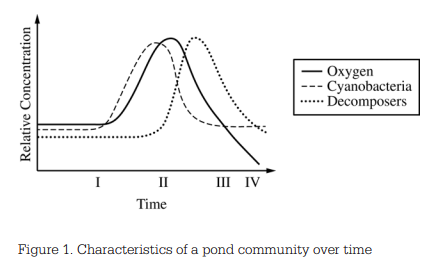
Microcystis aeruginosis is a freshwater photosynthetic cyanobacterium. When temperatures increase and nutrients are readily available in its pond habitat, M. aeruginosis undergoes rapid cell division and forms an extremely large, visible mass of cells called an algal bloom. M. aeruginosis has a short life span and is decomposed by aerobic bacteria and fungi.
Identify the metabolic pathway and the organism that is primarily responsible for the change in oxygen level in the pond between times I and II AND between times III and IV.
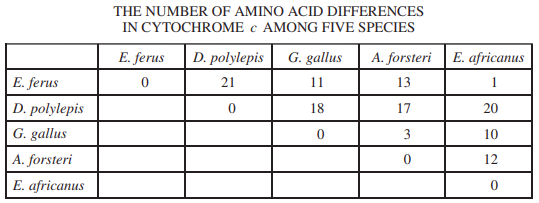
The amino acid sequence of cytochrome c was determined for five different species of vertebrates. The table below shows the number of differences in the sequences between each pair of species.
Using the data in the table, create a phylogenetic tree on the template provided to reflect the evolutionary relationships of the organisms.
Provide reasoning for the placement on the tree of the species that is least related to the others.
Identify whether morphological data or amino acid sequence data are more likely to accurately represent the true evolutionary relationships among the species, and provide reasoning for your answer.
The yeast Saccharomyces cerevisiae is a single-celled organism. Amino acid synthesis in yeast cells occurs through metabolic pathways, and enzymes in the synthesis pathways are encoded by different genes. The synthesis of a particular amino acid can be prevented by mutation of a gene encoding an enzyme in the required pathway.
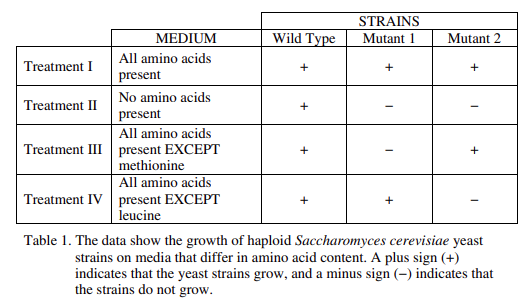
A researcher conducted an experiment to determine the ability of yeast to grow on media that differ in amino acid content. Yeast can grow as both haploid and diploid cells. The researcher tested two different haploid yeast strains (Mutant 1 and Mutant 2), each of which has a single recessive mutation, and a haploid wild-type strain. The resulting data are shown in Table 1.
Identify the role of Treatment I in the experiment.
Provide reasoning to explain how Mutant 1 can grow on Treatment I medium but cannot grow on Treatment III medium.
Yeast mate by fusing two haploid cells to make a diploid cell. In a second experiment, the researcher mates the Mutant 1 and Mutant 2 haploid strains to produce diploid cells. Using the table provided, predict whether the diploid cells will grow on each of the four media. Use a plus sign (+) to indicate growth and a minus sign (−) to indicate no growth.