Which process is shown in the image below?

Which process is shown in the image below?
NGSS: HS LS1-1 DCI: LS1.A CCC: Structure and Function
Questions 1-10 are worth 3 pts each.
NGSS: HS LS1-1 DCI: LS1.A CCC: Structure and Function Multiple choice are worth 3 pts each.
Put the steps of transcription and translation in the correct order.
Amino acids are added together with peptide bonds to make a polypeptide (protein)
Codons on the mRNA pair up with anti-codons on the tRNA
RNA nucleotides match their bases to the bases on the DNA strand
The Stop codon is reached and mRNA leaves the ribosome
mRNA connects to the ribosome
For each characteristic, indicate if it describes DNA, RNA, or both molecules.
Single stranded
Uracil
Ribose
Adenine
Cytosine
Found in the nucleus and cytoplasm
Found only in the nucleus
Guanine
Double stranded
Deoxyribose
Thymine
Made up of nucleotides
DNA
RNA
Both DNA & RNA
Order the steps of protein synthesis.
What is the first step of protein synthesis?
Which type of RNA carries the genetic information from DNA to the ribosome?
What is the function of tRNA in protein synthesis?
The process of transcribing a DNA gene into mRNA is known as:
Which of the following represents a group of three nucleotides on mRNA that specify a particular amino acid?
Which process is shown in the image below?
Which type or types of RNA contain a copy of the instructions that a gene carries for a particular trait?
Use the diagram below to translate the mRNA sequence AUG-UCU-UCG-UUA into their appropriate amino acids?
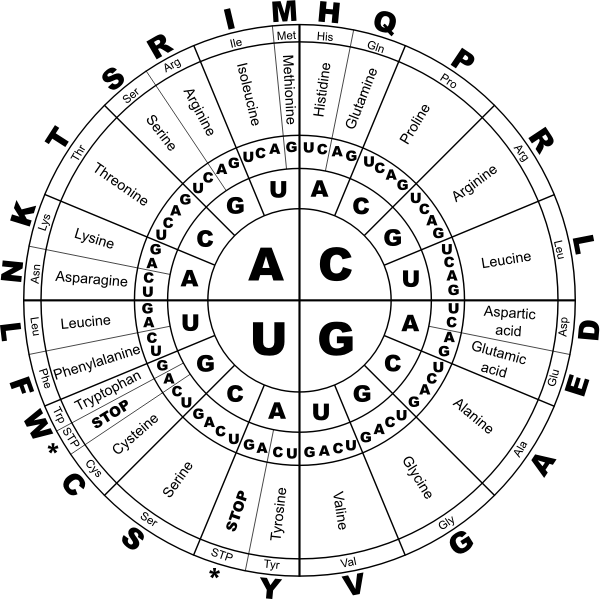
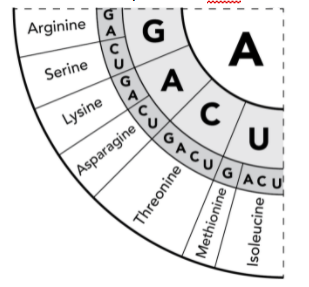
Which one of the conclusions listed below is most strongly supported by the evidence presented in the diagram (2 points)?
Where in the cell does translation take place?
Given that Alvin observed a nucleic acid containing A, C, G, and U, what can he conclude about its identity?
What is the DNA code that was used to transcribe the following mRNA code?
CUC AAG UGC UUC
PE: Performance Expectation: worth 5 pts
Imagine your body is built from billions of cells, each containing an identical copy of your complete DNA instruction manual. Yet, these cells don't all do the same job! For example:
Red blood cells are oxygen couriers, packed with the protein hemoglobin.
Muscle cells are powerful contractors, rich in the protein Myosin II.
Salivary gland cells are digestive helpers, secreting the enzyme Amylase to break down starch.
Given that every single one of your somatic (body) cells possesses the exact same DNA, explain how it's possible for different types of cells to produce such a wide variety of specialized proteins, leading to their unique functions.
CCC: Structure and Function: worth 7 pts
How does the DNA in a cell tell a protein how to be built? Describe the main steps involved in turning DNA instructions into a finished protein. (4 pts)
Draw or create a simple diagram/flowchart that shows these steps from DNA to protein. Label the important parts. (3 pts)
CER: Claim, Evidence, and Reasoning (worth 15 pts)
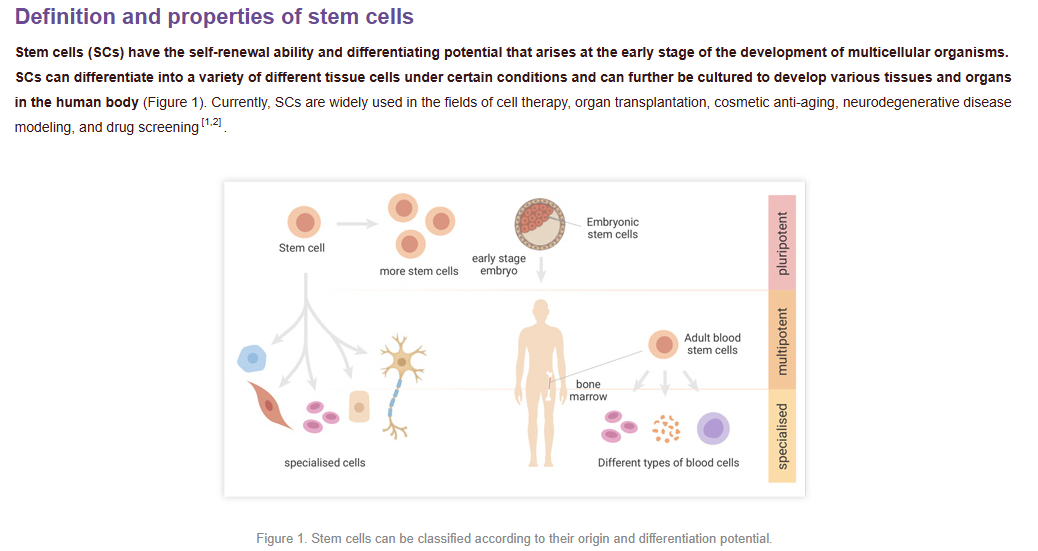
Refer to the provided diagram 'Definition and properties of stem cells' to understand the nature and potential of stem cells and specialized cells. Consider the implications of a DNA mutation occurring in different cell types.
Your Task (CER Format):
1. Claim: Which type of DNA mutation is more damaging to an organism's overall health:
a mutation that occurs in stem cells (undifferentiated cells at an early stage of development) or a mutation that occurs in a specific tissue cell (cells that have already differentiated into specialized functions)?
2. Evidence: Use information and concepts presented in the 'Definition and properties of stem cells' diagram and accompanying text to provide specific evidence that supports your claim.
3. Reasoning: Explain why the evidence you chose supports your claim. Connect your explanation to the properties of stem cells and differentiated cells, and how mutations in each would affect the organism.
See the rubric to ensure you get the greatest amount of points for your answer.