Asemmisa {{asɛmmisaAhyɛnsode}}
9.
A recent Harvard study concluded that people who drink coffee tend to live longer than those who don’t drink coffee. The study followed more than 20,000 nurses and doctors over a 30-year period, giving them frequent questionnaires to answer about their coffee habits. Researchers found that people who drank 3 to 5 cups of coffee a day had a mortality rate during the study that is 15% lower than those who did not drink coffee.
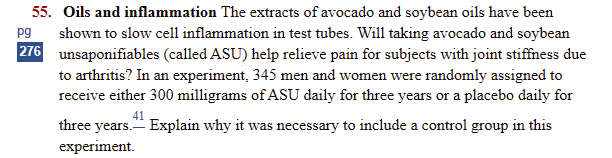
A recent study investigated the potential benefits of caffeine on athletic performance. Volunteers were randomly assigned to complete a 10-km bike ride after consuming caffeine and others after consuming a placebo. The average time to complete the 10-km bike ride was 1.6% faster for subjects who were given caffeine than for subjects who were given a placebo.
Several AP® Statistics students wondered whether caffeine could improve test scores. They randomly assigned 30 student volunteers to either drink regular coffee or decaffeinated coffee the morning of the students’ next test. At the end, they recorded test scores for each student volunteer.
Several AP® Statistics students wondered whether caffeine could improve test scores. They randomly assigned 30 student volunteers to either drink regular coffee or decaffeinated coffee the morning of the students’ next test. At the end of the experiment, they recorded test scores for each student volunteer. Identify the treatments and the experimental units in this experiment.
Does adding fertilizer affect the productivity of tomato plants? How about the amount of water given to the plants? To answer these questions, a gardener plants 24 similar tomato plants in identical pots in his greenhouse. He will add fertilizer to the soil in half the pots. Also, he will water 8 of the plants with 0.5 gallon of water per day, 8 of the plants with 1 gallon of water per day, and the remaining 8 plants with 1.5 gallons of water per day. At the end of 3 months, he will record the total weight of tomatoes produced by each plant.
List the factors in this experiment and the number of levels for each factor.
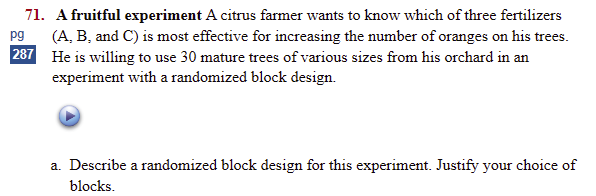
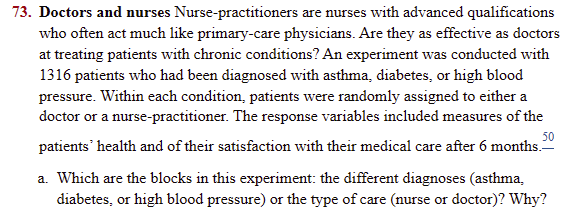
Do students learn geometry better from an online course or in class with a teacher? To find out, a large high school is setting up an experiment with the 500 students (100 freshmen, 400 sophomores) who signed up for geometry next year. The school’s guidance counselors randomly assign half the students to take the geometry course online, watching videos. The other half of the students will take a geometry course based on teacher lectures. At the end of the year, the success of each program will be measured by students’ scores on the geometry final exam, which will be the same for both courses.
The guidance counselors are convinced that these two learning formats will show different results for freshman and sophomore students.
(a) Describe a randomized block design for this experiment. Justify your choice of blocks.
(b) Explain why a randomized block design may be preferable to a completely randomized design for this experiment.
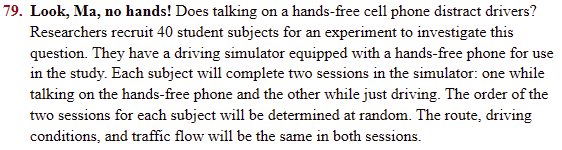
A track coach wants to know whether his long-distance runners are faster running the track clockwise or counterclockwise. Design an experiment that uses a matched pairs design to investigate this question. Explain your method of pairing.
In prospective studies, individuals are followed over time and data about them is collected as their characteristics or circumstances change.
In retrospective studies, individuals are sampled and information is collected about their past.
SKIP
Are there any problems above that you would like to go over in class? Indicate the question numbers below (Numbers refer to the Formative question number). I'll try to cover anything that is highly requested.