1
1
1
1
1
1
1
1
1
1

Explain why a giant star that is cooler than our Sun, similar to Aldebaran, has a greater luminosity than the Sun.
Identify the color of the star Bellatrix, which has a surface temperature of approximately 21,000 K.
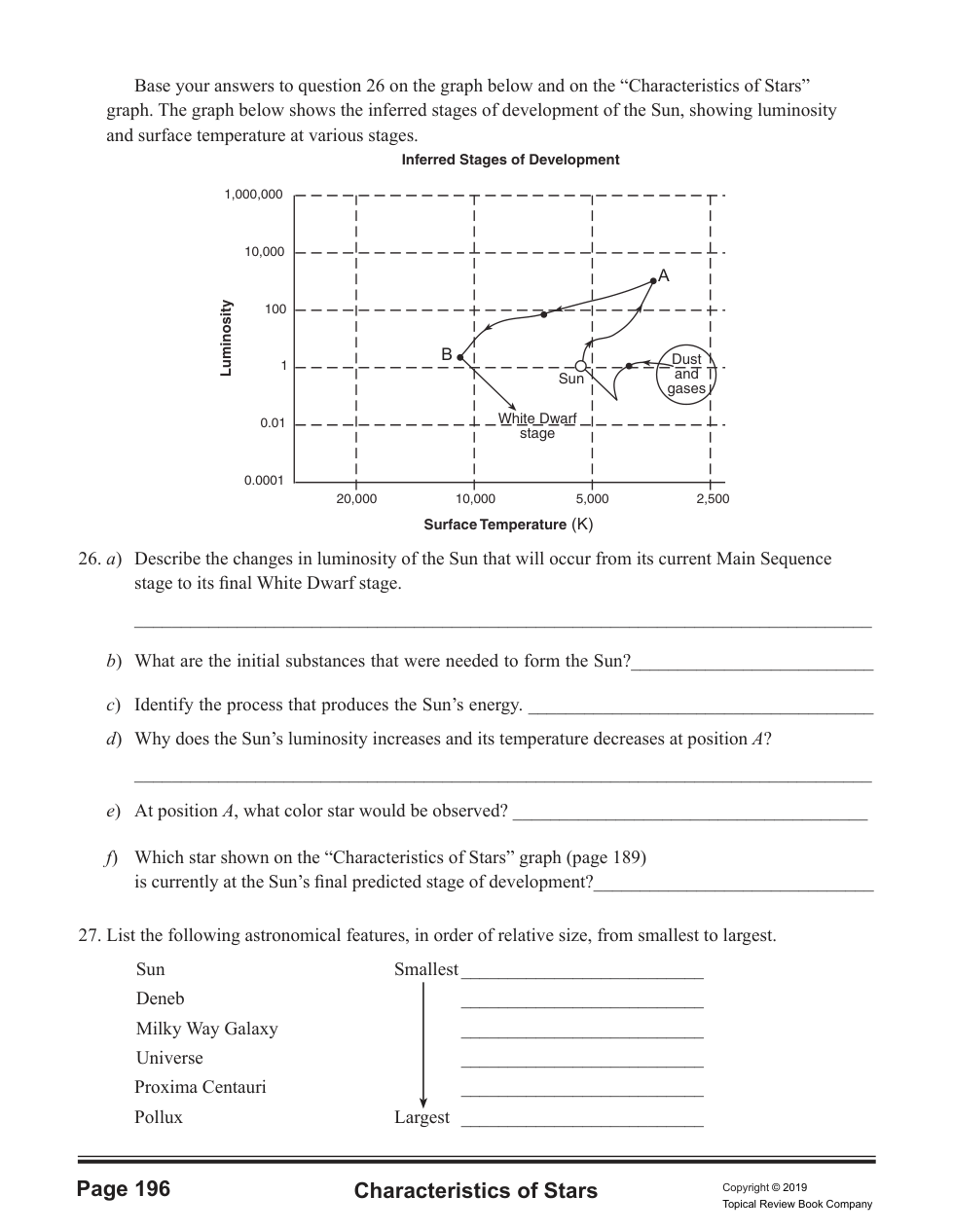
a) Describe the changes in luminosity of the Sun that will occur from its current Main Sequence stage to its final White Dwarf stage.
From Main Sequence to Giant:
Giant to white dwarf:
b) What are the initial substances that were needed to form the Sun?
c) Identify the process that produces the Sun’s energy.
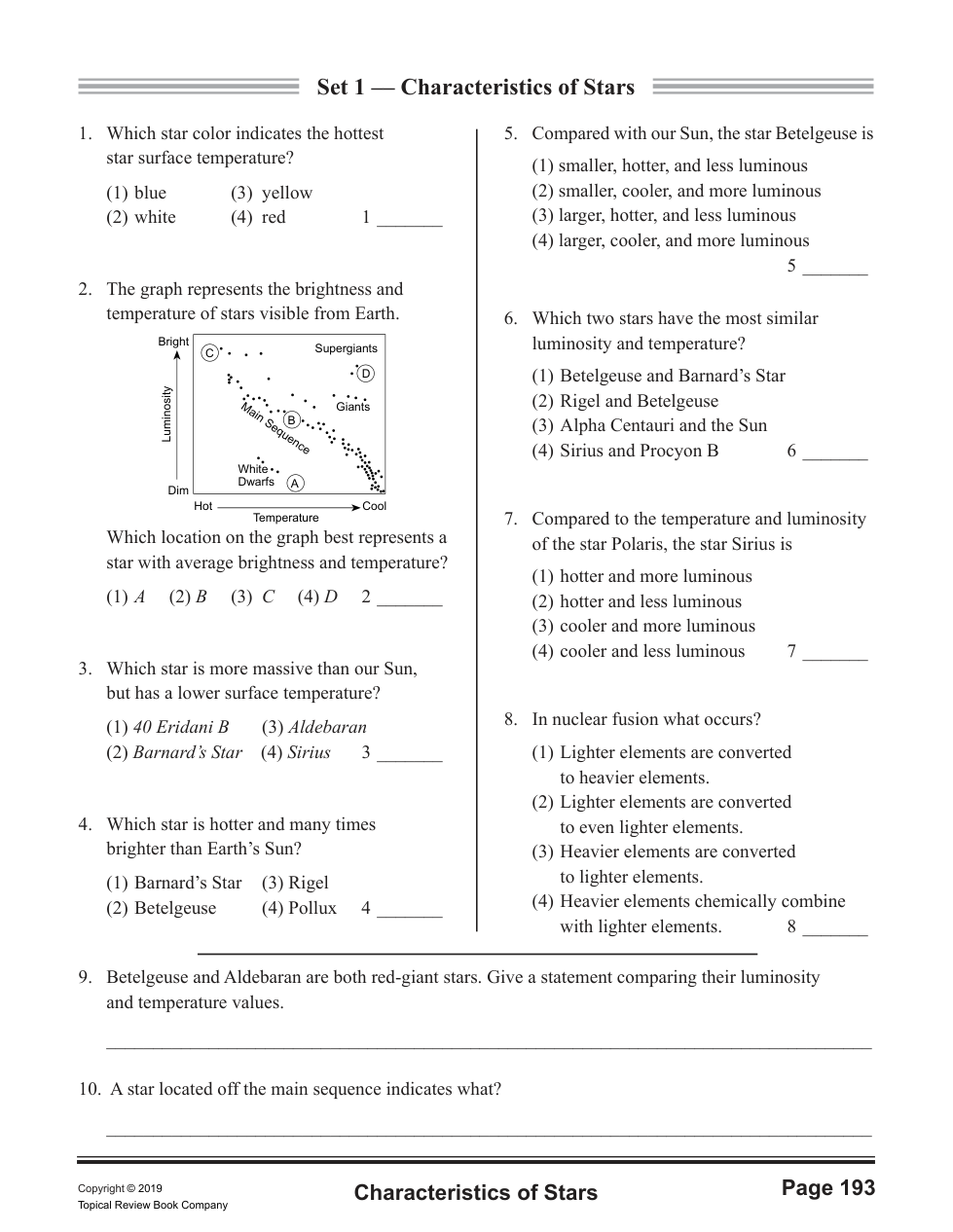
Which star color indicates the hottest star surface temperature?
The graph represents the brightness and temperature of stars visible from Earth. Which location on the graph best represents a star with average brightness and temperature?
Which star is more massive than our Sun, but has a lower surface temperature?
Which star is hotter and many times brighter than Earth’s Sun?
Compared with our Sun, the star Betelgeuse is
Which two stars have the most similar luminosity and temperature?
Compared to the temperature and luminosity of the star Polaris, the star Sirius is
In nuclear fusion what occurs?
Betelgeuse and Aldebaran are both red-giant stars. Give a statement comparing their luminosity and temperature values.
A star located off the main sequence indicates what?
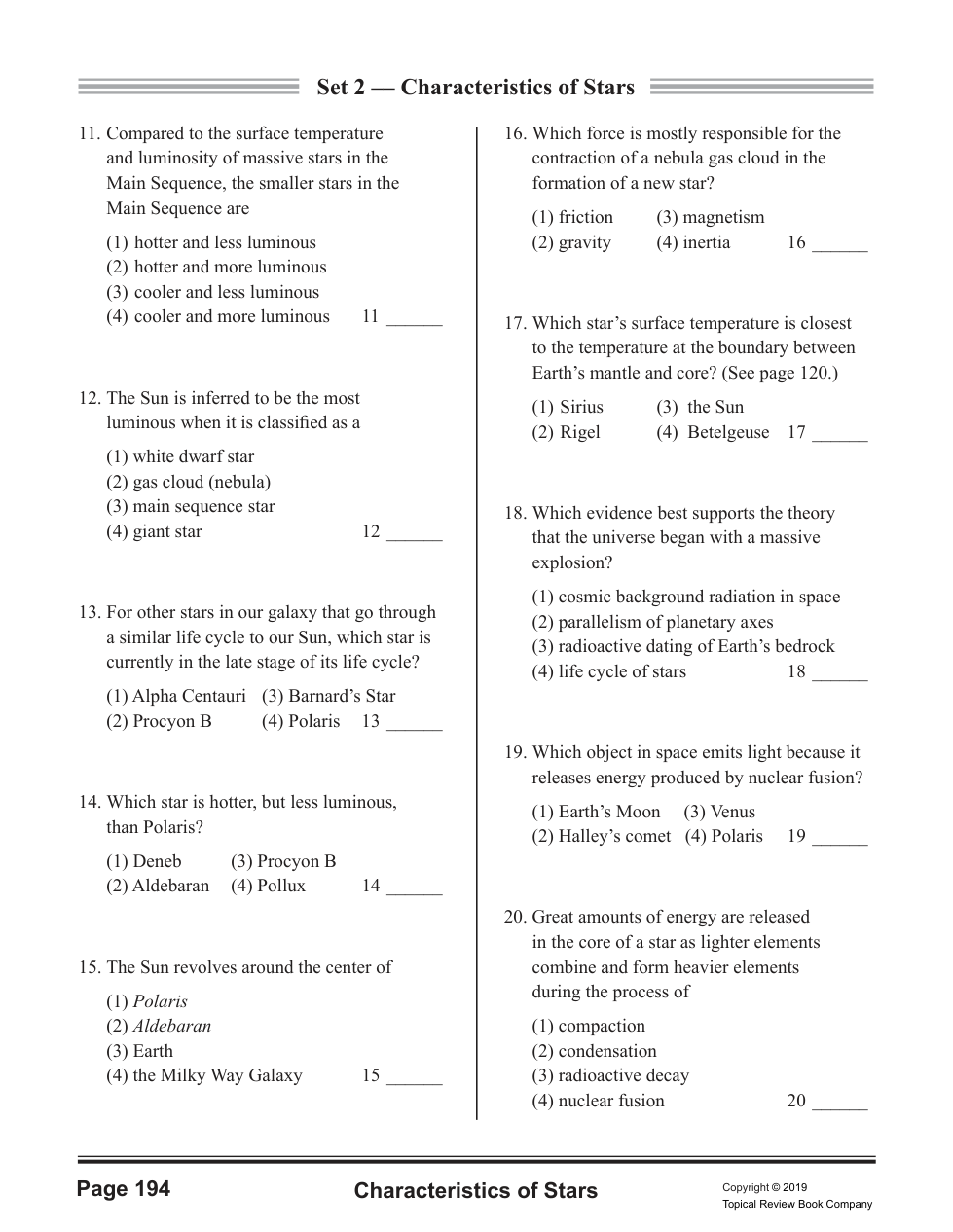
Compared to the surface temperature and luminosity of massive stars in the Main Sequence, the smaller stars in the Main Sequence are
The Sun is inferred to be the most luminous when it is classified as a
For other stars in our galaxy that go through a similar life cycle to our Sun, which star is currently in the late stage of its life cycle?
Which star is hotter, but less luminous, than Polaris?
The Sun revolves around the center of
Which force is mostly responsible for the contraction of a nebula gas cloud in the formation of a new star?
Tough question alert:Which star’s surface temperature is closest to the temperature at the boundary between Earth’s mantle and core? (ESRT pg. 10.)
Which evidence best supports the theory that the universe began with a massive explosion?
Which object in space emits light because it releases energy produced by nuclear fusion?
Great amounts of energy are released in the core of a star as lighter elements combine and form heavier elements during the process of
Compared to the luminosity and surface temperature of red main sequence stars, blue supergiants are
Light from distant galaxies most likely shows a
Excluding the star Bellatrix, which star, given on the chart, would be considered the youngest?
In the accompanying chart, list the stars, other than Bellatrix, found on the chart in order of decreasing luminosity. Rigel, the most luminous star, has been listed.
Betelgeuse
Procyon B
Rigel (Should be first)
Aldebaran
Sirius
Give a statement on the relationship between temperature and luminosity of the main sequence stars.
(Tip: keep it simple with a sentence like: As the temperature increases, the luminosity _____________)
Identify the color of the star Bellatrix, which has a surface temperature of approximately 21,000°C.
d) Why does the Sun’s luminosity increase and its temperature decrease at position A?
e) At position A, what color star would be observed?
Which star shown on the “Luminosity and Temperature of Stars” graph in the Earth Science Reference Tables is currently at the Sun’s final predicted stage of development?
List the following astronomical features, in order of relative size, from smallest to largest
Proxima Centauri
Sun
Universe
Milky way Galaxy
Deneb
Pollux