Ɛhia
1
Ɛhia
1
Ɛhia
1
The Doppler effect predicts that light from a source moving away from Earth will be
If we observe a Doppler blue shift from a star, the star must be
The spectral lines of this element are observed in light from a distant galaxy. Which diagram represents these spectral lines?
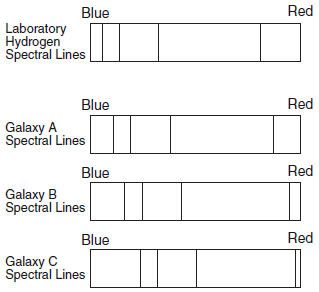
In the diagram below, the spectral lines of hydrogen gas from three galaxies, A, B, and C, are compared to the spectral lines of hydrogen gas observed in a laboratory.
What is the best inference that can be made concerning the movement of galaxies A, B, and C?
Cosmic Microwave Background Radiation
In the 1920s, Edwin Hubble's discovery of a pattern in the red shift of light from galaxies moving away from Earth led to the theory of an expanding universe. This expansion implies that the universe was smaller, denser, and hotter in the past. In the 1940s, scientists predicted that heat (identified as cosmic microwave background radiation) left over from the Big Bang would fill the universe. In the 1960s, satellite probes found that cosmic microwave background radiation fills the universe uniformly in every direction, and indicated a temperature of about 3 kelvins (K). This radiation has been cooling as the universe has been expanding.
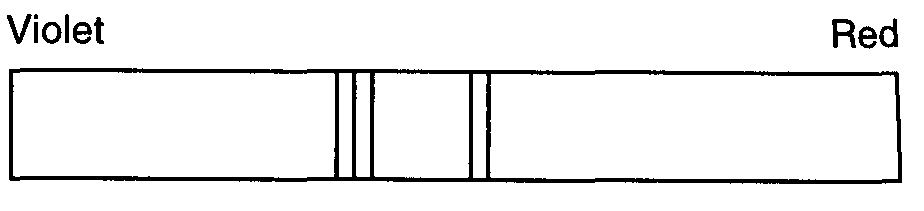
The diagram below represents the spectral lines from the light of an element in a laboratory on Earth.
Which diagram below best represents the pattern of spectral lines from the same element when it was observed by Edwin Hubble in the light of one of the distant galaxies?
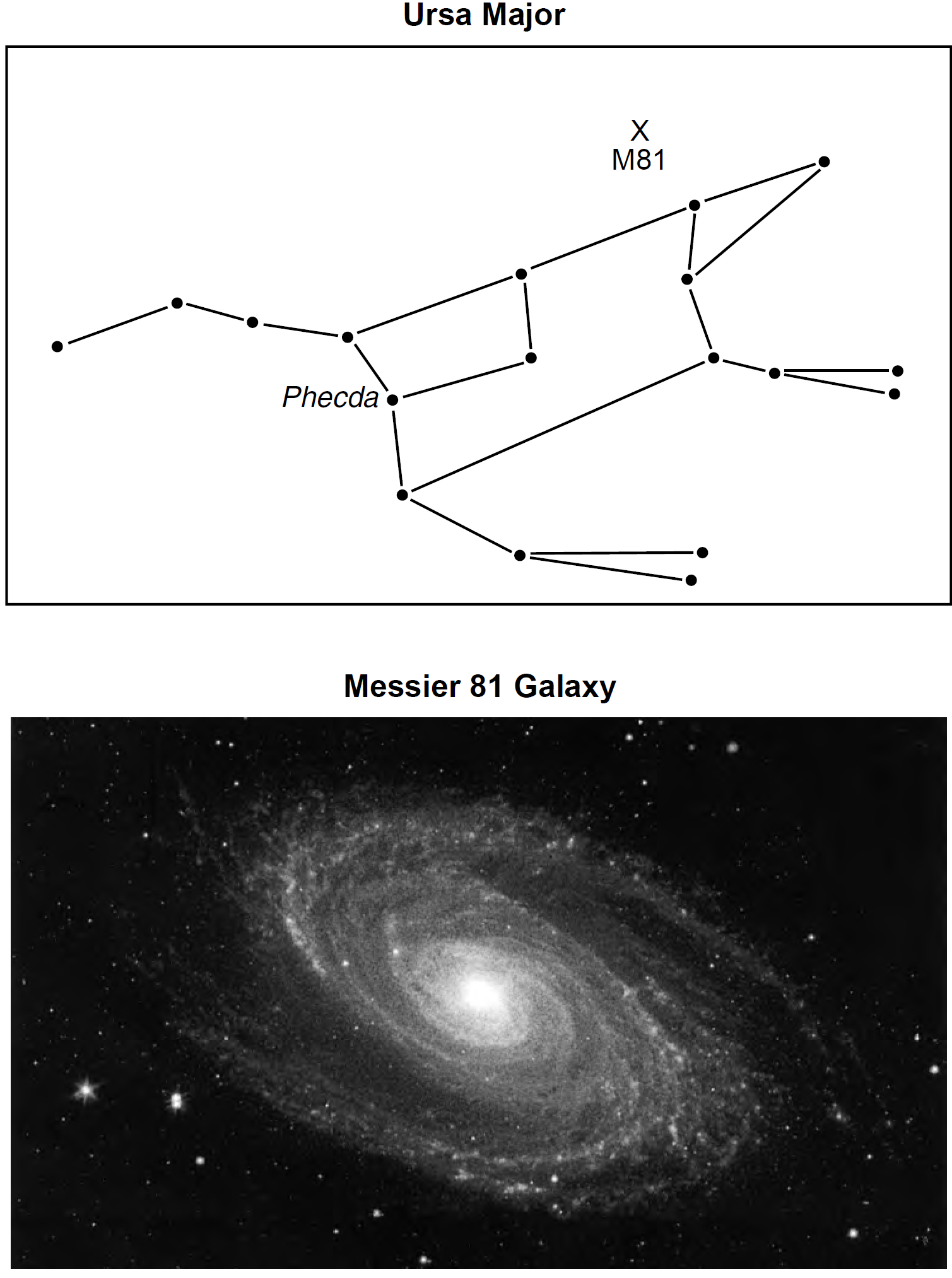
Base your answer on the diagram and photograph below and on your knowledge of Earth science. The diagram represents the constellation Ursa Major. One star, Phecda, has been labeled. Letter X represents the location of the Messier 81 galaxy (M81), which can be observed near Ursa Major. The photograph shows the Messier 81 galaxy as viewed through a telescope.
The study of spectral lines from the Messier 81 galaxy suggests that it is moving toward Earth. Identify the color toward which these spectral lines shift when visible light from the Messier 81 galaxy is observed on Earth.