Log in
Sign up for FREE
arrow_back
Library
Unit 4 Assessment
By Miss Douglas
star
star
star
star
star
Share
share
Last updated over 1 year ago
17 questions
Add this activity
1
1
1
1
1
1
1
Question 1
1.
Select
two
functions that have a
range
of all real numbers.
1
Question 3
3.
Given the roots of a function are x=\frac{3}{5} (multiplicity 2) and x=3i, write the equation of the function in factored form.
1
Question 5
5.
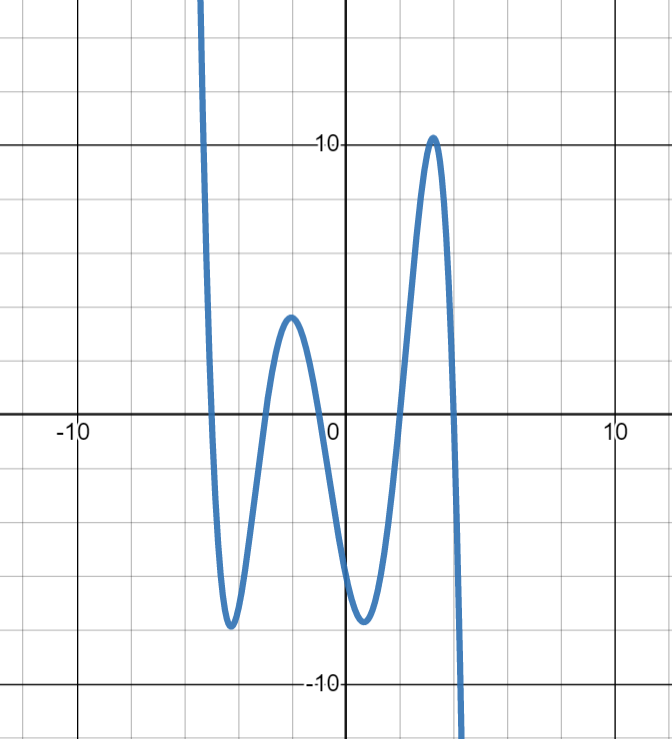
The graph of a function g(x) is shown below.
Select the statement that is
false
.
g(x) has an odd degree
g(x) has 4 turning points
g(x) has no absolute extrema
x\rightarrow\infty,g(x)\rightarrow-\infty
g(x) has a positive leading coefficient
Question 6
6.
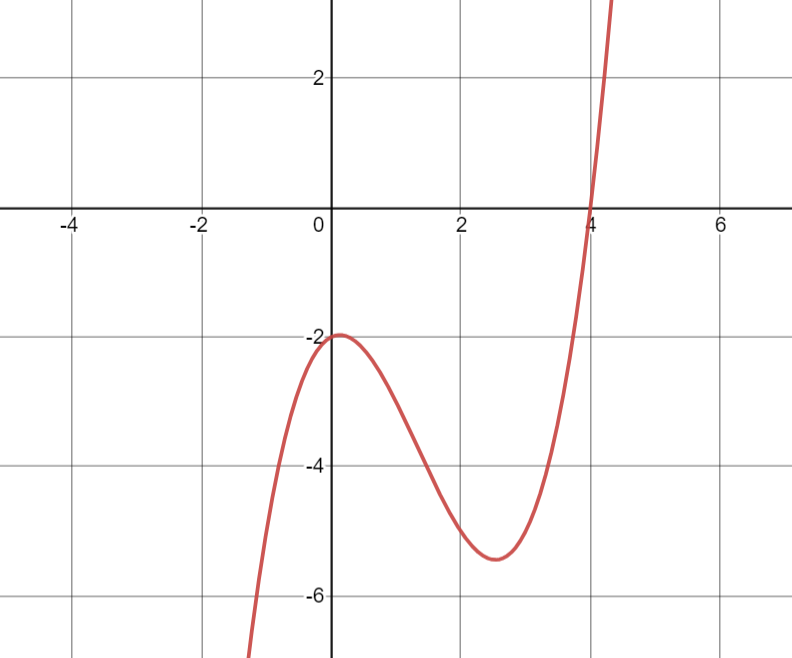
The graph of a function h(x) is shown below.
Select the
statements that are
true
.
h(x) has one real root and two imaginary roots
x\rightarrow-\infty,h(x)\rightarrow-\infty
h(x) has an even degree
h(x) has a positive leading coefficient
h(x)has two real roots and one imaginary root
Question 7
7.
Solve 2x^{3}+5x^{2}+6x+15 by
factoring
.
x=-3i
x=\frac{5}{2}
x=\frac{2}{5}
x=-i\sqrt{3}
x=3
x=-\frac{2}{5}
x=i\sqrt{3}
x=-\frac{5}{2}
x=3i
x=-3
visibility
View drawing
Question 8
8.
Select all factors of 3x^{3}-24 when it is completely factored.
(x+2)
2
(x^{2}-2x+4)
(x^{2}-2x-4)
(x^{2}+2x-4)
(x^{2}+2x+4)
(x-2)
3
8
visibility
View drawing
Question 9
9.
Select
all
factors of 2x^{4}-10x^{2}-72 when it is completely factored.
4
(x^{2}-4)
(x-3)
(x^{2}+4)
(x-9)
2
(x^{2}-9)
(x+9)
(x^{2}+2)
(x+3)
(x+2)
(x-2)
12
visibility
View drawing
10
11
12
13
15
17
16
14
zoom_in
0.5
0.5
0.5
0.5
0.5
0.5
0.5
0.5
Question 2
2.
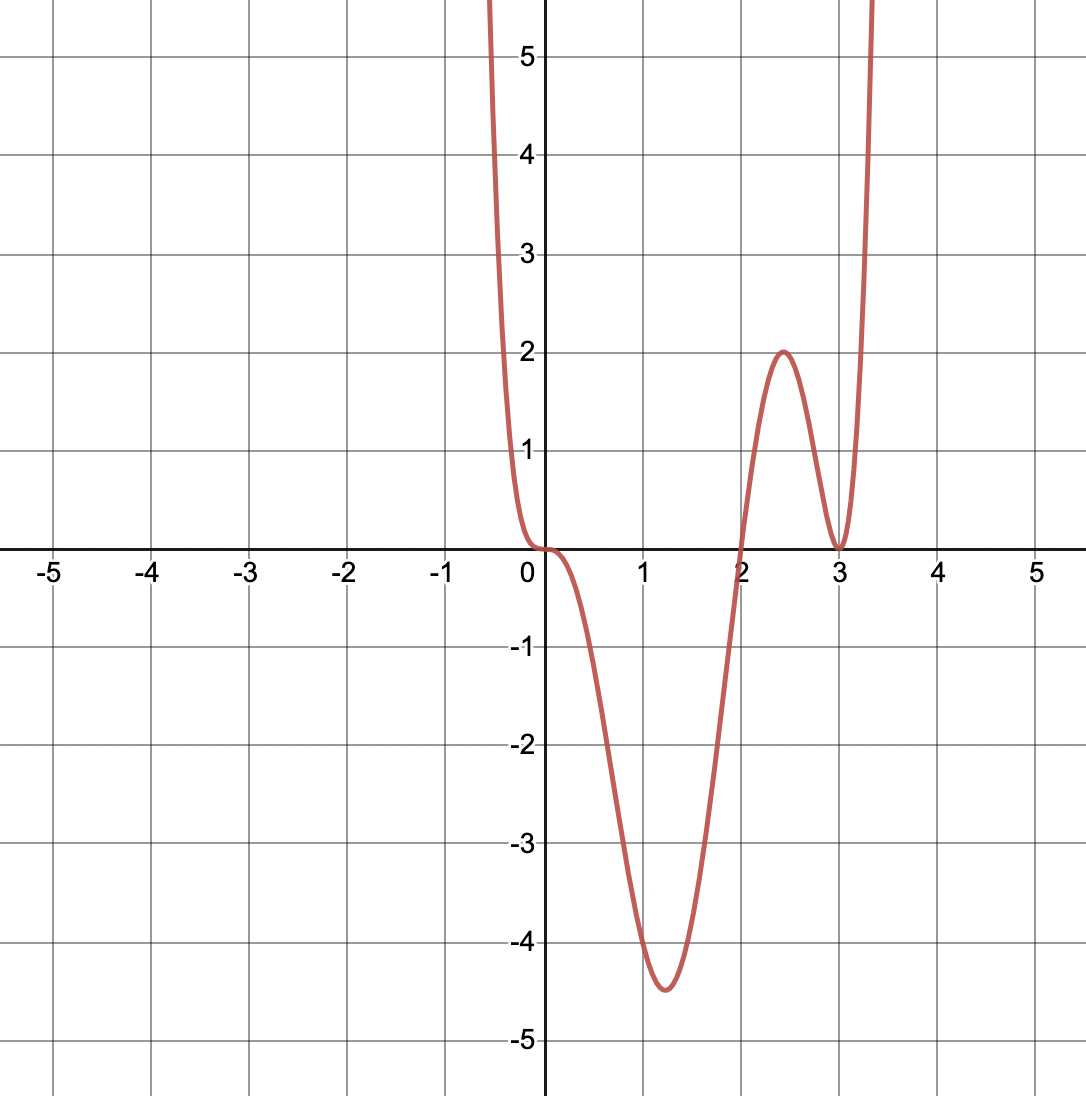
Select the
roots
and
multiplicities
of the function shown in the graph.
x=0 multiplicity 1
x=2 multiplicity 2
x=3 multiplicity 1
x=0 multiplicity 2
x=-2 multiplicity 1
x=2 multiplicity 3
x=-3 multiplicity 2
x=3 multiplicity 3
x=2 multiplicity 1
x=3 multiplicity 2
x=0 multiplicity 3
Question 4
4.
Select the
factors
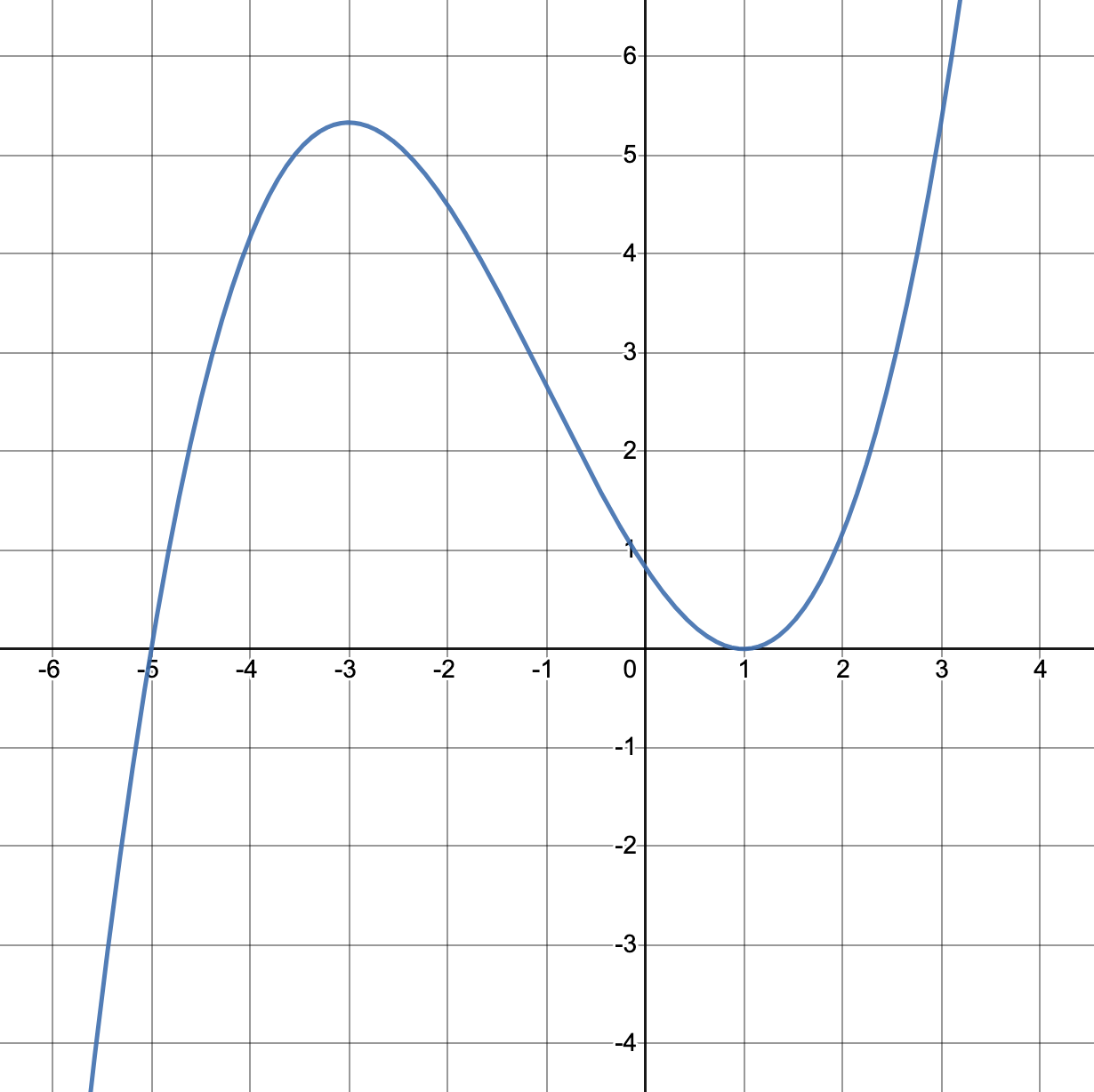
of the function shown in the graph.
(x+1)(x-5)^{2}
(x+1)(x+5)^{2}
(x+5)(x+1)^{2}
(x-5)(x-1)^{2}
(x-1)(x+5)^{2}
(x-1)(x-5)^{2}
(x+5)(x-1)^{2}
(x-5)(x+1)^{2}
Question 10
10.
Decreasing interval(s)
Question 11
11.
Increasing interval(s)
Question 12
12.
x-intercept(s)
(0, 0)
(-4, 0)
(0, -3)
(0, -4)
(5, 0)
(2, 0)
(0, 5)
Question 13
13.
y-intercept(s)
(5, 0)
(0, 0)
(2, 0)
(0, -3)
(-4, 0)
(0, -4)
(0, 5)
Question 14
14.
Absolute maximum(s)
None
(0, -3)
(-2.5, -10)
(-4, 0)
(5, 0)
(2, 0)
(4, -2)
Question 15
15.
Relative maximum(s)
(2, 0)
(0, -3)
(-4, 0)
(4, -2)
(-2.5, -10)
(5, 0)
None
Question 16
16.
Absolute minimum(s)
(5, 0)
(4, -2)
(-2.5, -10)
(-4, 0)
None
(2, 0)
(0, -3)
Question 17
17.
Relative minimum(s)
(-4, 0)
(4, -2)
(0, -3)
(5, 0)
(-2.5, -10)
None
(2, 0)