Log in
Sign up for FREE
arrow_back
Library

Unit 4 Assessment

star
star
star
star
star
Last updated over 1 year ago
17 questions
1
1
1
1
1
1
1
Question 1
1.

Select two functions that have a range of all real numbers.

1
Question 3
3.

Given the roots of a function are x=\frac{3}{5} (multiplicity 2) and x=3i, write the equation of the function in factored form.

1
Question 5
5.

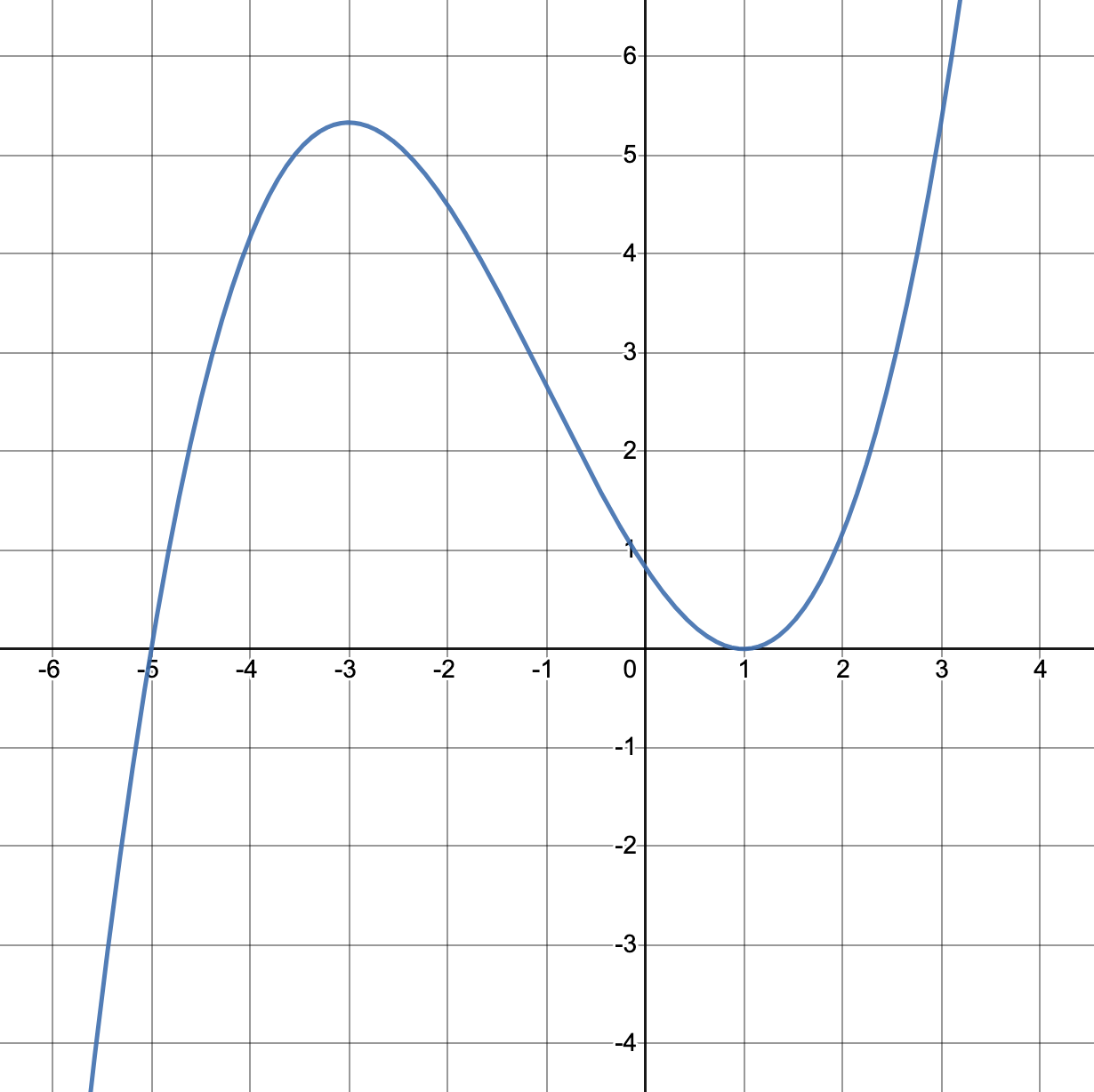
The graph of a function g(x) is shown below.

Select the statement that is false.

Question 6
6.

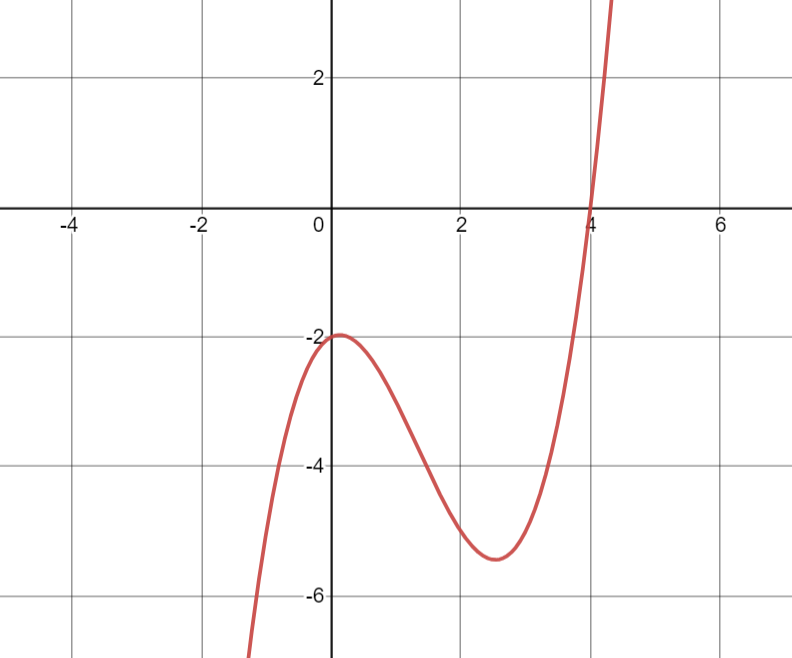
The graph of a function h(x) is shown below.

Select the statements that are true.

Question 7
7.

Question 8
8.

Question 9
9.

0.5
0.5
0.5
0.5
0.5
0.5
0.5
0.5
Question 2
2.

Question 4
4.

g(x) has 4 turning points
g(x) has no absolute extrema
x\rightarrow\infty,g(x)\rightarrow-\infty
g(x) has a positive leading coefficient
h(x) has one real root and two imaginary roots
x\rightarrow-\infty,h(x)\rightarrow-\infty
h(x) has an even degree
h(x) has a positive leading coefficient
h(x)has two real roots and one imaginary root
Solve 2x^{3}+5x^{2}+6x+15 by factoring.
x=-3i
x=\frac{5}{2}
x=\frac{2}{5}
x=-i\sqrt{3}
x=3
x=-\frac{2}{5}
x=i\sqrt{3}
x=-\frac{5}{2}
x=3i
x=-3
Select all factors of 3x^{3}-24 when it is completely factored.
(x+2)
2
(x^{2}-2x+4)
(x^{2}-2x-4)
(x^{2}+2x-4)
(x^{2}+2x+4)
(x-2)
3
8
Select all factors of 2x^{4}-10x^{2}-72 when it is completely factored.
4
(x^{2}-4)
(x-3)
(x^{2}+4)
(x-9)
2
(x^{2}-9)
(x+9)
(x^{2}+2)
(x+3)
(x+2)
(x-2)
12
Question 10
10.

Question 11
11.

Question 12
12.

Question 13
13.

Question 14
14.

Question 15
15.

Question 16
16.

Question 17
17.

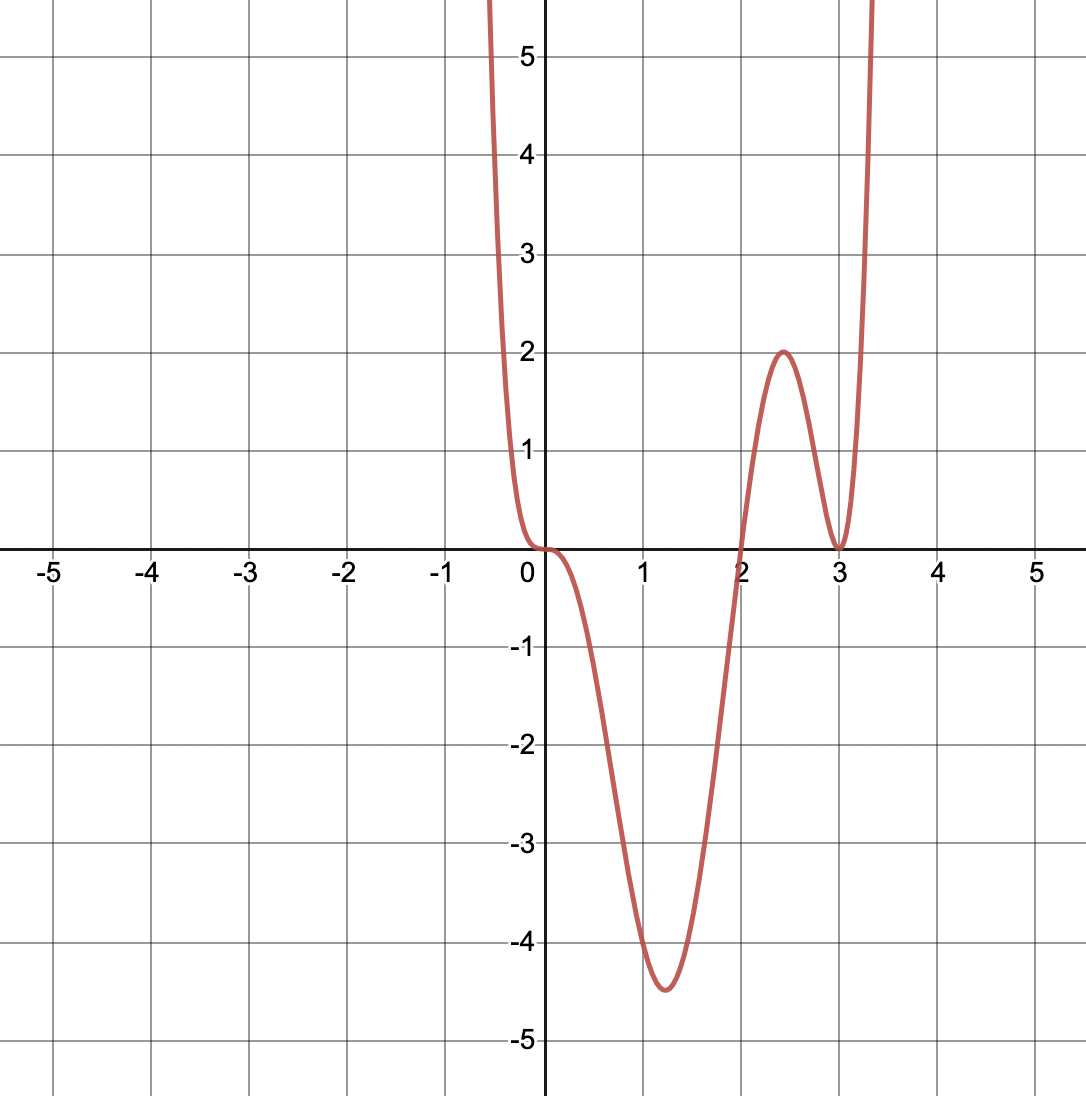
Select the roots and multiplicities of the function shown in the graph.
x=0 multiplicity 1
x=2 multiplicity 2
x=3 multiplicity 1
x=0 multiplicity 2
x=-2 multiplicity 1
x=2 multiplicity 3
x=-3 multiplicity 2
x=3 multiplicity 3
x=2 multiplicity 1
x=3 multiplicity 2
x=0 multiplicity 3
Select the factors of the function shown in the graph.
(x+1)(x-5)^{2}
(x+1)(x+5)^{2}
(x+5)(x+1)^{2}
(x-5)(x-1)^{2}
(x-1)(x+5)^{2}
(x-1)(x-5)^{2}
(x+5)(x-1)^{2}
(x-5)(x+1)^{2}
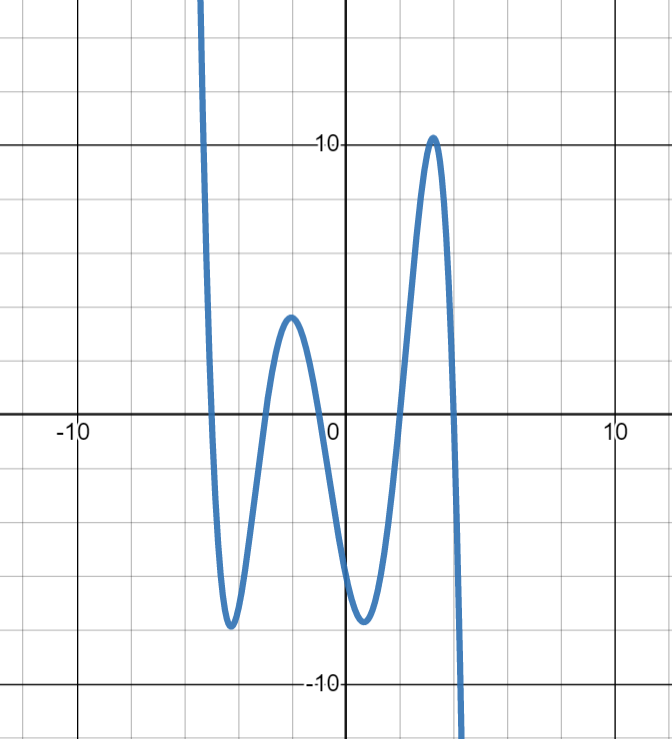
Decreasing interval(s)
Increasing interval(s)
x-intercept(s)
(0, 0)
(-4, 0)
(0, -3)
(0, -4)
(5, 0)
(2, 0)
(0, 5)
y-intercept(s)
(5, 0)
(0, 0)
(2, 0)
(0, -3)
(-4, 0)
(0, -4)
(0, 5)
Absolute maximum(s)
None
(0, -3)
(-2.5, -10)
(-4, 0)
(5, 0)
(2, 0)
(4, -2)
Relative maximum(s)
(2, 0)
(0, -3)
(-4, 0)
(4, -2)
(-2.5, -10)
(5, 0)
None
Absolute minimum(s)
(5, 0)
(4, -2)
(-2.5, -10)
(-4, 0)
None
(2, 0)
(0, -3)
Relative minimum(s)
(-4, 0)
(4, -2)
(0, -3)
(5, 0)
(-2.5, -10)
None
(2, 0)