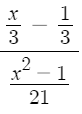
Don't forget (1) this is essentially a division problem, so you rewrite like that first. (2) Manage the addition of the numerator. (3) Flip the 2nd term. (4) FACTOR EACH TERM TOP AND BOTTOM (INCLUDING the GCFs...and don't forget about them, they stay with the term!!!)
1 point
1
Question 2
2.
The following describes the transformation to a reciprocal parent function:
Translated 3 units left and 9 units up. Reflected in the x-axis.
Write the equation to represent the new function (use f(x) in your answer)
1 point
1
Question 3
3.
The following describes the transformation to a reciprocal parent function:
Translated 2 units right and vertically stretched by a factor of 2
Write the equation to represent the new function (use f(x) in your answer)
1 point
1
Question 4
4.
The following describes the transformation to a reciprocal parent function:
Translated 1 unit left & 4 units down; reflected in the x-axis; and vertically stretched by a factor of 2.
Write the equation to represent the new function (use f(x) in your answer)
1 point
1
Question 5
5.
The following describes the asymptotes of a reciprocal parent function:
VA: x = 0, and HA: y = 6
Write an equation to represent the new function (use f(x) in your answer)
1 point
1
Question 6
6.
Graph the function on your whiteboard (or below):
Be sure to include asymptotes as dashed lines and find the x-intercept by solving for x by substituting a zero in for y as shown below: (the value of x will be where the graph hits the x-axis)...USE: