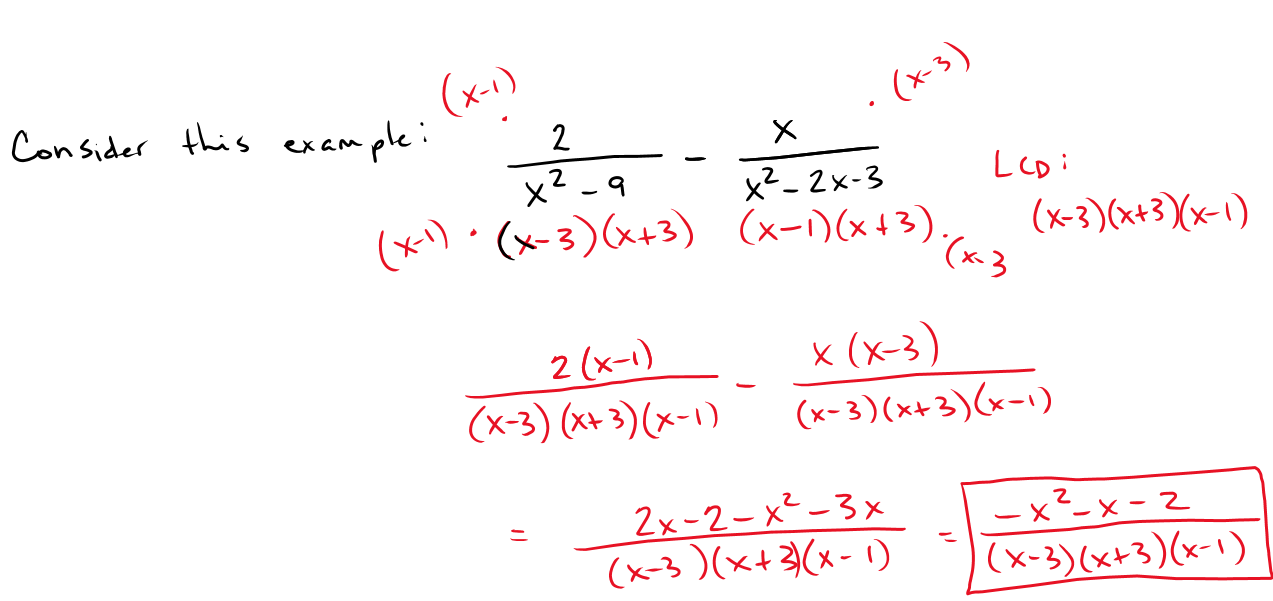
Here's an example to consider when completing number 5 below:
Simplify:
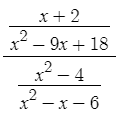
Find the quotient:
Give your answer in simplest form.
Find the sum:
Give your answer in simplest form.
Find the product:
Give your answer in simplest form.
Here's an example to consider when completing number 5 below:
Find the difference:
(be sure to put your answer in standard form with the highest degree in front in the numerator)
Simplify:

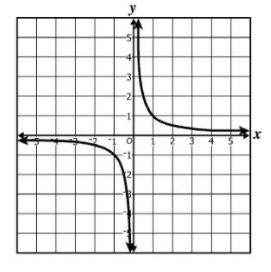
Given the function, the domain is:
(use set notation)
Given the function, the range is:
(use set notation)

The vertical asymptote of this function is:
The horizontal asymptote of this function is:
Which function below belongs in the same family of functions (has the same parent function) as the given graph?
Find the zero of the function:
(if your answer is a fraction, input the fraction NOT the decimal)
HINT!!!...set y = 0 then solve for x...note this does NOT follow the rules for rational functions
(this is NOT p(x)/q(x)) since there's an extra -2 at the back of the equation...just sub a 0 in for y and solve for x here to find the zero.

Given the function, what is the end behavior?
Given the function, what is the end behavior?
Identify the types of asymptotes for each of the equations below:
(grab the pretty circle on the right and move it to the correct answer...use your laws for asymptotes for rational functions)
| Draggable item | arrow_right_alt | Corresponding Item |
|---|---|---|
| arrow_right_alt | No Asymptotes | |
| arrow_right_alt | Both Horizontal and Vertical Asymptotes | |
| arrow_right_alt | A Horizontal Asymptote but not a Vertical |
Solve:
input your answer using set notation
Solve:
input your answer using set notation, low to high
(use 'd' for days and 'n' for number of construction workers)
Wind chill factor (W) varies directly with temperature (T) and inversely with the wind velocity (v). If k is the constant of proportionality, write an equation to represent this relationship:
Suppose c varies directly with a. When c = 20, a = 2. What is the value of c when a = 4?
Suppose y varies jointly with x and z. When y = 50, x = 2, and z = 1.5. What is the value of x when y = 35 and z = 4?
input your answer as a simplified fraction
What type of variation is shown the following equation? (direct, joint or inverse)
What type of variation is shown the following equation? (direct, joint or inverse)
upload your pages of work here--page 1
upload your pages of work here--page 2
upload your pages of work here--page 3
upload your pages of work here--page 4
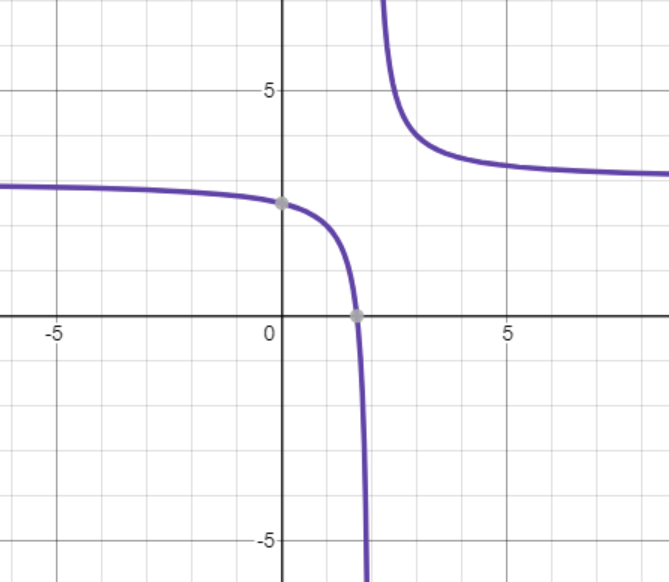
The graph at the left can be modeled by the equation:
(go to show your work and create your asymptotes if necessary)
h=?
The graph at the left can be modeled by the equation:
k=?
The graph at the left can be modeled by the equation:
The function shifted horizontially:
The graph at the left can be modeled by the equation:
The function shifted vertically:
The graph at the left can be modeled by the equation:
The domain of the function is: (use set notation)
The graph at the left can be modeled by the equation:
The range of the function is: (use set notation)
The graph at the left can be modeled by the equation:
The end behavior of this function is:
The graph at the left can be modeled by the equation:
The end behavior of this function is:
This function has the following discontinuity: (check all that apply)