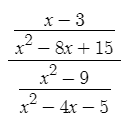
Simplify:
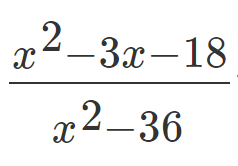
Simplify:
Solve:
input your answer using set notation
Simplify:
What is the quotient of:
What is the sum:
Simplify:
(give your answer as completely factored)
Find the difference:
(be sure to put your answer in standard form with the highest degree in front in the numerator)
Find the quotient:
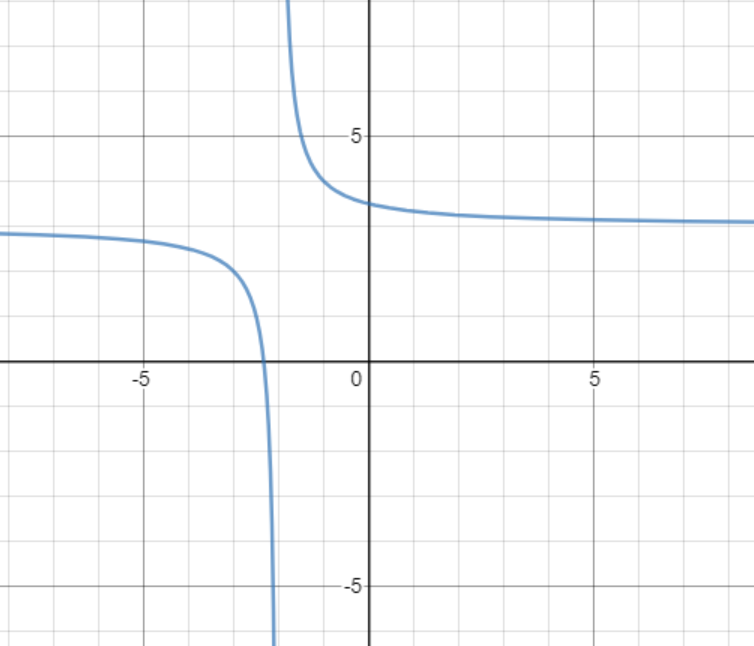
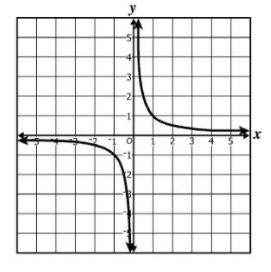
The graph to the left can be modeled by the equation:
h=
The graph to the left can be modeled by the equation:
k=
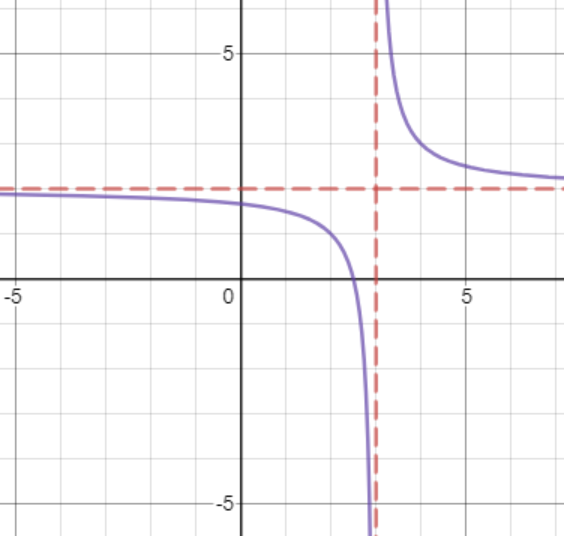
given the graph, the domain is:
(use set notation)
given the graph, the range is:
(use set notation)
given the graph, the end behavior will be
(just enter the answer)
given the graph, the end behavior will be
(just enter the answer)

The domain for this function will be:
(give set notation)
The range for this function will be:
(give set notation)

The vertical asymptote for this function is:
(if none, write none)
The horizontal asymptote for this function is:
(if none, write none)
Which function below belongs in the same family of functions (has the same parent function) as the given graph?
What is the zero of this function:
Solve:
input your answer using set notation
Identify the types of asymptotes for each of the equations below:
| Draggable item | arrow_right_alt | Corresponding Item |
|---|---|---|
| arrow_right_alt | No Asymptotes | |
| arrow_right_alt | Both Horizontal and Vertical Asymptotes | |
| arrow_right_alt | A Horizontal Asymptote but not a Vertical |
What type of variation is shown in the following equation? (type: direct, inverse, or joint in the answer box)
If c varies jointly with b and a and c = 25 when b = 2.5, and a = 2 find a when c = 40 and b = 6.
(enter your answer as a fraction or rounded to the tenths place)
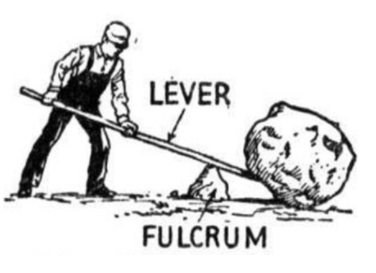
A lever pivots on a support called a fulcrum. (as shown in the picture)
For a balanced lever, the distance d (in feet) an object is from the fulcrum varies inversely with the object's weight w (in pounds). An object weighing 140 pounds is placed 6 feet from a fulcrum. How far from the fulcrum must a 112 pound object be place to balance the lever?
(round your answer to the nearest tenths place, enter the number only (no units))
"The volume (V) of gas varies directly as the temperature (T) and inversely as the pressure (P)." Which of the following represent the correct formula that represents this relationship?
The graph to the left can be modeled by the equation:
The function shifted horizontially to the
The graph to the left can be modeled by the equation:
The function shifted vertically
This function has the following discontinuity: (check all that apply)
The end behavior of this function is:
The end behavior of this function is: