1
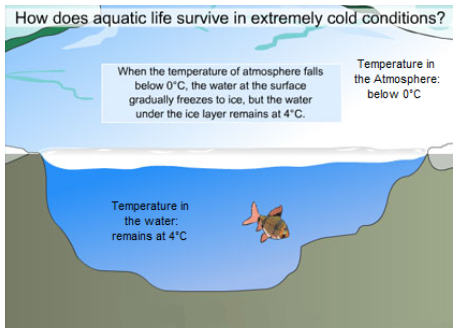
According to the picture, how cold is the air temperature?
According to the picture, how cold is the air temperature?
1
1
1
Review: A student has two solutions "M" and "P," and they want to determine which one is water. They add drops to a penny and find that solution "M" can fit 38 drops on the penny, but solution "P" can only fit 6 drops on the penny. They conclude that solution "M" is water. Are they correct?
Review: A student has two solutions "Z" and "X." They want to determine which one is water. They add a small amount of salt to the solutions and stir. They find that in solution "X" the salt dissolves completely, but in solution "Z" they can still see the salt in the water. They conclude that solution "X" is water. Are they right?
Review: Which term refers to water having partial positive and partial negative charge?
Ability to moderate temperature
Temperature moderation refers to water’s ability to maintain a fairly consistent temperature. Water molecules are attracted to one another by hydrogen bonds and this limits the movement of the molecules. This strong attraction between water molecules means that a large amount of energy is required to increase or decrease the temperature of water. Large bodies of water are slow to change temperature (such as lakes and oceans) which is good for the organisms living in them.
Heat capacity is related to a substance's ability to retain heat and the rate at which it will heat up or cool down. For example, a substance with a low heat capacity, such as iron, will heat and cool quickly, while a substance with a high heat capacity, such as water, heats and cools slowly.
Based on the reading, what type of bond forms between water molecules?
According to the picture, how cold is the air temperature?
Also, due to their high water content, the bodies of organisms are also slow to change temperature and this makes maintaining a stable body temperature easier. While temperature moderation refers to the difficulty or ease of raising or lowering the temperature, temperature variation refers to the difference between the highest and lowest temperature of a liquid during a given time frame.
An experiment using 4 different liquids was conducted to see the difference in temperature variation. The four liquids were exposed to heat for 5 minutes. After 5 minutes, the liquids were removed from the heat and cooled for 10 minutes. The temperature of each liquid was recorded every minute for 10 minutes and any variation in temperature was observed. The bar graph below shows the temperature variation in the four unknown liquid samples over a period of 10 minutes.
Which of the following statements best describes how water affects temperature?
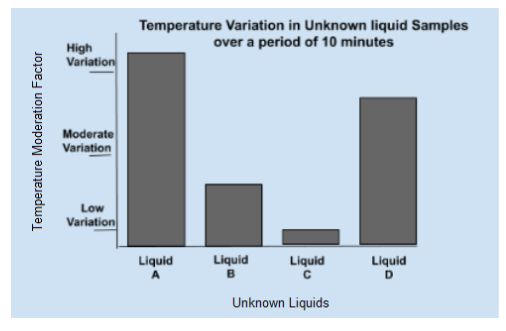
Which two liquids showed HIGH temperature variation
Expansion upon freezing
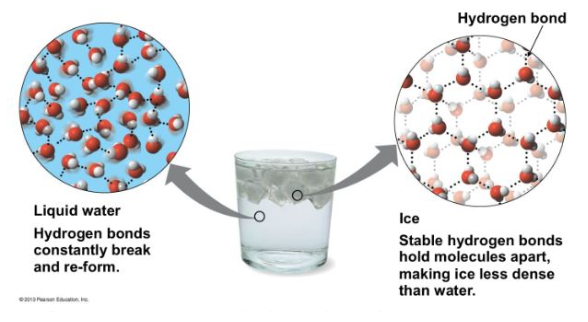
Water molecules (H2O) are made of two hydrogen and one oxygen atoms held together by covalent bonds. When water molecules bond together, hydrogen bonds connect one molecule to the next. When water freezes into a solid (ice), it forms a geometric pattern that spaces the molecules further apart than in a liquid state which takes up more space (i.e. expansion). Because of this expansion, solid water becomes less dense than liquid water and will FLOAT on its surface. This property of water allows the top layer of frozen lakes to act as an insulator. It keeps the water underneath slightly warmer than freezing, protecting the aquatic life below.
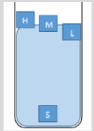
A student has 4 cubes of frozen liquid and they want to determine which one is ice (frozen water). They decide to test the density by placing them in solution. Which frozen liquid is water?
Why does ice stay at the top of oceans instead of sinking to the bottom?
During the winter months, the temperature in the northern states decreases causing lakes to freeze. How do aquatic animals survive in frozen lakes?
Based on the reading, is the following statement TRUE or FALSE?
"Water is slow to change in temperature"
Based on the reading, is the following statement TRUE or FALSE? "Water has a high specific heat capacity"
According to the picture, how cold is the water temperature?
Where is it warmer in the picture?
How does the layer of ice at the surface affect the water and the fish below the surface?
Which liquid showed the least amount of temperature variation?
Based on the above answers, which liquid is most likely water?