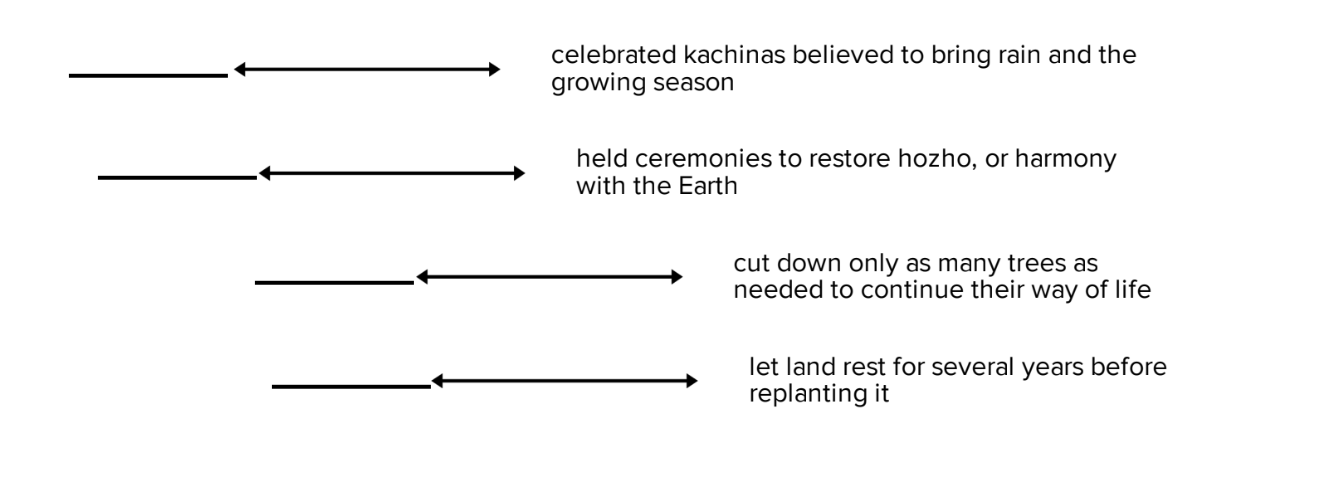
Match each custom with the Native American group associated with the custom.
Mmuae Afoforo a Wobɛpaw:
Eastern Woodlands peoples
Hopi
Navajo
Pacific Northwest peoples
Which statement best explains why a land bridge formed between Asia and the Americas?
PART A
Which of these practices by the Hohokam best shows how they adapted to the climate in the Southwest?
PART B
Which evidence from the text best supports the correct response to Part A above?
PART A
After the Spanish settlers came, how did the Navajo get most of the meat they ate?
PART B
“The Navajo were originally hunter-gatherers but quickly adopted new techniques for surviving in the desert. In addition to learning farming from the Pueblo, the Navajo also learned from Spanish settlers when they arrived in the 1500s. They were interested in the animals the Spanish brought with them. The Navajo soon became skilled at herding sheep and cattle, as well as at riding horses.”
Which sentence best supports the correct response to Part A above?
Which sentence best supports the conclusion that early Europeans in the Pacific Northwest thought highly of Chief Seattle?
“Explorers from Spain brought horses to the Americas, and some of the horses escaped. After about one hundred years, the horses had traveled up to the Great Plains. There the Lakota caught and tamed them. After another hundred years, most Native Americans on the Plains were using horses to help them hunt buffalo and move their camps.
The introduction of horses completely changed the way of life for the Plains people. Before they had horses, Plains people followed the buffalo on foot. They trained dogs to pull belongings on a special sled called a hupak’in. After the introduction of horses, a person’s wealth was measured by the number of horses owned.”
Besides using them to hunt buffalo, in what other important way did Plains peoples most clearly use horses?
Which two statements contain details that help to explain WHY Eastern Woodlands peoples wore the clothing they did?
“If a nation, part of a nation, or more than one nation within the Five Nations should in any way endeavor to destroy the Great Peace by neglect or violating its laws and resolve to dissolve the Confederacy, such a nation or such nations shall be deemed guilty of treason and called enemies of the Great Peace.”
What is the meaning of the term endeavor?
Match each custom with the Native American group associated with the custom.
Using details from the text, summarize the Hopi’s methods for growing crops and the reason they had to grow crops this way.
Using details from the text, summarize the role women played in Iroquois society.
How did the natural environment impact the way Native Americans lived? Use evidence from the text to support your response with examples.