Log in
Sign up for FREE
arrow_back
Library

Science Interim 1 2022-2023

star
star
star
star
star
Last updated over 3 years ago
30 questions
1
1
1
1
1
1
1
1
1
1
1
1
1
1
1
1
1
1
1
1
1
1
1
1
1
1
1
1
1
1
Question 26
26.

Question 27
27.

Question 28
28.

Question 29
29.

Question 30
30.

Question 1
1.

Question 2
2.

Question 3
3.

Question 4
4.

Question 5
5.

Question 6
6.

Question 7
7.

Question 8
8.

Question 9
9.

Question 10
10.

Question 11
11.

Question 12
12.

Question 13
13.

Question 14
14.

Question 15
15.

Question 16
16.

Question 17
17.

Question 18
18.

Question 19
19.

Question 20
20.

Question 21
21.

Question 22
22.

Question 23
23.

Question 24
24.

Question 25
25.

Different beak shpaes in different birds most likely mean the birds:
A. build different kinds of nests.
B. migrate at different times of the year.
C. produce different numbers of eggs.
D. eat different kinds of food.
Which statement best supports the claim that certain plants survive better and produce more offspring in a desert than in a forest?
A. Some types of plants are found in deserts but not in forests.
B. Some types of plants are found in both deserts and forests.
C. Some types of plants are never found in deserts or forests.
D. Some types of plants change their features as they grow so they can live in deserts or forests.
During hibernation, an animal is not active for a long period of time. As an animal hibernates, its heart rate and body temperature both decrease. Bears are one animal that hibernates. Hibernation is an adaptation because:
A. each bear chooses if it wants to hibernate or not.
B. each bear that hibernates can live in different types of forests.
C. in a group of bears living in the same area, the bears that hibernate are less able to survive and produce less offspring than the bears that do not hibernate.
D. in a group of bears living in the same area, the bears that hibernate are better able to survive and produce more offspring than the bears that do not hibernate.
Scientists have evidence from fossils that early horses had 3 toes. Horses today have 1 toe. Which of these claims can be best supported by this evidence?
A. More horses with 3 toes survived to produce more offspring than horses with 1 toe.
B. More horses with 1 toe survived to produce more offspring than horses with 3 toes.
C. Horses with 3 toes required more food than horses with 1 toe, so fewer survived to produce offspring.
D. Horses with 1 toe required more food than horses with 3 toes, so fewer survived to produce offspring.
Which word best describes a single feature an animal has that helps it to survive in its surroundings?
A. biome
B. niche
C. adaptation
D. selection
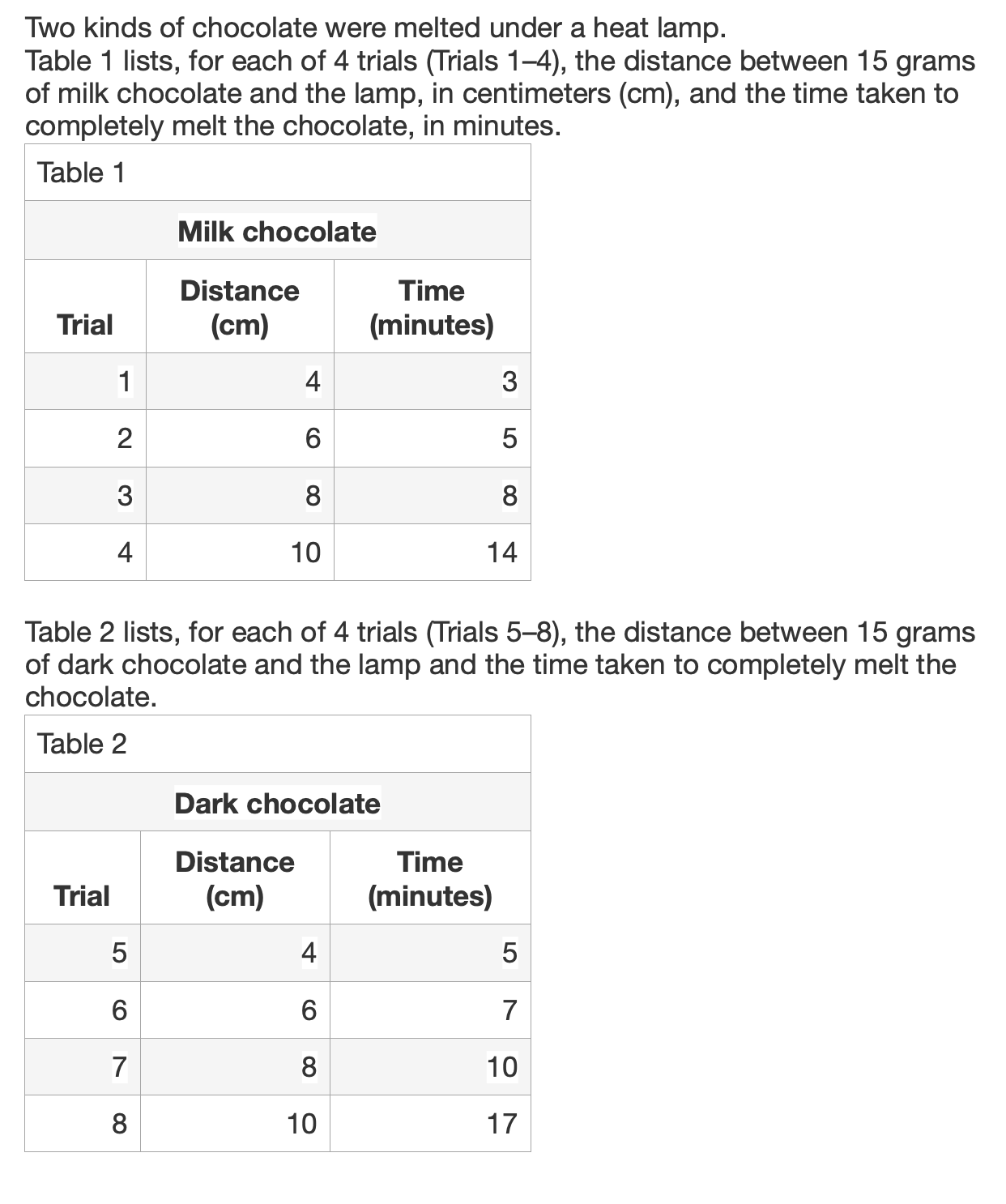
Look at Table 2. The dark chocolate took 7 minutes to completely melt in which trial?
Trial 5
Trial 6
Trial 7
Trial 8
Look at Table 1. The milk chocolate took 14 minutes to completely melt when the distance between the chocolate and the lamp was:
6 cm.
8 cm.
10 cm.
14 cm.
Which of these things was kept the same in Trials 1–8 ?
The distance between the chocolate and the lamp
The kind of chocolate that was melted
The mass of chocolate that was melted
The time taken to completely melt the chocolate
Look at Table 1 and Table 2. The kind of chocolate that completely melted in the least amount of time was the:
dark chocolate that was 4 cm from the lamp.
dark chocolate that was 10 cm from the lamp.
milk chocolate that was 4 cm from the lamp.
milk chocolate that was 10 cm from the lamp.
Look at Table 1 and Table 2. The milk chocolate that was 6 cm from the lamp took the same amount of time to completely melt as the:
dark chocolate that was 4 cm from the lamp.
dark chocolate that was 8 cm from the lamp.
milk chocolate that was 4 cm from the lamp.
milk chocolate that was 8 cm from the lamp.
Suppose 15 grams of the dark chocolate had been placed 12 cm from the lamp. Look at Table 2. The time taken to completely melt the dark chocolate would most likely have been:
less than 7 minutes.
between 7 minutes and 10 minutes.
between 10 minutes and 17 minutes.
greater than 17 minutes.
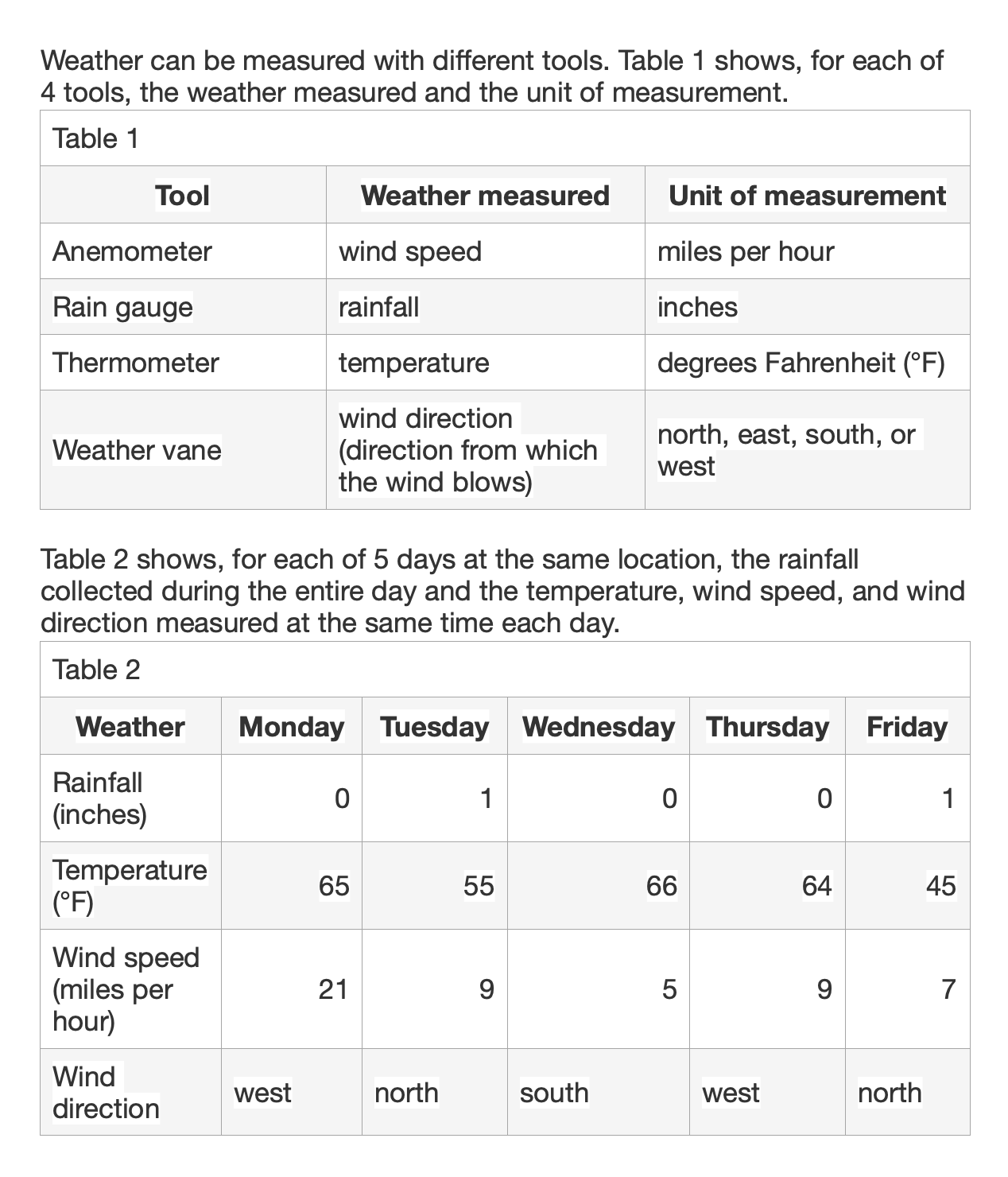
Look at Table 2. On which day did the wind blow from the south?
Monday
Tuesday
Wednesday
Thursday
Look at Table 2. What is the correct order of the days from lowest to highest temperature?
Tuesday, Thursday, Monday, Wednesday, Friday
Tuesday, Monday, Wednesday, Thursday, Friday
Friday, Thursday, Monday, Tuesday, Wednesday
Friday, Tuesday, Thursday, Monday, Wednesday
Look at Table 2. What was the total amount of rainfall measured, if any, for all 5 days?
0 inches
1 inch
2 inches
3 inches
Which of these correctly matches a tool with its unit of measurement?
Anemometer and °F
Anemometer and inches
Rain gauge and °F
Rain gauge and inches
The arrow on a weather vane points in the direction from which the wind blows.

When the wind was measured on Friday,  in what direction did the arrow most likely point?
North
East
South
West
A student claimed that days with temperatures less than 50°F will have winds that blow from the north. Do the measurements in Table 2 support the student’s claim?
Yes; Friday had a temperature less than 50°F and wind that blew from the north.
Yes; Friday had a temperature less than 50°F and wind that blew from the south.
No; Friday had a temperature less than 50°F and wind that blew from the north.
No; Friday had a temperature less than 50°F and wind that blew from the south.
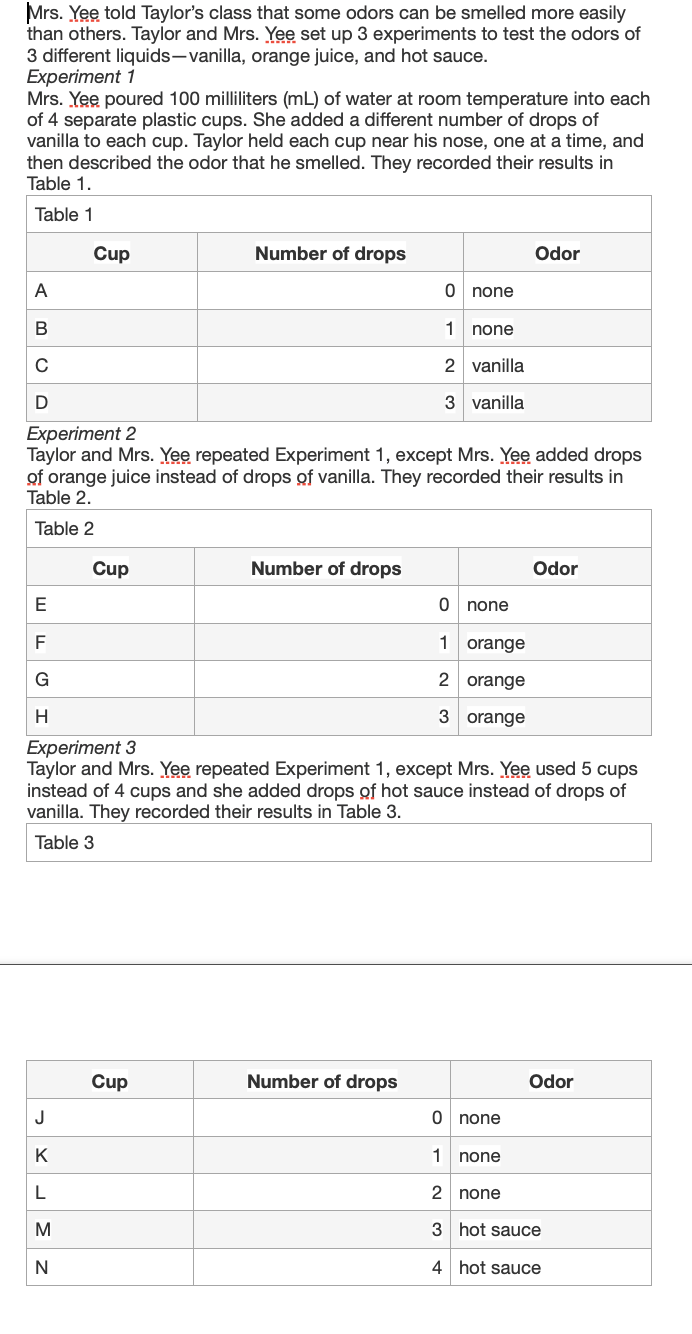
Look at Table 2. What was the smallest number of drops needed for Taylor to smell the orange juice?
0
1
2
3
Which of these scientific tools was most likely used to add the hot sauce to the cups in Experiment 3 ?
Dropper
Ruler
Scissors
Stopwatch
Which of these things did Mrs. Yee change in each experiment?
The liquid being tested
The person smelling the liquid
What the cups were made of
What volume of water was in the cups
What total volume of water did Mrs. Yee use in Experiment 1 ?
100 mL
200 mL
300 mL
400 mL
A student claimed that more drops of vanilla than of orange juice would be needed for Taylor to smell each liquid. Which experiments tested this claim?
Experiments 1 and 2 only
Experiments 1 and 3 only
Experiments 2 and 3 only
Experiments 1, 2, and 3
Suppose that in Experiment 3, Mrs. Yee had added 5 drops of hot sauce to a cup holding 100 mL of water. Would Taylor most likely have smelled the hot sauce in this cup?
Yes; Taylor smelled the hot sauce in Cup L.
Yes; Taylor smelled the hot sauce in Cup N.
No; Taylor did not smell the hot sauce in Cup J.
No; Taylor did not smell the hot sauce in Cup K.
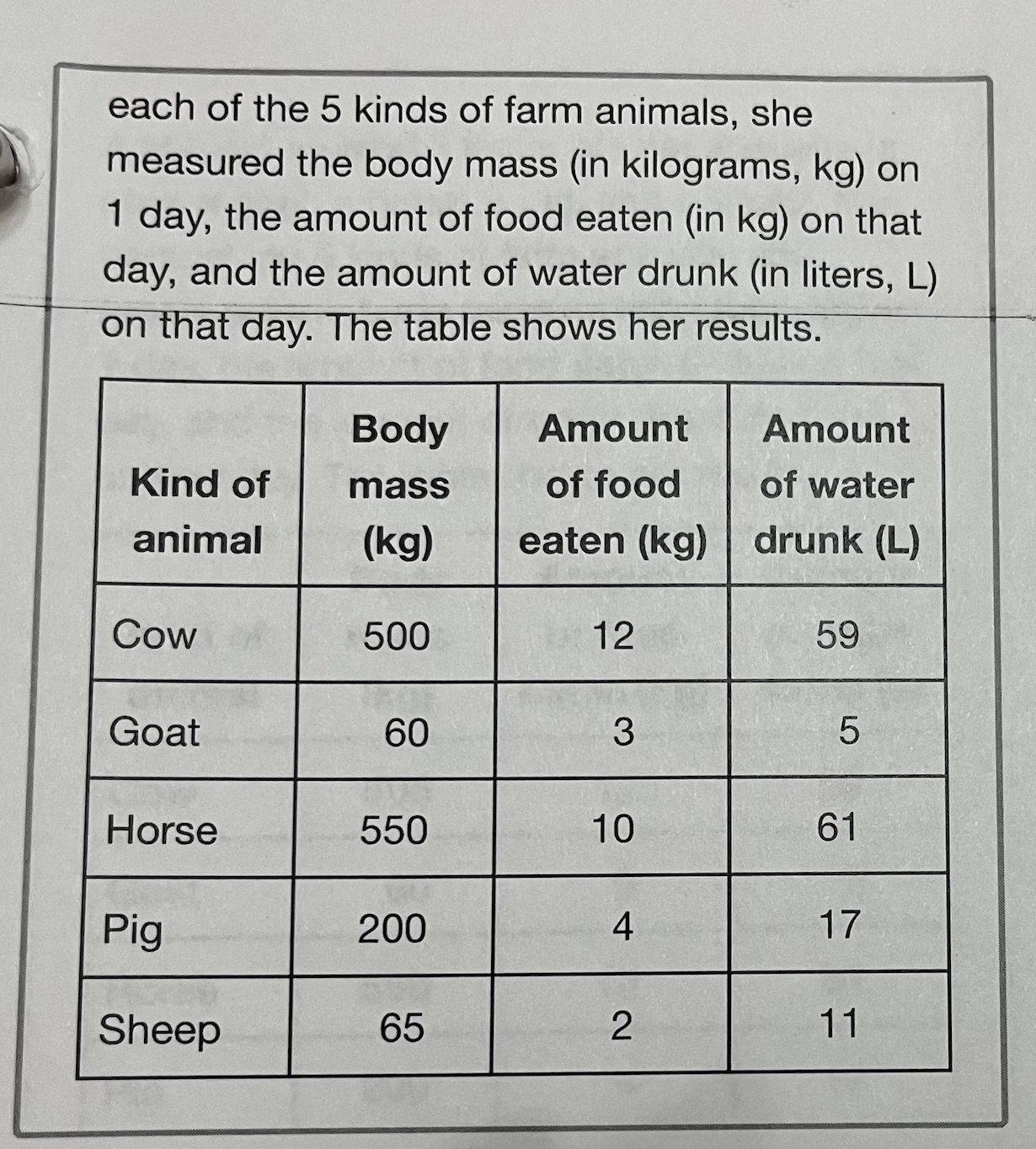
The body mass of the sheep was closest in value to the body mass of which kind of animal?
A. cow
B. goat
C. horse
D. pig
Which of these questions can be answered using the results shown in the table?
A. How much milk did the cow produce?
B. How much wool did the sheep produce?
C. What amount of food did the chicken eat?
D. What amount of water did the goat drink?
How many total kilograms of food would the sheep most likely eat in 7 days?
A. 2 kg
B. 4 kg
C. 10 kg
D. 14 kg
As the body mass of the kind of animal increased, the amount of water drunk:
A. increased only
B. decreased only
C. increased and then decreased
D. decreased and then increased
What kind of animal ate 10 kg of food?
A. cow
B. goat
C. horse
D. sheep
Suppose a student has a 10 L container to measure water. He should fill the container hall full to get the exact amount of water drunk by which kind of animal?
A. goat
B. horse
C. pig
D. sheep
What amount of water did the pig drink?
A. 5 L
B. 11 L
C. 17 L
D. 61 L