Mountains and Precipitation
We now know that weather (like rain, wind, hail, snow, ect) all occur in the troposphere - how does this tie into plate tectonics from yesterday? When mountains are created at convergent boundaries, these mountains affect what happens in the troposphere - therefore affect the weather!
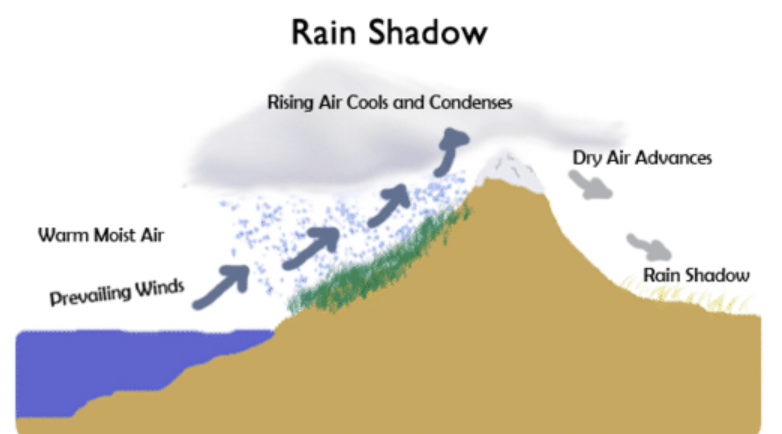
Mountains can affect precipitation. Mountains and mountain ranges can cast a rain shadow. As winds rise up the windward side of a mountain range, the air cools and precipitation falls. On the other side of the range, the air is dry, and it sinks. So there is very little precipitation on that side of a mountain range.
How are the tectonic plates and atmosphere related to on another?
Mountains and Precipitation
We now know that weather (like rain, wind, hail, snow, ect) all occur in the troposphere - how does this tie into plate tectonics from yesterday? When mountains are created at convergent boundaries, these mountains affect what happens in the troposphere - therefore affect the weather!
Mountains can affect precipitation. Mountains and mountain ranges can cast a rain shadow. As winds rise up the windward side of a mountain range, the air cools and precipitation falls. On the other side of the range, the air is dry, and it sinks. So there is very little precipitation on that side of a mountain range.
How are the tectonic plates and atmosphere related to on another?