Log in
Sign up for FREE
arrow_back
Library

11/9 Global Wind Patterns 4.5

star
star
star
star
star
Last updated 12 months ago
17 questions
1
1
1
1
1
1
1
1
1
1
1
1
1
1
1
1
1
Read the section below and answer questions 1-11

An air mass is a body of air that is characterized by a particular temperature and humidity. Air masses usually cover hundreds of thousands of square miles and have temperatures and humidities similar to the area where they originate. Polar air masses are those originating between the Arctic Circle and the North Pole or between the Antarctic Circle and the South Pole; they are characteristically cold. Tropical air masses are those originating between the Tropic of Cancer and the Tropic of Capricorn; they are warm air masses. Maritime air masses form over the ocean; they are very moist. Continental air masses, as their name implies, form over land; they often to contain less moisture than maritime air masses.

As air molecules are heated, they gain energy and move apart from one another, increasing the volume of the air mass and decreasing its density. As its density decreases, the air mass rises. When air molecules cool, they move closer together, increasing in density, and the air mass sinks. When the air in the atmosphere cools and becomes dense, it sinks toward a source of heat, becomes warmer and less dense, then rises and moves away from the heat source, in a circular motion – this is called a convection current. Remember, it is the differing density of air masses (due to temperature) that leads to convection currents in the atmosphere.
Question 1
1.

Question 2
2.

Question 3
3.

Question 4
4.

Activity 1: Convection
1. Place the vial on a hot plate set on its lowest heat setting.
2. As the convection fluid heats up, observe the currents in the fluid.
3. Answer the questions for Activity 1.
Question 5
5.

Question 6
6.

Question 7
7.

Question 8
8.

Question 9
9.

Question 10
10.

Question 11
11.

Read the section below and answer questions 12-14

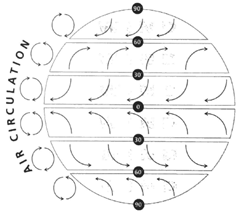
The Coriolis Effect occurs when a moving object, including air masses, appear to be deflected to the right or left of their path when traveling over a rotating body – like the Earth. The amount of deflection is determined by both the speed and latitude of the moving object. The greater the speed, the greater the deflection force exerted on the object.

How does this force relate to the other mechanisms that affect the global climate? Consider that, in the absence of other forces, wind moving in a straight line at a certain speed will continue to do so. However, because the Earth’s surface moves more quickly at the equator than it does at the poles, winds in the Northern Hemisphere are deflected to the right, and winds in the Southern Hemisphere are deflected to the left. The Coriolis force not only affects the path of large air masses, but it also affects the rotation of large storm systems including hurricanes and typhoons, as well as the movement of ocean currents.
Question 12
12.

Describe the Coriolis Effect?

Question 13
13.

Question 14
14.

Procedure


Note: Move the pen across the surface of the globe at the same speed in each step of this activity.

1. Have one partner hold the globe while another partner uses the marker to draw a line on the globe from the North Pole to the equator.
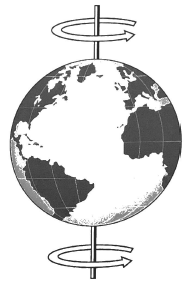
2. Have one partner hold the globe and rotate it counterclockwise as viewed from the North Pole, as shown in the figure. While the globe is rotating, have another partner use the wet-erase marker to draw a single line form the North Pole to the Arctic Circle, then back from the Arctic Circle to the North Pole.
3. Continue to rotate the globe counterclockwise while one partner draws a single line from the Arctic Circle to the Tropic of Cancer, then back to the Arctic Circle.
4. Continue to rotate the globe counterclockwise while one partner draws a single line from the Tropic Cancer to the equator, then back to the Tropic of Cancer.
5. Continue to rotate the globe counterclockwise while one partner draws a single line from the equator to the Tropic of Capricorn, then back to the equator.
6. Continue to rotate the globe counterclockwise while one partner draws a single line from the Tropic of Capricorn to the Antarctic Circle, then back to the Tropic of Capricorn.
7. Continue to rotate the globe counterclockwise while one partner draws a single line from the Antarctic Circle to the South Pole, then back to the Antarctic Circle.
8. Study the lines drawn on the globe, and then answer the questions for Activity 2
Question 15
15.

Question 16
16.

Question 17
17.

What is the difference between polar air masses and tropical air masses?
They are both warm
Polar air masses are warm and tropical air masses are cold
Polar air masses are cold and tropical air masses are warm
They are both cold
What is the difference between continental air masses and marine air masses?
They are both dry
Continental air masses are moist and marine air masses are less moist
Marine air masses are moist and continental air masses are less moist
What happens to an air masses density and movement as is it heated?
They stay in the same area
They gain energy and move apart from one another, decreasing density. As its density decreases, the air mass rises
They lose energy and move closer together, increasing density. As its density increases, the air mass sinks
What happens to an air masses density and movement as it is cooled?
They gain energy and move apart from one another, decreasing density. As its density decreases, the air mass rises
They lose energy and move closer together, increasing density. As its density increases, the air mass sinks
They stay in the same area
What happens to the convection fluid as it heats up?
Rises
Sinks
Stays the same
What do you expect will occur as air masses move over cold locations?
They cool, become denser, and sink
They warm, become less dense, and rise
They stay the same
What do you expect will occur as air masses move over hot locations?
They cool, become denser, and sink
They stay the same
They warm, become less dense, and rise
What type or types of air masses originate from near the equator?
Polar
Tropical
Which type of air mass, continental or marine, would have more moisture?
Continental
Marine
What climate would regions where air masses from the equator and the poles collide probably have?
Temperate climates (without extremes of temperature and precipitation)
Polar climates (extreme cold, with lots of snow and ice)
Tropical climate (hot and wet year round)
Arid climate (hot and dry year round)
Where would you expect to find these regions?
Near the equator
Near the poles
Halfway between the equator and poles
Anywhere on earth
Because of the Coriolis Effect, winds in the Northern Hemisphere are deflected in what direction?
Right
Left
Because of the Coriolis Effect, winds in the Southern Hemisphere are deflected in what direction?
Right
Left
As the globe rotated counterclockwise, what happened to the line that was being drawn, observed from a point above the North Pole? (did it stay straight, move right, move left, ect)
Move straight
Move right
Move left
Based on your observations, how does the Earth’s clockwise rotation affect the movement of air masses in the Northern AND Southern hemisphere? (Two correct choices)
When viewed from the South Pole, air masses are deflected to the left
When viewed from the North Pole, air masses are deflected to the right
When viewed from the North Pole, air masses are deflected to the left
When viewed from the South Pole, air masses are deflected to the right
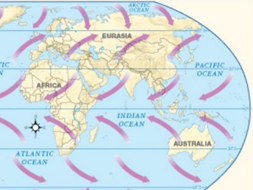
Although it is near the Atlantic Ocean, the northwest coast of Africa is characterized by hot, dry deserts. Using your knowledge of the Coriolis Effect and the picture provided, explain why this is true.

The Coriolis Effect deflects moist marine air masses into the region
The Coriolis Effect deflects dry marine air masses into the region
The Coriolis Effect deflects moist continental air masses into the region
The Coriolis Effect deflects dry continental air masses into the region