HOMEWORK: Lessons 3.1 - 3.4 DUE 10/31

Last updated over 1 year ago
25 questions
Note from the author:
Get out all your notes.
Work with a partner, read the questions to each other.
Get out all your notes.
Work with a partner, read the questions to each other.
Required
2

How many people attended the different NFL playoff games each year over the last 20 seasons?

Is this a statistical question?

Required
2

How many viewers watched game 7 of the 2016 NBA finals?

Is this a valid statistical question?

Required
2

How many days are in January?

Is this a statistical question?

Required
2

How many text messages does a high school student at DHS send each day?

Is this a statistical question?

Required
1

Use the following information for #5 & 6
On July 5-8, 2014, The Gallup organization telephoned a random sample of 1,028 adults in all 50 U.S. states and Washington DC. They had a 98% response and found that 41% supported a decrease in immigration.

The population of interest is all U.S. adults.

Required
2

In #5, is 41% a parameter or a statistic?

Explain.
Select both answers.

Required
1

Use this information for #7 - 9
A political scientist surveys 400 voters randomly selected from the list of
all registered voters in a community.
The purpose is to estimate the proportion of registered voters who will vote in an upcoming election.

What is the population of interest in this survey?

Required
1

Use this information for #7 - 9
A political scientist surveys 400 voters randomly selected from the list of
all registered voters in a community.
The purpose is to estimate the proportion of registered voters who will vote in an upcoming election.

What is the sample in this survey?

Required
4

What is the parameter of interest in this survey?
(what are we interested in finding out? Read the given information carefully in #8)
I will grade this question.

Required
2

An educator wants to compare the effectiveness of computer software for teaching biology with that of a textbook presentation.
She gives a biology pretest to each of a group of high school juniors, then randomly divides the students into two groups.
One group of students uses the computer.
The other group of students studies the text.
At the end of the year, she tests all the students again and compares the increase in biology test scores in the two groups.

Is this an observational study or an experiment? Explain your reasoning.

Required
2

A University of Helsinki (Finland) study wanted to determine if chocolate consumption during pregnancy had an effect on infant temperament (smiling, laughing, fear, etc) at age 6 months.
Researchers began by asking 305 healthy pregnant women to report their chocolate consumption.
Six months after birth, the researchers asked mothers to rate their infants’ temperament, including smiling, laughter, and fear.
The babies born to women who had eaten chocolate daily during pregnancy were found to be more active and “positively reactive”—a measure that the investigators said encompasses traits like smiling and laughter.
Is this an observational study or an experiment? Explain your reasoning.

Required
1

A school district has three high schools. The district decides to randomly test high school students for attention deficit disorder (ADD). The school board creates a list of all of the students from the three high schools and randomly samples 250 students from that list.
Is this a simple random sample?
(hint: think about the specific requirement we discussed in class re. SRS)

Required
4

A chemistry professor who teaches a large lecture class gives a survey to those present in class about how he can make the class more interesting.
The survey is conducted in a way that student's answers are anonymous, which means all students will participate. The professor watches as students answer the survey.
He is hoping he can get more students to attend his class.
This survey method suffers primarily from which types of bias?
Why?
Select two types of bias and the two reasons (4 correct answers).

Required
2

The quality-control department at an automobile factory checks the tightness of motor-mounting bolts installed by assembly-line workers by sampling the first 25 cars produced by the assembly line each day.
Explain why this sampling method is biased.
Is this method likely to overestimate or underestimate the proportion of bolts that are improperly tightened?

Required
2

The following is an example of response bias, when the way a question is asked or worded influences the answers of those surveyed.

A college group is investigating student opinions about funding of the military. They phone a random sample of students at the college, asking each person one of these questions (randomly chosen):

A: “Do you think that funding of the military should be increased?”

B: “Do you think that funding of the military should be increased so that the United States can better protect its citizens?”

Which question do you expect will elicit greater support for increased military funding?
Explain.

Select both answers.

Required
2

Jane wants to know what percent of students at her high school have a driver’s license. She surveys all students in her statistics class and finds that 68% of the students in her sample have a driver’s license.
What type of sample did Sammy obtain?

Required
2

Use the information from #16:
Explain why this sampling method is biased.
AND
Is 68% likely to be greater than or less than the percent of all students at her high school who have a driver’s license?

Required
4

Use the information from #17:
Explain how Jane could avoid the bias described in #17. I will grade this question.

Required
3

Randomization in sample selection is very important in the collection of data to ensure the sample is representative of the population we are studying.

What are the steps for a random sample?

  • Identify the objects or individuals in the sample based on the corresponding random numbers.
  • Label with numbers the objects or individuals that are in the population
  • Use a randomized process such as drawing slips of paper out of a hat or a random number generator to produce random numbers for the sample.
  • First
  • Second
  • Third
Required
2

A botanist wants to create a sample of size of 10 from 60 plants that are arranged in an array of 10 rows of 6 plants each.
She numbers the plants in each row from one to six.
For each of the 10 rows, she rolls a six-sided number cube and selects the plant corresponding to the number rolled.

Which statements are true? Check all that apply.

Required
1

In an SRS of 100 calls to a customer service line, the mean time that callers were placed on hold was 12.5 minutes.
What is n, the sample size, for this survey?

Required
2

In an SRS of 100 calls to a customer service line, the mean time that callers were placed on hold was 12.5 minutes.
Do you think the mean time that all callers to the customer service line were placed on hold is exactly 12.5 minutes? Explain.

Choose both answers.

Required
2

In an SRS of 100 calls to a customer service line, the mean time that callers were placed on hold was 12.5 minutes.
Suppose the customer-service manager only had time to collect an SRS of 25 calls before reporting to a managers’ meeting.
What effect would this have on the spread of the values and the estimated mean?

Choose both answers.

Required
2

What proportion of students are willing to report cheating by other students?
A student project put this question to an SRS of 172 undergraduates at a large university: “You witness two students cheating on a quiz. Do you go to the professor?”
Only 11% answered “Yes.”
The dotplot shows the proportion who would go to the professor in each of 1000 random
samples of size 172 from a population where 11% would go to the professor.
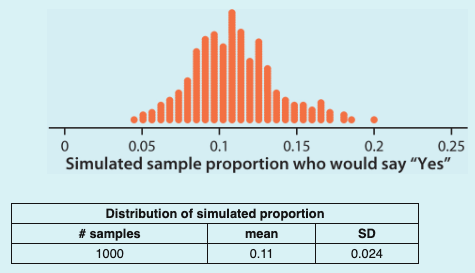
Use the results of the simulation to approximate the margin of error for Gallup’s estimate of the proportion of U.S. adults who were satisfied with the way things were going in the United States at the time of the poll.
Give the interval for the margin of error using the format we used in class, use a + symbol.

Required
4

Use the information in #24, interpret the Margin of Error.
Use your notes Lesson 3.4!
I will grade this question.