Log in
Sign up for FREE
arrow_back
Library
Chemical reactions
By Mr Pike
star
star
star
star
star
Share
share
Last updated 4 days ago
61 questions
Add this activity
Required
1
Required
8
1
1
1
1
1
1
1
1
1
1
1
1
1
1
1
1
1
1
1
1
1
1
1
1
1
1
2
1
1
1
2
1
1
1
1
Question 1
1.
Where is most of the mass of the atom found?
Electron Cloud
Nucleus
Protons only
Neutrons only
zoom_in
Required
1
Question 2
2.
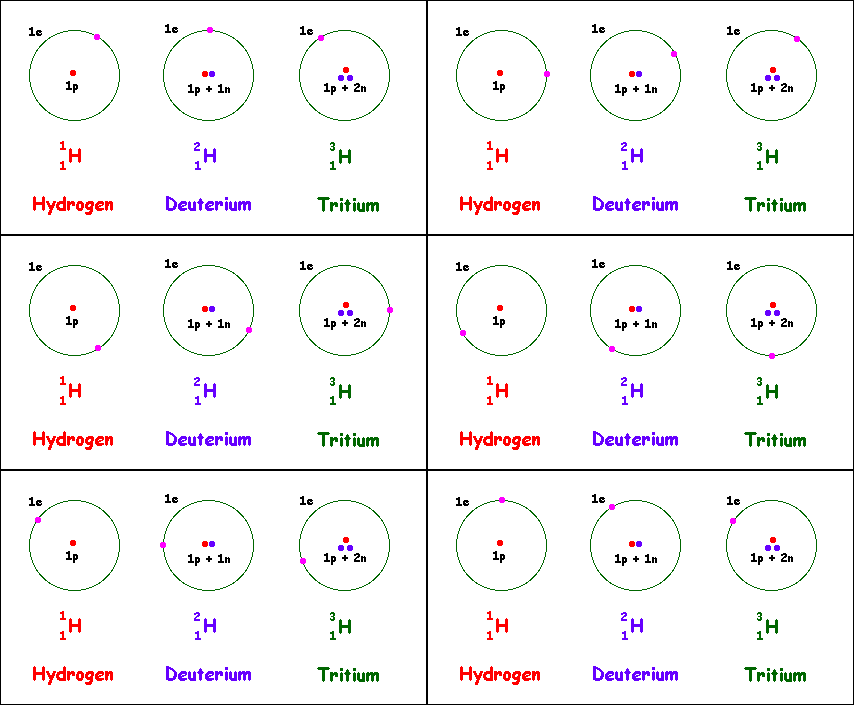
Which statement best describes the image.
The atoms are isotopes
Required
1
Question 4
4.
Question 5
5.
If you see something in the classroom or laboratory that is dangerous, tell the teacher
when you have time
after class
at once
after school
Question 6
6.
Any spill on the floor can cause an accident. Always clean it up
at once
when you have time
at the end of the day
at the end of the period
Question 7
7.
When you work with laboratory chemicals and bunsen burners, long hair must be
cut off
kept out of the way by wearing a hair tie, band, or net
held with both hands
styled nicely
Question 8
8.
What is the smallest particle into which an element can be divided and still be the same substance?
electron
neutron
proton
atom
Question 9
9.
What part of the atom has a positive charge?
electron
neutron
proton
atom
Question 10
10.
What part of the atom has a negative charge?
electron
neutron
proton
atom
Question 11
11.
What part of the atom has a no charge?
electron
neutron
proton
atom
Question 12
12.
What is found in the center of an atom
electron
nucleus
library
electron cloud
Question 13
13.
What subatomic particles are found in the nucleus? Check all that apply
proton
electron
neutron
Question 14
14.
On a drawing a proton is shown with the symbol____?
(+)
(-)
(0)
Question 15
15.
On a drawing a electron is shown with the symbol____?
(+)
(-)
(0)
Question 16
16.
An electron is found...
inside the nucleus
next to a proton
outside the nucleus
next to a neutron
Question 17
17.
The main parts of an atom are?
proton, neutron, electron
proton, atom, electron
proton, compound, electron
Question 18
18.
Isotopes are atoms of the same element with the same number of protons and
a different number of electrons
Question 19
19.
What is the maximum number of electrons that are allowed on the second shell/orbit?
9
7
8
3
Question 20
20.
An atom becomes negatively charged by
gaining an electron
Question 21
21.
Potassium has an atomic number of 19 and a mass number of 39. So, it has
_________________neutrons.
19
18
20
21
Question 22
22.
Which statement is true about the Periodic Table?
The Periodic Table allows you to easily compare the properties of one element to another
Question 23
23.
In the Periodic Table, the vertical columns that extend down the Periodic Table are called
periods
groups
classes
Question 24
24.
Hydrogen is located in Group_________of the Periodic Table.
1
2
3
4
Question 25
25.
Which scientist is credited with inventing the Periodic Table?
Gregor Mendel
Question 26
26.
In the Modern Periodic Table, the elements are arranged in order of
increasing mass
Question 27
27.
Copper
Question 28
28.
Fluorine
Give the element name that matches the symbol below.
Question 29
29.
Au
Question 30
30.
Ge
31
32
33
34
code
code
code
code
code
code
code
code
code
zoom_in
1
1
1
1
Question 35
35.
Select the general properties of metals:
Metals are shiny
Metals conduct electricity very well
Metals are flexiable
36
37
38
39
40
41
42
43
44
45
zoom_in
1
1
1
1
1
1
1
1
1
1
46
47
48
49
50
51
52
53
zoom_in
1
1
1
1
1
1
1
1
Question 54
54.
What is an example of an exothermic reaction?
A lightbulb
The sun
A firecracker
Vinegar and baking soda
Question 55
55.
Endothermic reactions release energy stored in chemical bonds.
True
False
Question 56
56.
A balanced equation demonstrates...
The law of conservation of energy
There was an exothermic reaction
Question 57
57.
State one way that you could speed up the rate of a chemical reaction.
Question 58
58.
What characteristics do endthermic reactions have? (select all that apply)
Aborb heat
Temperature increases
Release heat
Temperature decreases
Question 59
59.
What characteristics do exothermic reactions have? (select all that apply)
Absorb heat
Temperature increases
Releases heat
Temperature decreases
Question 60
60.
Select
two
examples of endothermic reactions.
Cooking an egg
Melting ice cubes
Wood burning
Explosive dynamite
Question 61
61.
Select two examples of
exothermic
reactions.
Baking soda and vinegar reacting
Hand warmers
Wood burning
Photosynthesis
The atoms are ions
The atoms represent different elements
Question 3
3.
Explain why you chose your answer for #2.
Select the type of subatomic particle that matchs the statement.
Electron
Neutron
Proton
NOT found in the nucleus
Has no charge
Has +1 charge
Has -1 charge
Identifier of the element
Has almost no mass
a different number of molecules
a different number of neutrons
the same number of neutrons
losing an electron
losing a proton
gaining a neutron
Each horizontal row of the Periodic Table is called a group
Each vertical column of the Periodic Table is called a period
All of the above are correct
Watson and Crick
Albert Einstein
Dimitri Mendeleev
increasing atomic volume
increasing atomic number
the alphabet
Question 31
31.
What group is column 2
A - Lanthanide
B - Noble Gas
C - Alkali Metal
D - Alkaline Earth
Question 32
32.
What Group is Column 17?
A - Noble Gas
B - Halogen
C - Alkaline Earth
D - Alkali Metal
Question 33
33.
What Group is Column 18?
A - Nonmetal
B - Noble Gas
C - Transition Metal
D - Halogen
Question 34
34.
Why does Tungsten have a chemical symbol W?
Question 36
36.
What is the bunsen burner used for?
Question 37
37.
The utility clamp and the iron ring can both be attached to help hold beakers, test tubes, and flasks.
True
False
Question 38
38.
You do not need to wear safety glasses if you have eye glasses or contacts.
True
False
Question 39
39.
It is ok to put your hand on the pan if you want to know how much it mass it has.
True
False
Question 40
40.
This tool is best used to meausre the volume of liquids
True
False
Question 41
41.
This tool is used to hold liquids while heating in the bunsen burner.
True
False
Question 42
42.
This tool is used to move beakers when the beaker is hot.
True
False
Question 43
43.
This a good tool for stirring solutions.
True
False
Question 44
44.
It is ok to use the same pipette in multiple different solutions during the lab.
True
False
Question 45
45.
These are good tools for getting a small amount of chemical out of the stock bottle.
True
False
Question 46
46.
A
B
C
D
Question 47
47.
A
B
C
D
Question 48
48.
A
B
C
D
Question 49
49.
A
B
C
D
Question 50
50.
A
B
C
D
Question 51
51.
A
B
C
D
Question 52
52.
A
B
C
D
Question 53
53.
A
B
C
D
Energy has neither been created or destroyed
There is the same amount of atoms on both side of the equation
The law of conservation of mass
E
E
E
E
E