Star Formation
star
star
star
star
star
Last updated over 3 years ago
25 Nsɛmmisa
All stars start from
Gravity helps spiral the dust and gas together and this heats up to a high degree to make a
A star forms when Hydrogen nuclei are hot enough to fuse and form...

When a star exits the protostar period it enters the ____________ for about 10 billion years.
In a star Hydrogen eventually stops fusing into
When the inner force of fusion is less than the force of gravity the star starts to
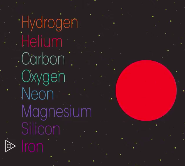
Fusion of helium in the red giant will eventually
Massive stars...
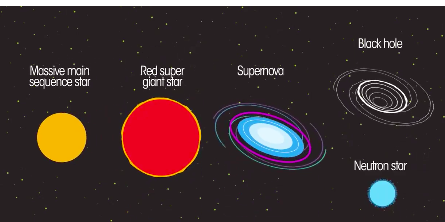
Which statement(s) are true
Massive stars lifespan is about

Which have a longer life span
Hydrogen is lost quicker from...
Massive main sequence stars
Supernova's relase energy in the form of ____________ and ____________, which can outshine all light in the galaxy for several weeks.
All of the pressure and temperature in the supernova is enough to do what?
Supernova's distribute these elements all throughout the universe meaning...
What are the two possible things that a supernova can become?
1.
2.
Describe how a neutron star is made
Describe how a black hole is formed