This content check is due tomorrow for a daily grade.
The homework formative is also due tomorrow for a daily grade, you have had that for over a week to work on.
This content check is due tomorrow for a daily grade.
The homework formative is also due tomorrow for a daily grade, you have had that for over a week to work on.
Required
6 points
6
Question 1
1.
Categorize the questions as statistical or non-statistical questions
How many quarters equal $10?
How much money do high school students carry with them?
How tall are the elm trees on Elm Street?
How tall is the elm tree in Laura’s backyard?
What proportion of Texas residents would choose vanilla as their favorite ice cream flavor?
What is the governor’s favorite ice cream flavor?
Statistical Question
Non-statistical Question
Required
6 points
6
Question 2
2.
Categorize the studies:
Among a group of disabled women aged 65 and older who were tracked for several years, those who had a vitamin B12 deficiency were twice as likely to suffer severe depression as those who did not. (American Journal of Psychology 157 [2000]: 715)
Over a 4‐month period, among 30 people with bipolar disorder, patients who were given a high dose (10g/day) of omega‐3 fats from fish oil improved more than those given a placebo. (Archives of General Psychiatry 56 [1999]: 407)
The leg muscles of men aged 60 to 75 were 50% to 80% stronger after they participated in a 16‐week, high‐intensity resistance‐training program twice a week. (Journal of Gerontology 55A [2000}: B336)
Observational Study
Experiment
Required
2 points
2
Question 3
3.
Each week, the Gallup Poll surveys about 1500 adult U.S. residents to determine current opinions on a wide variety of issues. Identify the population and sample in this setting.
Required
2 points
2
Question 4
4.
A large retailer prepares its customers’ monthly credit card bills using a machine that folds the bills, stuffs them into envelopes, and seals the envelopes for mailing.
Are the envelopes completely sealed?
Inspectors choose 40 envelopes at random from the 1000 stuffed each hour for visual inspection. Identify the population and sample in this setting.
Required
2 points
2
Question 5
5.
To fund a program to buy electronic tablets for every second-grade student in Springdale public schools, the board of education proposes a 5% increase in property taxes.
One local “golden oldies” radio station asks listeners to call in to voice their support for, or opposition to, the proposal.
The station finds that 78% of the callers are opposed.
What type of sample did the station collect?
Is it biased?
Why?
Answer BOTH questions.
Required
3 points
3
Question 6
6.
Is 78% likely to be greater than or less than the true percent of all Springdale residents who oppose the proposal?
Select three answers below.
Required
4 points
4
Question 7
7.
Explain how the radio station could avoid the bias in question #5.
Hint: check notes 3.2.
Required
3 points
3
Question 8
8.
To gather data on a 1200-acre pine forest in Louisiana, the U.S. Forest Service laid a grid of 1410 equally spaced circular plots over a map of the forest. The Forest Service wants to visit a sample of 10% of these plots.
Describe how to select an SRS of 10% of the plots using a random number generator (RNG) with technology.
Make sure to include all three steps from 3.3.
Required
4 points
4
Question 9
9.
During the political crisis in Ukraine in spring 2014, a national polling organization asked an SRS of 2066 Americans to locate Ukraine on a map of the world.
The sample proportion who successfully located Ukraine was 0.166.
Do you think that the actual proportion of all Americans who can locate Ukraine on a map is 0.166?
Explain why or why not, use the vocabulary word from 3.3 in your answer.
Hint: look at lesson 3.3 and think about our activity with the 'Crazy In Love' lyrics for average word length. Did anyone get exactly the true average of 3.53 letters?
Required
2 points
2
Question 10
10.
In the population of people in the United States, about 10% are left-handed. After bumping elbows at lunch with several left-handed students, Simon wondered if more than 10% of students at his school are left-handed.
To investigate, he selected an SRS of 50 students and found 7 lefties.
He then selected one hundred simulated SRSs.
Each dot in the graph shows the number of students that are left-handed in a simulated SRS of 50 students, assuming that each student has a 10% chance of being left-handed.
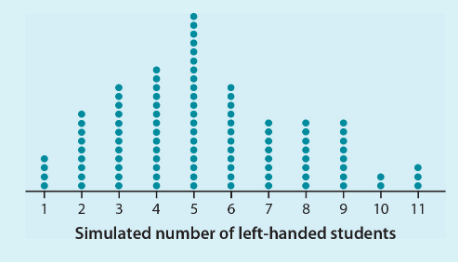
Does this distribution demonstrate sampling variability?
Explain.
Required
2 points
2
Question 11
11.
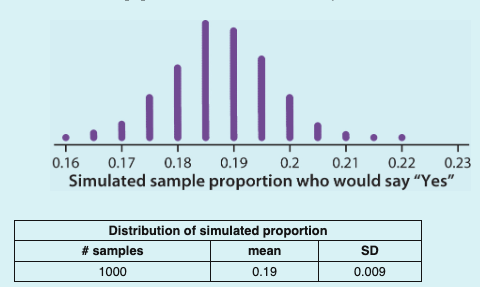
The Pew Internet and American Life Project asked a random sample of 2253 U.S. adults, “Do you ever use Twitter or another service to share updates about yourself or to see updates about others?”
In the sample, 19% said “Yes.”
The dotplot shows the proportion who would say “Yes” to this question in each of 1000 simulated random samples of size 2253 from a population where 19% would say “Yes.”
Use the results of the simulation to approximate the margin of error for the estimate of the proportion of U.S. adults who would say “Yes” to this question.
Round your answer to three places past the decimal point.
Check Lesson 3.4 for the Margin of Error formula.
Required
2 points
2
Question 12
12.
Many people have asked the question, but few have been patient enough to collect the data. 'How many licks does it take to get to the center of a Tootsie Pop? '
Researcher Corey Heid decided to find out. He instructed a random sample of 92 students to lick a Tootsie Pop along the non-banded side until they could taste the chocolate center.
The mean number of licks was 356.1 and the margin of error for this estimate is 9.6 licks.
Think about it the formula for the margin of error, write it down.
If the margin of error was 9.6, what do you think the Standard Deviation was?
Check the formula to figure it out, work backwards.
Keep all decimal places.
Required
2 points
2
Question 13
13.
Many people have asked the question, but few have been patient enough to collect the data. 'How many licks does it take to get to the center of a Tootsie Pop? '
Researcher Corey Heid decided to find out. He instructed a random sample of 92 students to lick a Tootsie Pop along the non-banded side until they could taste the chocolate center.
The mean number of licks was 356.1 and the margin of error for this estimate is 9.6 licks.
Interpret the margin of error, be sure to include context and units in your answer.
Required
2 points
2
Question 14
14.
Use the information in #12 & 13, calculate the Confidence Interval that would contain the true population mean for the number of licks. Use the margin of error to calculate the upper and lower limits.
Put the lower and upper limits in parenthesis like below.
Use the format: (low#, high#)
Include all decimal places.
Required
2 points
2
Question 15
15.
Use the information from #12 & 13:
Would you be skeptical if someone claimed that it takes more than 400 licks, on average, to get to the center of a Tootsie Pop? Explain.
Hint: is 400 licks inside the margin of error interval?
Required
2 points
2
Question 16
16.
Use the information from #12 & 13:
Explain how Corey Heid could reduce the margin of error for the estimate.
Required
2 points
2
Question 17
17.
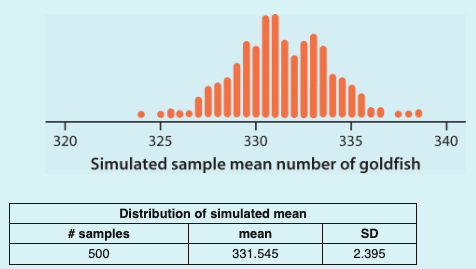
Carly and Maygen plan to be pre-school teachers after they graduate from college. To prepare for snack time, they want to know the mean number of goldfish crackers in a bag of original goldfish.
To estimate this value, they randomly selected 12 bags of original goldfish from HEB and counted the number of crackers in each bag.
The sample mean for these data is = 331.4 goldfish.
The dotplot shows the distribution of the sample mean number of goldfish for 500 random samples of size 12 .
Use the results of the simulation to approximate the margin of error for the estimate of the mean number of goldfish in a bag of original goldfish.