Unit 2 Summative Assessment (5th Grade)
star
star
star
star
star
Last updated almost 4 years ago
26 Nsɛmmisa
Hyɛ no nsow a efi ɔkyerɛwfo no hɔ:
Chemical and Physical Change
1
Chemical and Physical Change
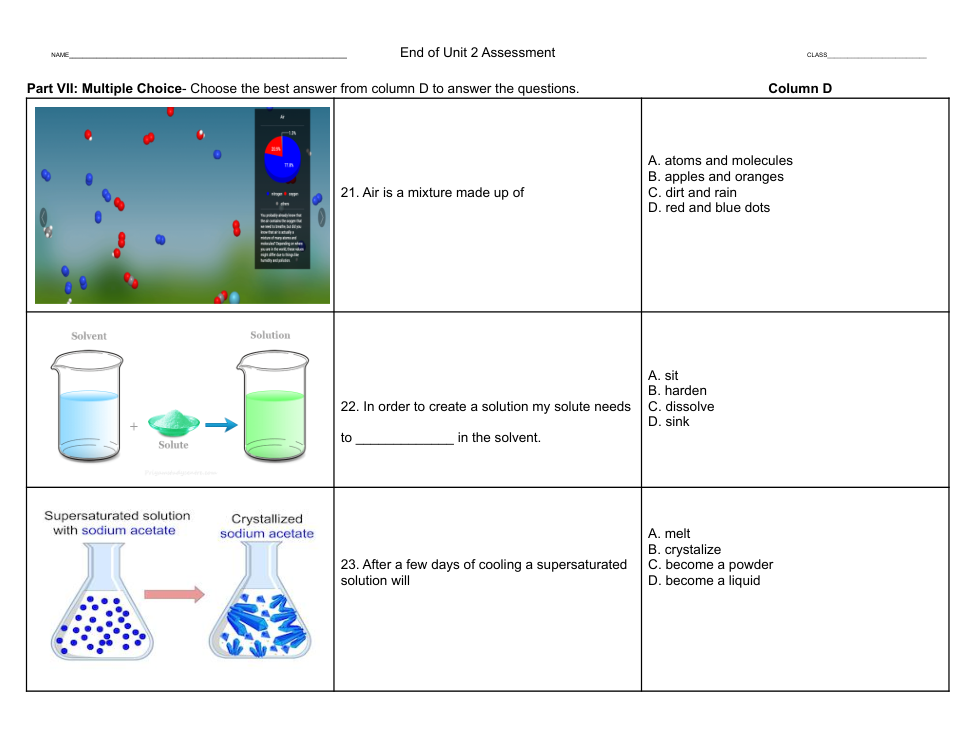
Air is a mixture made up of
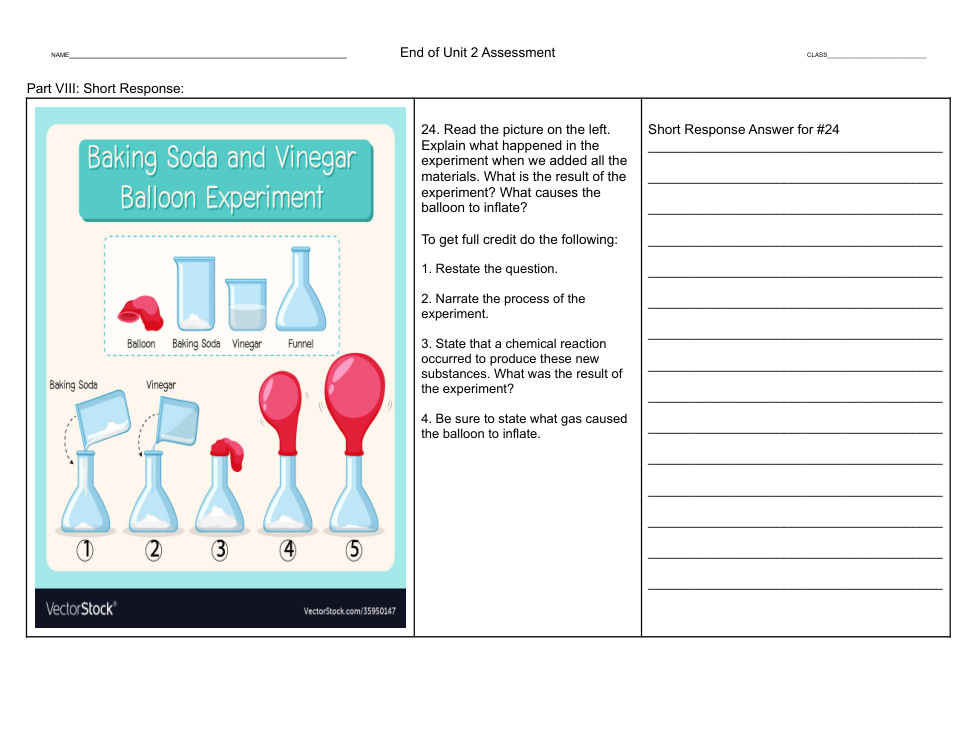
Read the picture on the left.
Explain what happened in the experiment when we added all the materials. What is the result of the experiment? What causes the balloon to inflate?
To get full credit do the following:
1. Restate the question.
2. Narrate the process of the experiment.
3. State that a chemical reaction occurred to produce these new substances. What was the result of the experiment?
4. Be sure to state what gas caused the balloon to inflate.
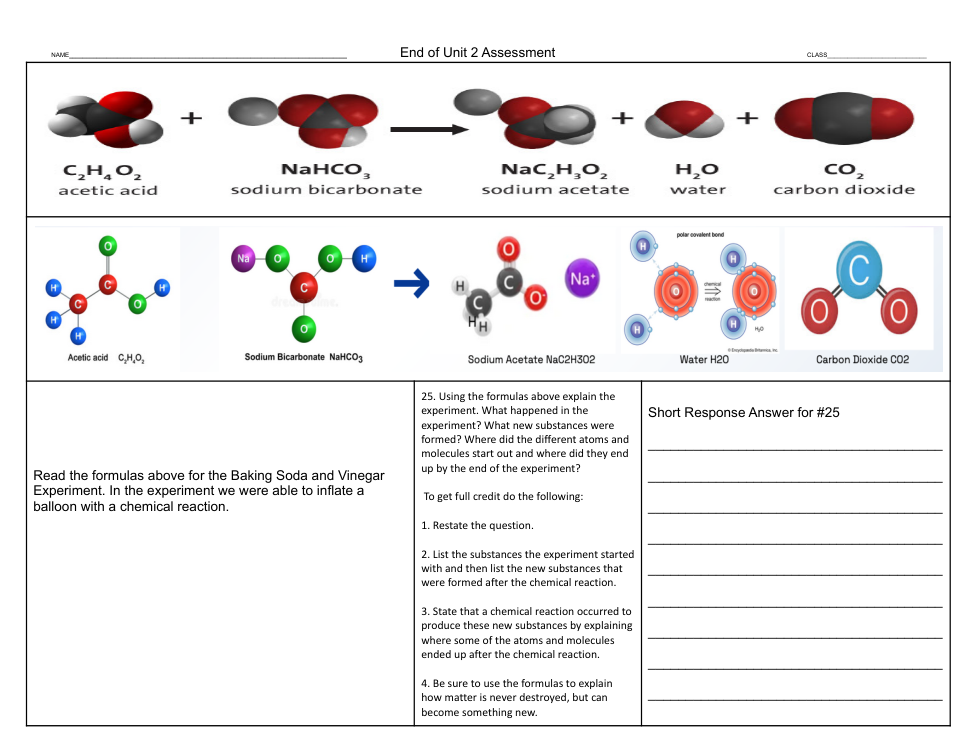
Using the formulas above explain the experiment. What happened in the experiment? What new substances were formed? Where did the different atoms and molecules start out and where did they end up by the end of the experiment?
To get full credit do the following:
1. Restate the question.
2. List the substances the experiment started with and then list the new substances that were formed after the chemical reaction.
3. State that a chemical reaction occurred to produce these new substances by explaining where some of the atoms and molecules ended up after the chemical reaction.
4. Be sure to use the formulas to explain how matter is never destroyed, but can become something new.
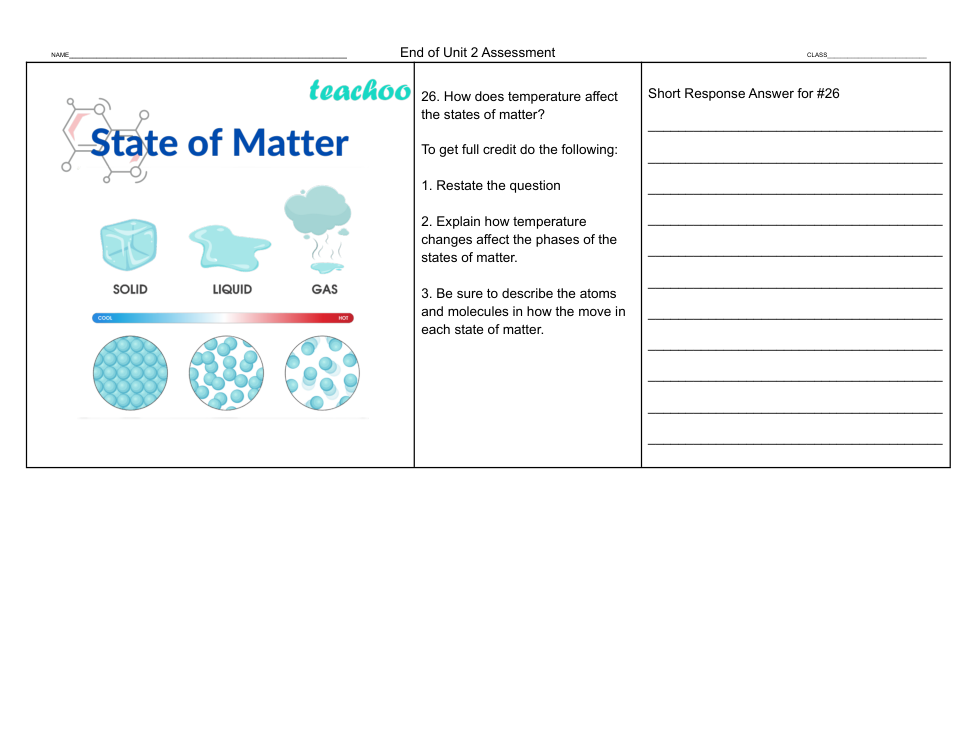
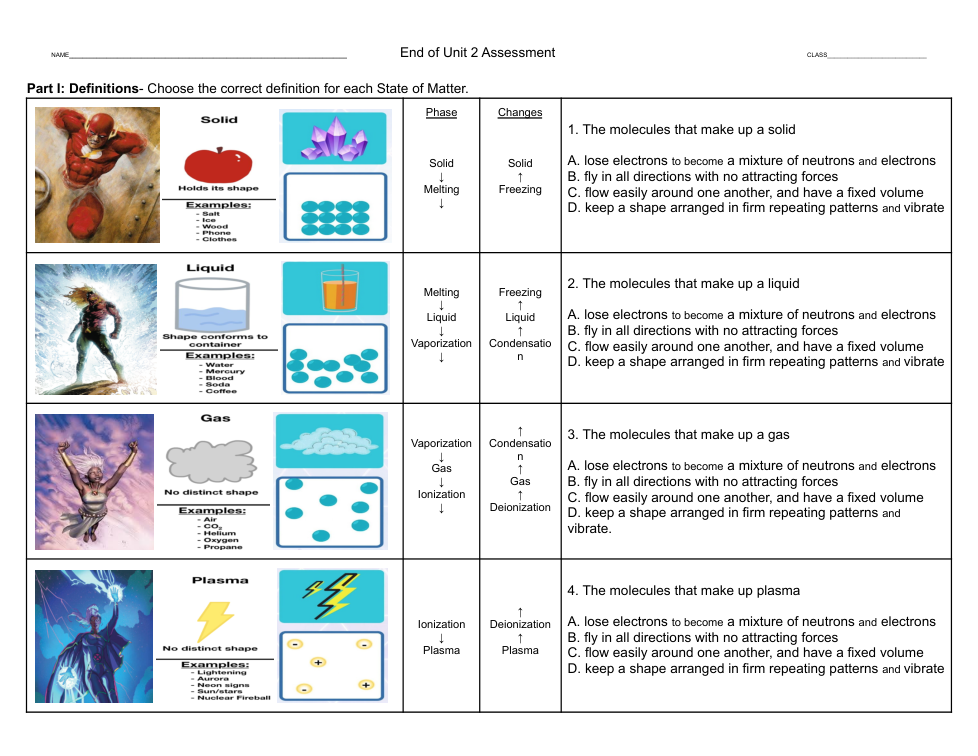
Be sure to describe the atoms and molecules in how they move in each state of matter.
The molecules that make up a solid
The molecules that make up a liquid
The molecules that make up a gas
The molecules that make up plasma
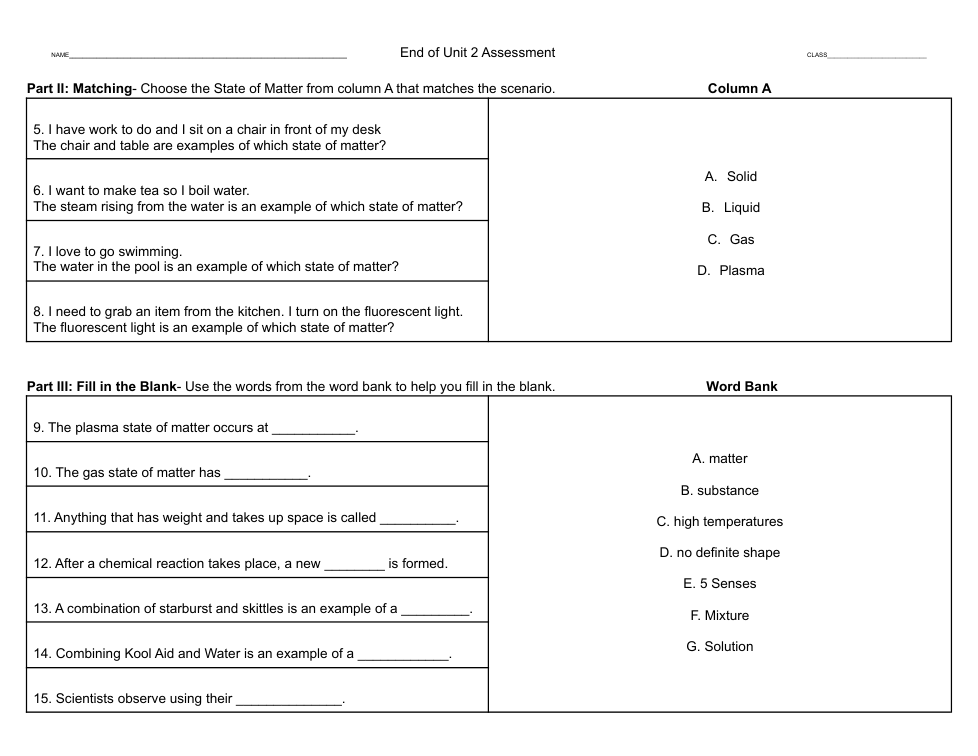
I have work to do and I sit on a chair in front of my desk. The chair and table are examples of which state of matter?
I want to make tea, so I boil water.
The steam rising from the water is an example of which state of matter?
I love to go swimming.
The water in the pool is an example of which state of matter?
I need to grab an item from the kitchen. I turn on the fluorescent light. The fluorescent light is an example of which state of matter?
The plasma state of matter occurs at ___________.
The gas state of matter has ___________.
Anything that has weight and takes up space is called __________.
After a chemical reaction takes place, a new ________ is formed.
A combination of starburst and skittles is an example of a _________.
Combining Kool Aid and water is an example of a ____________.
Scientists observe using their ______________.
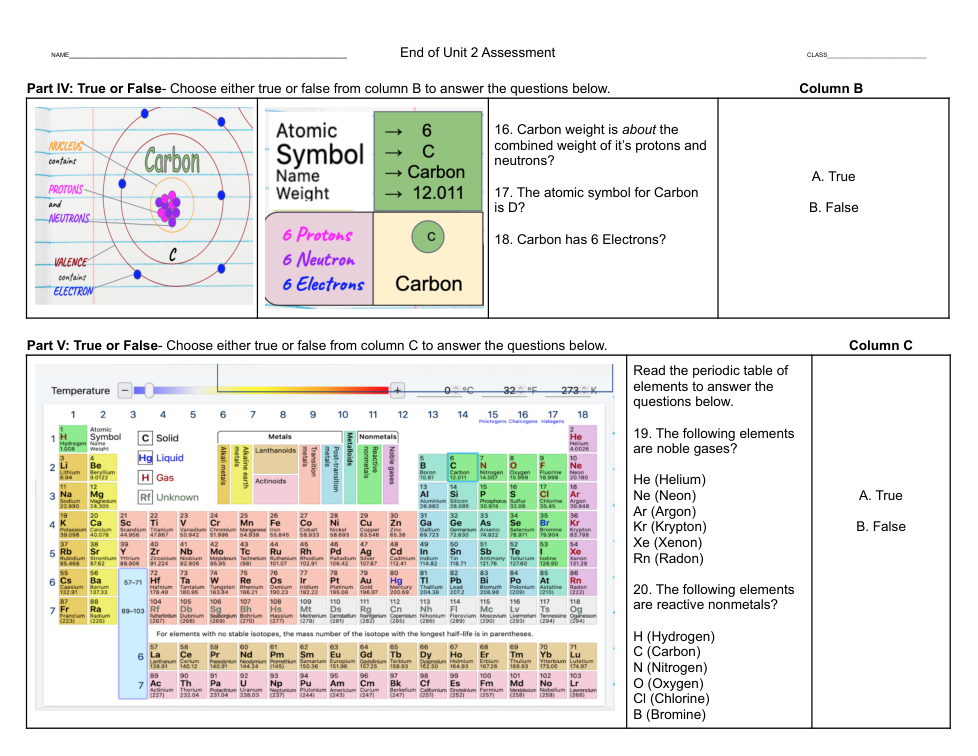
Carbon's weight is about the combined weight of its protons and neutrons?
The atomic symbol for Carbon is D?
Carbon has 6 Electrons?
The following elements are
noble gases?
He (Helium)
Ne (Neon)
Ar (Argon)
Kr (Krypton)
Xe (Xenon)
Rn (Radon)
The following elements are
reactive nonmetals?
H (Hydrogen)
C (Carbon)
N (Nitrogen)
O (Oxygen)
Cl (Chlorine)
B (Bromine)
In order to create a solution my solute needs to _____________ in the solvent.
After a few days of cooling a supersaturated solution will