Log in
Sign up for FREE
arrow_back
Library

Unit 2 Factors That Affect Climate Retake Test

star
star
star
star
star
Last updated over 3 years ago
25 questions
1
1
1
1
1
1
1
1
1
1
1
1
1
1
1
1
1
1
1
1
1
1
1
1
1
Question 1
1.

Question 2
2.

Question 3
3.

Question 4
4.

Question 5
5.

Question 6
6.

Question 7
7.

Question 8
8.

Question 9
9.

Question 10
10.

Question 11
11.

Question 12
12.

Question 13
13.

Question 14
14.

Question 15
15.

Question 16
16.

Question 17
17.

Question 18
18.

Question 19
19.

Question 20
20.

Question 21
21.

Question 22
22.

Question 23
23.

Question 24
24.

Question 25
25.

How are surface currents connected to density currents in the global conveyor belt?
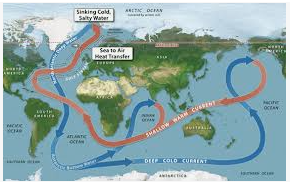
Surface currents move toward the equator becoming warm and dense and sink. They then move toward the poles where they become less dense in the cooler waters and slowly rise to the surface.
Surface currents move toward the poles becoming cool and dense and sink. They then move toward the equator where they become less dense in the warmer waters and slowly rise to the surface.
Surface currents move toward the equator becoming cool, less dense and sink. They then move toward the poles where they become denser in the cooler waters and slowly rise to the surface.
Surface currents move toward the poles becoming warmer and less dense and they rise to the surface. They then move toward the equator where they become cool, denser, and they sink.
Why does an increase in salinity cause a density current to form?
Saltier water flows more slowly, creating a drag on the water and forming a current.
The saltier water floats away on the surface. Water flows up from the bottom to replace it, forming a current.
Saltier water is higher in density than fresh water. This water then sinks to the bottom, forming a current.
Saltier water travels from the equator. This warmer water is denser, and it sinks toward the bottom, forming a current.
The two main controlling factors for deep ocean currents are
salinity and wind.
pressure and salinity.
wind and temperature.
temperature and salinity.
Warm water is ______________ dense and ____________________than cold water.
more; heavier
more; lighter
less; heavier
less; lighter
Which of the following descriptions explains how heat is distributed in Earth's oceans?
Even heating of Earth’s surface causes ocean water to rise and sink, creating conduction currents.
Even heating of Earth’s surface causes ocean water to rise and sink, creating convection currents.
Uneven heating of Earth’s surface causes ocean water to rise and sink, creating convection currents.
Uneven heating of Earth’s surface causes ocean water to rise and sink, creating conduction currents.
Which of these best describes how heat is moved around in Earth’s oceans?
Warm winds blow over the oceans from land, causing the ocean water to warm up.
Warmer ocean water from the equator flows toward Earth’s poles, where the water cools and sinks.
Waves are created by wind, which warms the water by friction and pushes water around in the oceans.
Ocean water along the shore rises and falls two times during each day, washing heat from the sand into the oceans.
Which one does NOT affect ocean surface currents?
The density of water from colder temperatures and higher salinity
Continental deflection causing a current to change direction as it approaches a continent
Global winds formed from the uneven heating of the Earth
The curving motion of fluids known as the Coriolis Effect caused by the rotation of the Earth
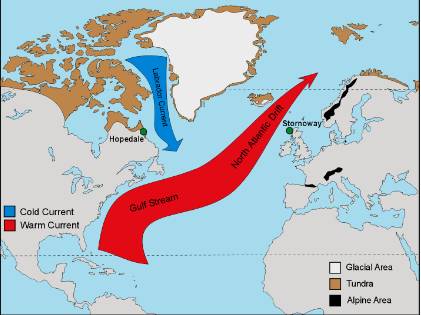
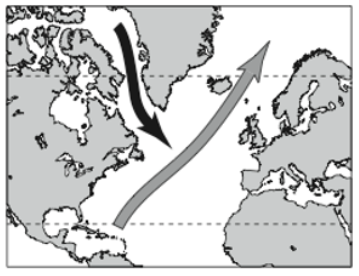
The Gulf Stream is shown with the lighter colored arrow, while the Labrador Current is shown with a darker colored arrow.      Which best describes the movement of the Labrador Current?

Warm currents carry cold water from the tropics toward the poles.
Warm currents carry warm water from the tropics toward the poles
Cold currents carry cold water from the polar zones toward the equator.
Cold currents carry warm water from the polar zone toward the equator.
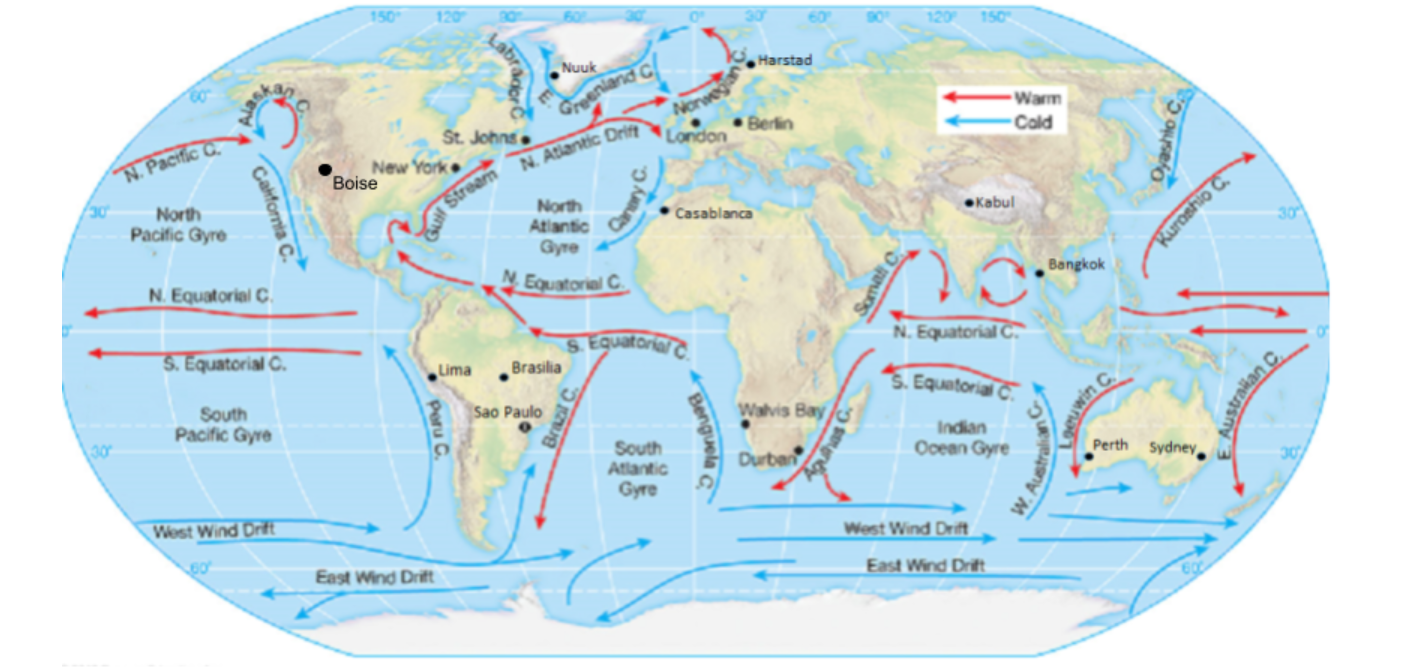
Use the map and your knowledge of the movement of currents to answer the following question.   Which best describes the movement of the Brazil Current?

Warm currents carry cold water from the tropics toward the poles.
Warm currents carry warm water from the tropics toward the poles.
Cold currents carry cold water from the polar zones toward the equator.
Cold currents carry warm water from the polar zone toward the equator.
What is the main energy source for ocean currents?
The gravitational pull of the moon
Density of ocean water
Heat from the Sun
The rotation of the Earth
Read the observations of Robbie's trip below and decide which phenomenon Robbie experienced.

Robbie and his family spent the week at a nearby mountain range.  As Robbie hiked the mountains he made several observations.  He noticed that as he hiked up to a higher elevation, the temperature became colder and it was raining. He noticed that there were many types of trees on this side of the mountain. As he crossed the mountain and hiked back down to the other side Robbie noticed that it was very dry and hot with very little trees.  It almost looked like a desert.
Mountain Breeze Effect
The Rain Shadow Effect
The Lake Effect
The Coriolis Effect
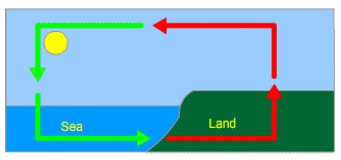
What type of wind pattern is this and when is it most likely to occur?

This is a sea breeze. It occurs during the day when the surface of the sea cools faster than the land.
This is a sea breeze. It occurs during the day when the land heats faster than the surface of the sea
This is a land breeze. It occurs during the night when the surface of the sea cools faster than the land.
This is a land breeze. It occurs during the night when the air above the land is warmer than the air above the sea.
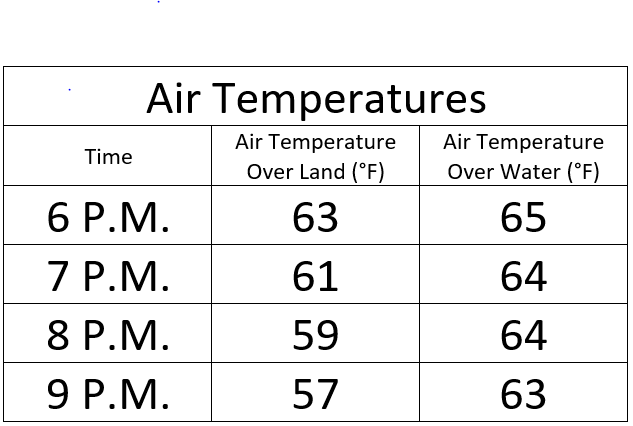
Air temperature data was recorded on a trip to the beach and were recorded in the table below.   What phenomena was occurring at the beach?

low tide
high tide
sea breeze
land breeze
The Gulf Stream in the Northern Hemisphere moves from the Equator toward the North Pole. The coastal areas bordering this current will be...
warmer and more humid
warmer and dryer
cooler and dryer
cooler and more humid
On the leeward side of a mountain you might find
more vegetation
heavy rainfall
less vegetation
more snowfall
Hopedale and Stornoway are near the same latitude line.  Which statement best describes the climates of Hopedale and Stornoway?

Hopedale and Stornoway both have mild winters.
Hopedale and Stornoway both have very cold winters.
Hopedale has a mild winter while Stornoway has a very cold winter.
Hopedale has a very cold winter while Stornoway has a mild winter.
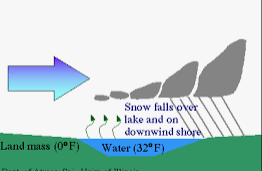
What phenomenon is shown in the model below?

Coriolis Effect
Rain Shadow Effect
Lake Effect
Valley Breeze Effect
What landform causes the rain shadow effect?
Mountains
Lakes
Plains
Valleys
The warm Gulf Stream passes the southern tip of Florida on its way north. How does the warm, moist air associated with this current affect the climate of southern Florida?
It decreases the amount of rainfall in southern Florida.
It causes southern Florida to be cooler than northern Florida.
It increases the amount of rainfall in southern Florida.
It causes southern Florida to be dryer than northern Florida.
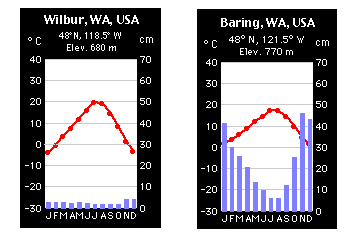
Which city is experiencing the rain shadow effect and why?

Baring, WA is because it has cooler temperatures and more rainfall.
Baring, WA is because it has warmer temperatures and less rainfall.
Wilbur, WA is because it has warmer temperatures and less rainfall.
Wilbur, WA is because it has cooler temperatures and more rainfall.
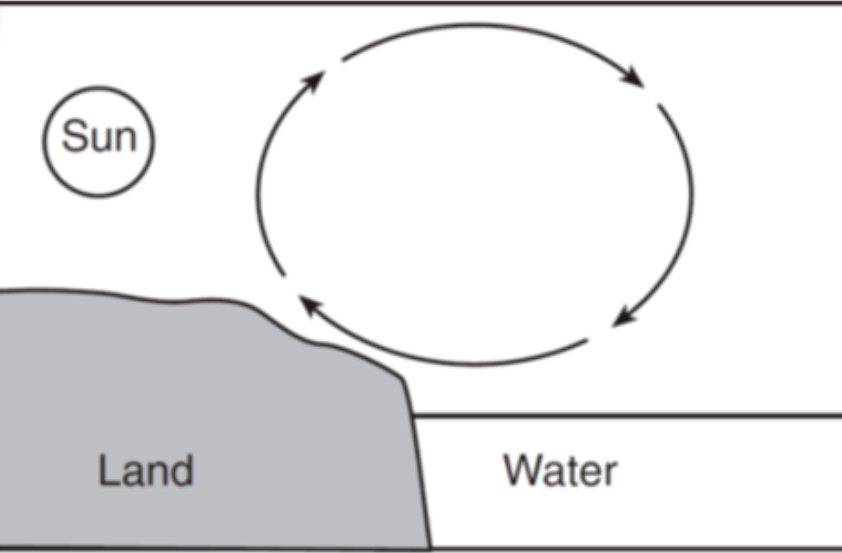
The arrows in the diagram below show the circulation of air on a sunny day. The air circulation shown is caused by --

the uneven heating of the land and the water causing the warm air to rise and the cold air to sink
the uneven heating of the land and the water causing the warm air to sink and the cold air to rise
the even heating of the land and the water causing the warm air to rise and the cold air to sink
the even heating of the land and the water causing the warm air to sink and the cold air to rise
What is the primary cause of global wind patterns on Earth?
ice caps melting
uneven heating of Earth's surface
weather changes
even heating of Earth's surface
Which answer choice correctly describes the movement of air on Earth?
Warm air rises from the equator and moves toward the poles because it is less dense.
Warm air rises from the equator and moves toward the poles because it is more dense.
Warm air rises from the north and south poles, then sinks toward the equator because it is less dense.
Warm air rises from the north and south poles, then sinks toward the equator because it is more dense.
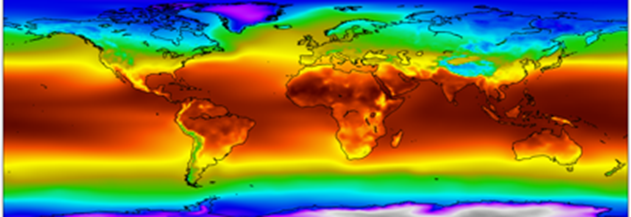
What does this map prove?

It proves that there are more cold places on Earth than there are warm places.
It proves that indirect heating occurs more at the equator than at the poles.
It proves that the world is flat.
It proves that direct heating occurs more at the equator than at the poles.
What is happening in the diagram and why?
This is a conduction current in which cold less dense air is rising while warm dense air is sinking due to the uneven heating of the earth.
This is an ocean current where the warm water is heading toward the equator while the cold water is heading toward the poles.
This is a convection current in which warm less dense air is rising while cold dense air is sinking due to the uneven heating of the earth.
This is the current that happens over mountains during the winter.