Today, we will be examining how heat flows from one object to another. To do this, we will use two different PhET simulations. These simulations will allow you to investigate heat transfer in ways that you would not be able to do in the classroom for whatever reason. Heat transfer is a constant in the universe and vitally impacts your everyday life. Knowing more about the process will help you make wise decisions as you grow up and become an independent adult.
Today, we will be examining how heat flows from one object to another. To do this, we will use two different PhET simulations. These simulations will allow you to investigate heat transfer in ways that you would not be able to do in the classroom for whatever reason. Heat transfer is a constant in the universe and vitally impacts your everyday life. Knowing more about the process will help you make wise decisions as you grow up and become an independent adult.
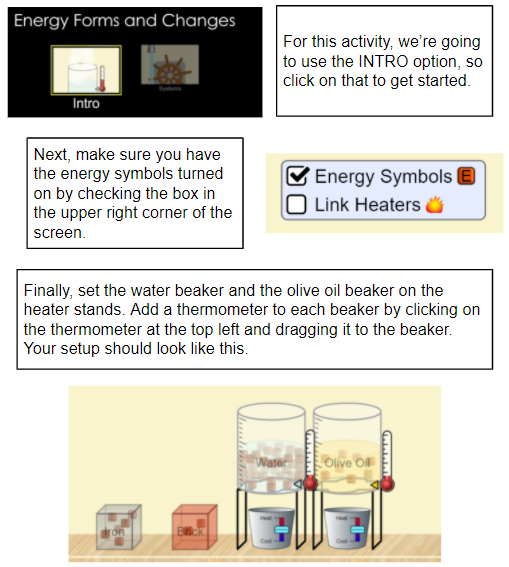
Drag the thermometer from the left corner to sit in the olive oil. Turn on the heater under the olive oil by dragging the slider to the heat setting. Keep the heater on until you see smoke
What happens to the amount of energy in the olive oil?
What does that do to the temperature?
Pick up the brick and drop it into the now heated olive oil.
How does the energy move now that the brick is in the olive oil?
When the brick is dropped in the temperature of the brick
(increases or decreases)
Take the brick out of the olive oil and put it on top of the iron.
How does the energy move now that the brick is on the iron?
What does that do to the temperature of the brick?
Turn on the cooler under the water by dragging the slider to the cool setting. Keep the cooler on until the temperature stops moving.
What happens to the amount of energy in the water?
Where does the thermal energy go?
Take the brick off of the iron and put it in the water.
How does the energy move now that the brick is in the water?
Insert a screenshot of your brick in the water.
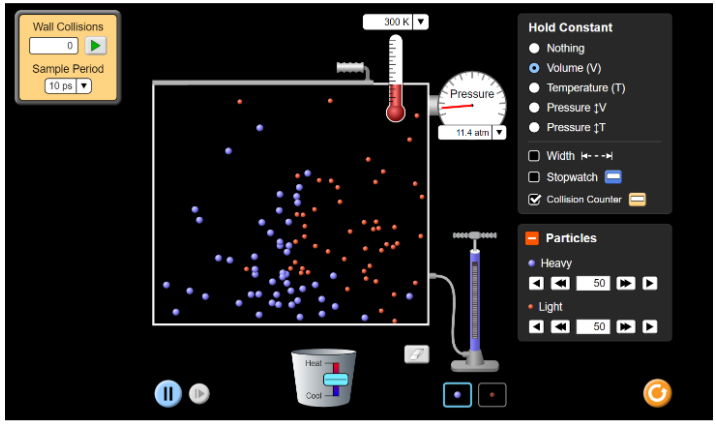
Your setup should look like this.
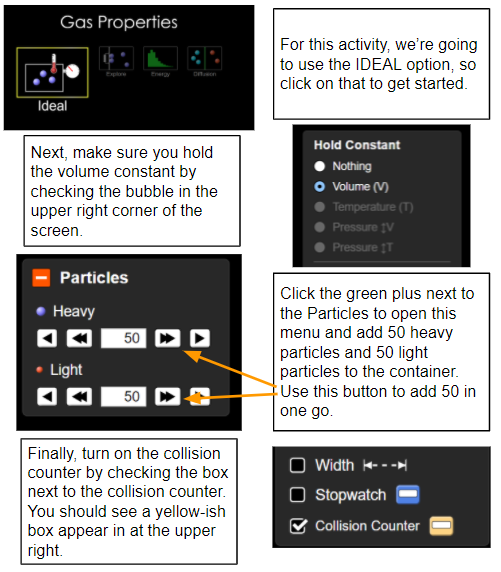
What do you notice about the velocities of the heavy particles compared to the velocities of the light particles?
Record your initial temperature and pressure of the container in the table. Use the collision counter to gather the number of collisions in 10 ps (just press play). Then, use the heater to raise the temperature to somewhere around 800K. Record new measurements for temperature, pressure, and collisions in the table.
Which particles are faster?
What happens to the pressure as the temperature increases?
Copy your initial temperature, pressure, and collisions of the container over from the previous section. Then, use the cooler below the container to lower the temperature to somewhere below 100K. Record new measurements in the table.
Which particles are slower?
What happens to the pressure as the temperature decreases?
Copy your initial temperature, pressure, and collisions of the container over from the previous section. Now, use the heater below the container to raise the temperature to somewhere above 5100K. Record new measurements in the table.
What happened to the container when the temperature got so high?
Why do you think that happens?
Why is it unfair to measure the collisions at this point?
Insert a screenshot of your heated oil beaker here.
What does that do to the temperature of the olive oil?
Insert a screenshot of your brick in the oil here.
The temperature of the brick
(increases or decreases)
Insert a screenshot of your brick on the iron.
Insert a screenshot of your cold water beaker here.
What does that do to the temperature of the brick?
How does the temperature of the brick compare to that of water after some time passes?
What are some general statements you can make about the movement of thermal energy after observing the various scenarios in the simulator?