Use this Simulation and set the settings like the example below:
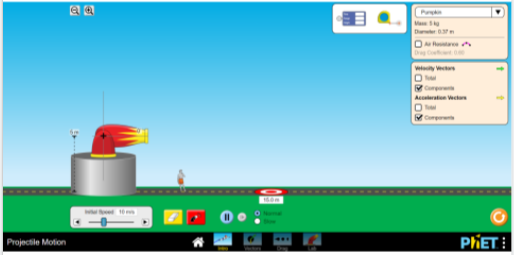
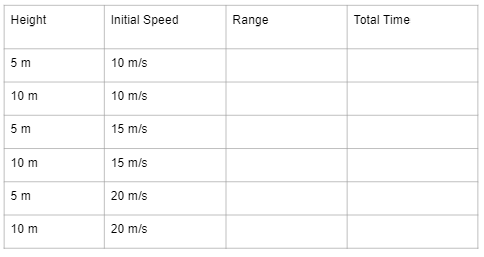
Change the Height and Initial Speed to match the data table below and use the Blue Measuring tool (Right corner) to take measurements.
Create a hypothesis for this experiment by writing a testable answer to the above question in an if/then format.
Use this Simulation and set the settings like the example below:
Change the Height and Initial Speed to match the data table below and use the Blue Measuring tool (Right corner) to take measurements.
Clear your path after each launch to keep the screen clean.
Fill in the Data Table.
What happens to the Range as Height increases? Why?
What happens to the Range as Initial Speed increases? Why?
What happens to range as mass increases? Why?
Launch one more time and watch the Velocity Vectors (components). What happens to the Horizontal Velocity Vector (Green arrow) throughout the launch?
Launch on more time and watch the vectors. What happens to the Acceleration Vector (Yellow arrow) throughout the launch?
Is there any acceleration in the x direction?
How does gravity affect the projectile?
What would happen if it were fired on a planet without gravity?
How does this compare to yesterday's lab (other than one is vertical and one is horizontal)
If you were given the range and the time it took to fall, how would you find the initial velocity?
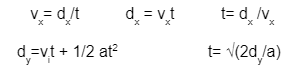
Just like Freefall, this still uses the basic kinematics formulas. The only tricky part is you may need to mix and match to find certain variables.
What is the initial velocity of a projectile that has a range (dx) of 2.5 m and landed in 2.6 s?
What is the height (dy) this projectile was dropped from?
Question: How do height and initial velocity affect the range and time of a projectile?
Write a mini CER (8-15 sentences) for horizontal projectiles. (No need for procedure or sources of error)
How long did it take for a projectile dropped from 5 m to land?
If the initial velocity was 1.8 m/s, what is the range of the projectile? (Use your time from #15)