Log in
Sign up for FREE
arrow_back
Library

Unit 2.5 Classwork: The Indian Removal Act & the Trail of Tears

star
star
star
star
star
Last updated almost 2 years ago
14 questions
Note from the author:
0
Required
1
CCSS.ELA-LITERACY.RH.11-12.1
IIRC.01
Required
0.5
CCSS.ELA-LITERACY.RH.11-12.1
IIRC.02
Required
0.5
CCSS.ELA-LITERACY.RH.11-12.1
IITE.01
Required
0.5
CCSS.ELA-LITERACY.RH.11-12.4
RWC.01
Required
0.5
CCSS.ELA-LITERACY.RH.11-12.1
IITE.01
0
Content Objective: I will be able to explain the conditions of the Trail of Tears and explain why it happened..

Standard Objective: I will be able to identify explicitly stated relationships between individuals (e.g. comparison-contrast).

Absent? Want to see the slides? Click here!
Content Objective: I will be able to explain the conditions of the Trail of Tears and explain why it happened..

Standard Objective: I will be able to identify explicitly stated relationships between individuals (e.g. comparison-contrast).

Absent? Want to see the slides? Click here!
Question 1
1.

Opinion Question: Does the United States government have the right to make you move away from your home? Explain your answer in at least two complete sentences.

Required
1
Question 2
2.
At the beginning of the 1830s, nearly _______ Native Americans lived on millions of acres of land in Georgia, Tennessee, Alabama, North Carolina and Florida. Their ancestors had occupied and _______ this land for generations, but by the end of the decade, very few Native Americans remained anywhere in the southeastern United States.

White Americans often feared and _______ the Native Americans: to them, Native Americans were unfamiliar people who occupied land that white settlers wanted. But the Native Americans’ land was valuable, and it grew to be more _______ as white settlers flooded the region. Many of these whites yearned to make their fortunes by growing cotton, and often resorted to violent means to take land from their Native neighbors. They stole livestock; burned and looted houses and towns; and even committed mass murder.
1
Question 3
3.
The Indian Removal Act of 1830 was a key feature of Andrew Jackson’s presidency that gave him power to negotiate removal treaties with Indian tribes living east of the Mississippi river. Working on behalf of white settlers who wanted to grow _______ on the Natives’ land, the U.S. government forced them to leave their homelands and walk hundreds of miles to a specially designated "_______ Territory," which would later become the state of Oklahoma.

By the end of the decade, _______ eastern Native Americans were relocated to the” Indian Territory. Since the bulk of the new territory was in the American south, Jackson successfully opened up 25 million acres of land to white settlement and the expansion of _______ .
Question 4
4.

Required
1
Question 5
5.
Some tribes _______ their forced removal from their ancestral homes, which they coined the Trail of Tears because of its devastating effects on the exhausted migrants. Over 70,0000 Native Americans were forced to march more than _______ miles to Indian Territory. Disease was _______ .

Historians estimate that more than _______ Cherokee died as a result of the journey, and these deaths do not even account for the other four tribes who were also forced to make the journey. Another notable tribe was the _______ Indians of Florida recruited runaway enslaved Blacks to fight alongside them and bravely waged three different wars until the U.S. government _______ the remaining members of their tribe to settle west in present-day Oklahoma.
Required
1
CCSS.ELA-LITERACY.RH.11-12.4
IIWD.01
Required
1
CCSS.ELA-LITERACY.RH.11-12.4
IIWD.01
Question 8
8.

Question 9
9.

Required
1
CCSS.ELA-LITERACY.RH.11-12.4
IIWD.01
Required
1
CCSS.ELA-LITERACY.RH.11-12.4
IIWD.01
Question 12
12.

Question 13
13.

Question 14
14.


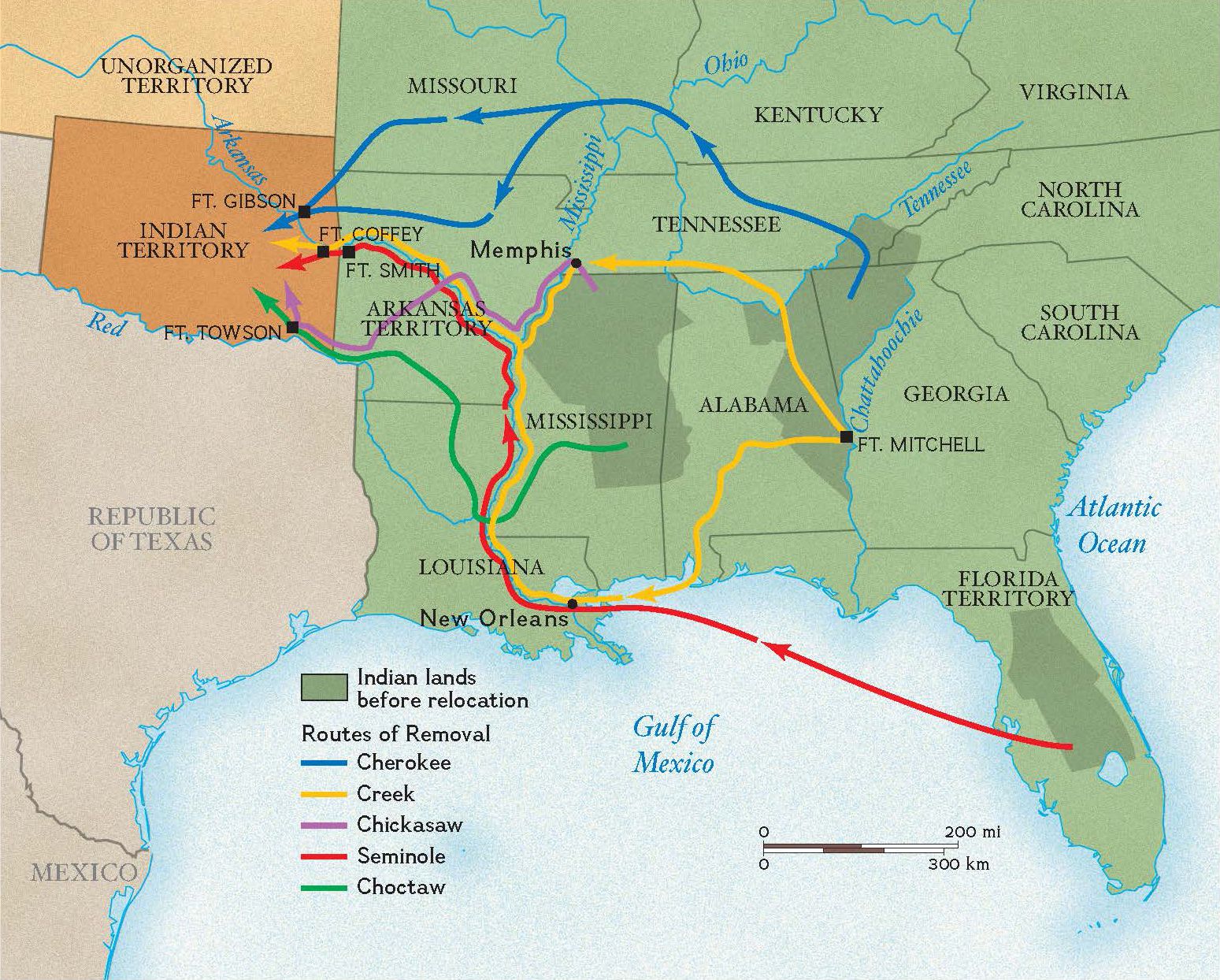
According to the map above, which Native American tribe was NOT affected by the Indian Removal Act?
The Chickasaws
The Creeks
The Choctaws
The Iroquois
Question 6
6.

Question 7
7.

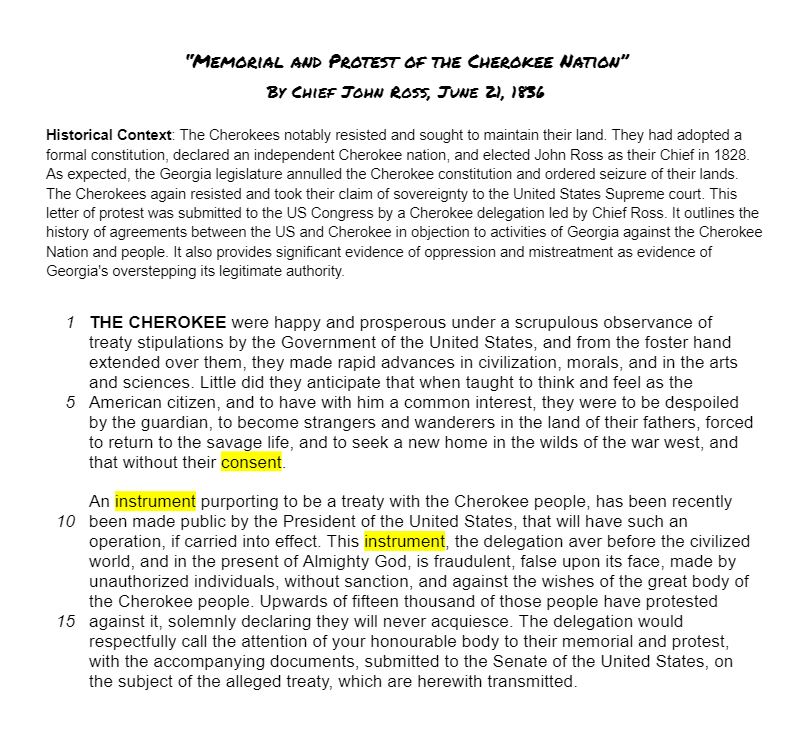
It can be reasonably inferred from the passage that
President Jackson was able to secure the explicit permission of Chief Ross to relocate the Cherokee.
the Cherokee people had made efforts to assimilate and adopt white American culture.
Chief Ross and his people were pleased with the situation surrounding Indian Removal.
the Cherokee had fought numerous wars in defiance of the Indian Removal Act.
Which choice provides the best evidence for the answer to the previous question?

Under "Show Your Work," explain this evidence in your own words.
Line 1-2 ("The Cherokee... United States")
Line 3-4 ("they made... and sciences")
Line 11-12 ("This instrument... its face")
Line 14-15 (Upwards of... never acquiesce")
Question 10
10.

Question 11
11.

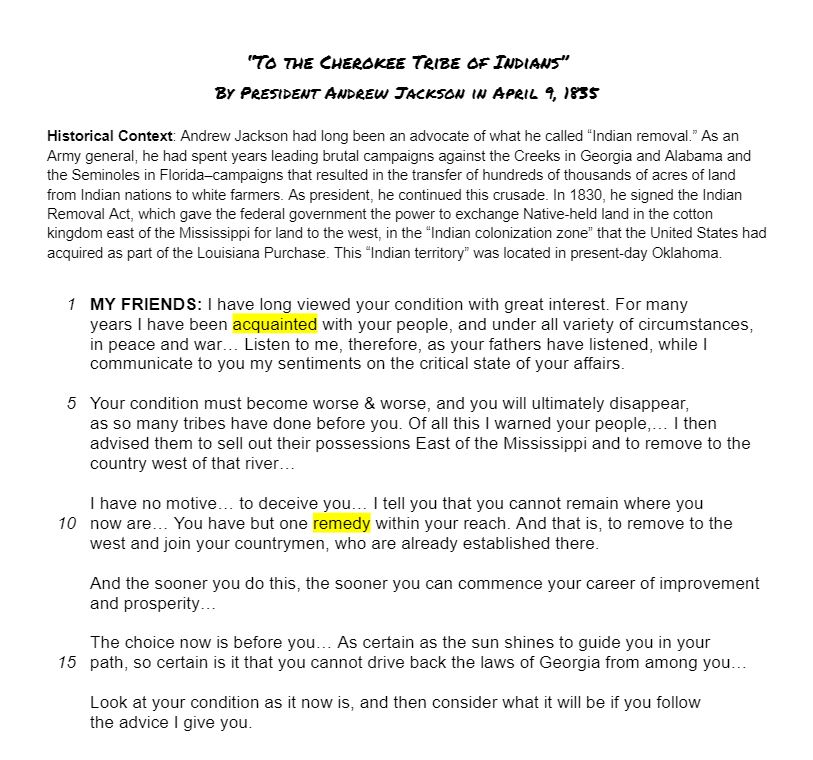
President Jackson uses the phrase "your condition" (lines 1, 5, and 16) in order to
emphasize the dire fact that Native Americans facing near extinction.
suggest that he is chronically sick of the Cherokee people.
propose helpful alternatives for the situation of the Cherokee Nation.
indicate that he is apathetic about the affairs of indigenous people and their land.
Which choice provides the best evidence for the answer to the previous question?

Under "Show Your Work," explain this evidence in your own words.
Line 2-3 ("For many... and war")
Line 3-4 ("Your condition... established there")
Line 10-11 ("You have... its face")
Line 16-17 (Look at... give you")
Exit Ticket: Please evaluate how well you understood today’s lesson on a scale from 1 to 4:
1 - I need to seek out extra help from someone else.
2 - I need to find resources and relearn on my own.
3 - I understood the lesson on my own, and should pass on the knowledge!
4 - I was able to successfully explain and help someone else’s understanding.
As used in line 8, "consent" most nearly means

Under "Show Your Work," share the specific context clue and/or synonym that you used to arrive at this answer.
signature
denial
permission
awareness
As used in lines 9 and 11, "instrument" most nearly means

Under "Show Your Work," share the specific context clue and/or synonym that you used to arrive at this answer.
document
device
harmony
apparatus
As used in line 2, "acquainted" most nearly means

Under "Show Your Work," share the specific context clue and/or synonym that you used to arrive at this answer.
ignored
friendly
disciplined
familiarized
As used in line 10, "remedy" most nearly means

Under "Show Your Work," share the specific context clue and/or synonym that you used to arrive at this answer.
antidote
cause
medicine
solution