Unit 2.3 Classwork: Westward Expansion & Manifest Destiny
star
star
star
star
star
Last updated about 2 years ago
6 Nsɛmmisa
Hyɛ no nsow a efi ɔkyerɛwfo no hɔ:
Ɛhia
1

Ɛhia
1
1
Content Objective: I will be able to explain the concept of Manifest Destiny in my own words.
Standard Objective: I will be able to determine implicit relationships between and among individuals and events, (e.g., cause-effect).
Absent? Just want to review the guided notes? Slides are linked here.
Content Objective: I will be able to explain the concept of Manifest Destiny in my own words.
Standard Objective: I will be able to determine implicit relationships between and among individuals and events, (e.g., cause-effect).
Absent? Just want to review the guided notes? Slides are linked here.
Welcome to Unit 2: Westward Expansion & the Age of Jackson. In this unit, we are going to explore the ways in which the expansion of the United States territory set the scene for what would eventually turn into the worst crisis in our country's history: the Civil War. We are also going to look at how our government significantly changed during the presidency of one of our most controversial leaders, Andrew Jackson.

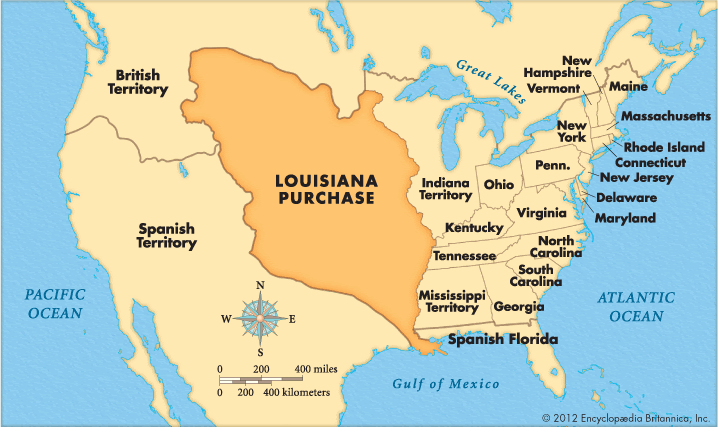
Although we are skipping over the first few presidencies to focus on more modern parts of our history, there is one important event that we need to discuss. During
For Context:
One cent in 1803 = 73 cents today
One football field = 1.32 acres
Shade the boundaries of The Louisiana Purchase in with your favorite color on the image below.
All of the following are effects of the Louisiana Purchase EXCEPT
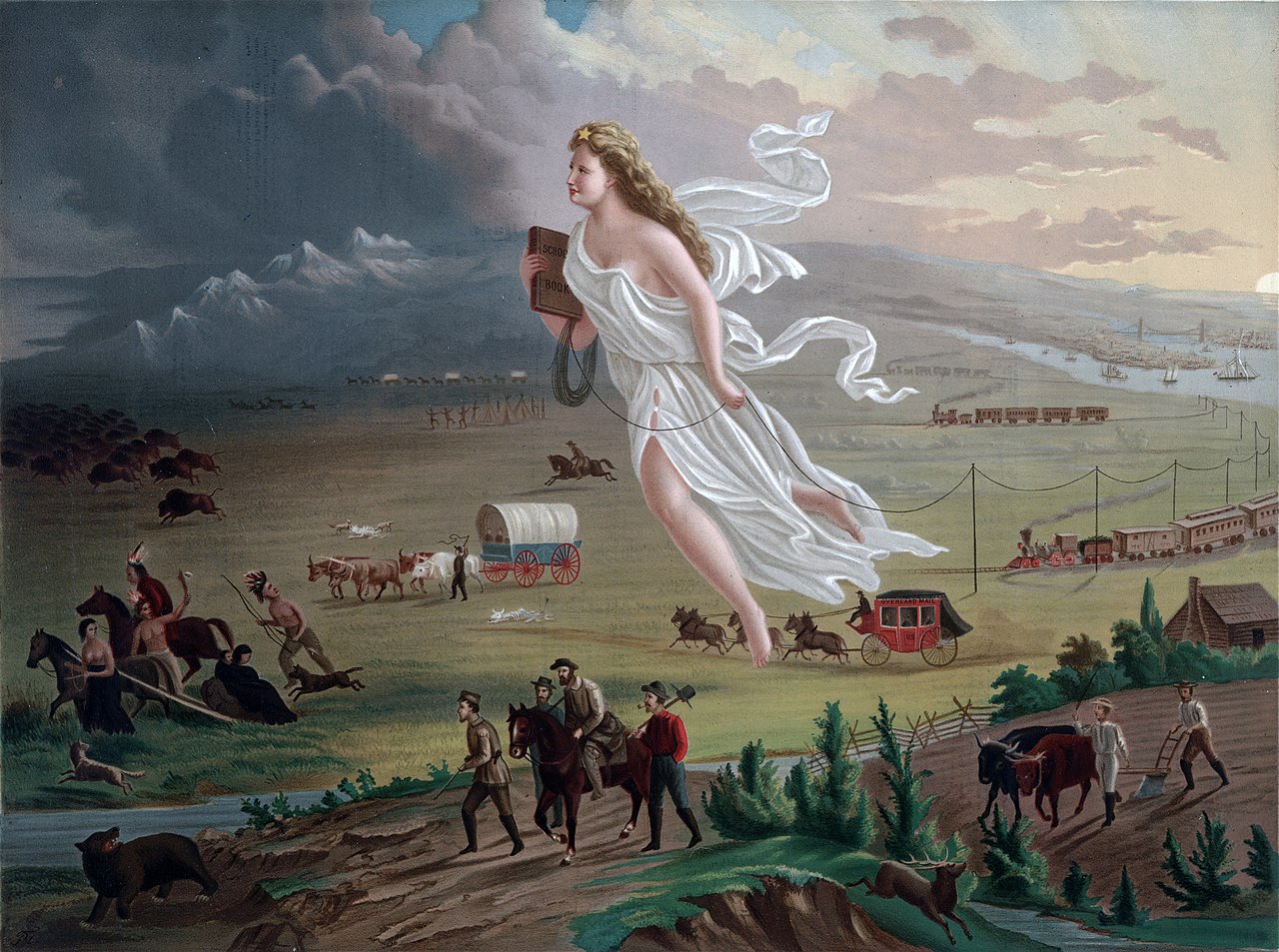
Circle at least three key details of the painting that you observe. Be ready to discuss them with the class!
What do you notice about John Gast’s “American Progress” painting? (1872)
Did someone share an interesting idea in your group? Add what they said in [hard brackets] so we can visibly see how we are learning from one another!
Many historians believe that John Gast's painting depicts the key concept of Manifest Destiny, a term that emerged in the