Lessons 3.5 -3.9 Partner Content Check due 11/14 beginning of class

Last updated over 1 year ago
18 questions
Required
2

The director of student life at a university wants to know what percent of students eat regularly on campus. To find out, the director selects an SRS of 300 students who live in the dorms.
Describe how undercoverage might lead to bias in this study.

Required
2

The director of student life at a university wants to know what percent of students eat regularly on campus. To find out, the director selects an SRS of 300 students who live in the dorms.
Will the results cause the director of student life to overestimate or underestimate the percent of students who eat regularly on campus?
Why?

Required
3

Suppose an SAT preparation course makes the following statement in their advertising brochure:
“Thousands of students have taken our SAT prep course. We asked our graduates to report on their SAT scores before and after taking our course. The mean increase in SAT scores for the 500 graduates who responded was 210 points.”

Describe how nonresponse might lead to bias in this study from the pamphlet.

Required
2

Is the mean of 210 points likely greater than or less than the actual mean increase for all graduates of the course?
Select both answers.

Required
2

Emma asked 80 randomly selected people if free health care should be provided to the homeless. Half of the people were shown a picture of a homeless woman with a small child.

When shown the picture, 67.5% agreed that free health care should be provided to the homeless.
When the picture was not shown, only 45% agreed with this statement.

1. Explain why the two percentages are so different.
2. What type of bias is present?

Required
3

In a series of experiments, subjects were randomly assigned to receive a flu vaccine or a placebo, they were not told which shot they received.
The researchers did not know which vaccine the subjects received until the end of the study.
In addition to recording whether or not subjects contracted the flu, researchers also recorded whether or not subjects suffered from “major adverse cardiovascular events” such as heart attacks.
They found the subjects that received the flu vaccine were less likely to have a cardiovascular event.

Why was it necessary to perform an experiment rather than simply asking people if they have received a flu vaccine?

Required
2

Use the information from #6:
Explain why it was important for the experiment to include a control group that didn’t receive a flu vaccine.

Required
3

Use the information from #6:

1. Explain how blinding is used
2. What type of blinding (single or double)
3. Why is blinding beneficial or what does it help prevent?

Be sure to include all three points, number them to make it easier.

Required
3

Preschool:Does preschool help low-income children stay in school and hold good jobs later in life?

The Carolina Abecedarian Project (the name suggests the ABCs) has followed a group of 111 children since 1972. Back then, these individuals were all healthy, low-income black infants in Chapel Hill, North Carolina.
All the infants received nutritional supplements and help from social workers.

The infants were randomly assigned half to an intensive preschool program and
the other half did not go to a preschool program.

Describe how the researchers could have carried out the random assignment.
Explain clearly how this could have been done.
Include all three steps.
Make sure to include context.

Required
2

Using the experiment in #9:

Why was it important that the researchers randomly assigned treatments to the infants?
Select two correct answers.

Required
7

Using the experiment in #9:

Identify all variables that the researchers kept the same for all subjects. Why was it important that the researchers keep these variables the same?

Crime Metaphors:
A recent study examined the impact of metaphors on the way people think about complex issues.
In one part of the study, subjects were divided randomly into two groups.
One group read a passage that described crime in a fictional city as a “beast” ravaging the city.
The second group read an identical passage with one change—the word “beast” was replaced with the word “virus.”
After reading the passage, all the subjects were asked what the town should do in response to crime and their responses were compared.
Required
1
Responses were categorized from participants in the study above as either suggesting more enforcement or more social programs.
Here are the results:
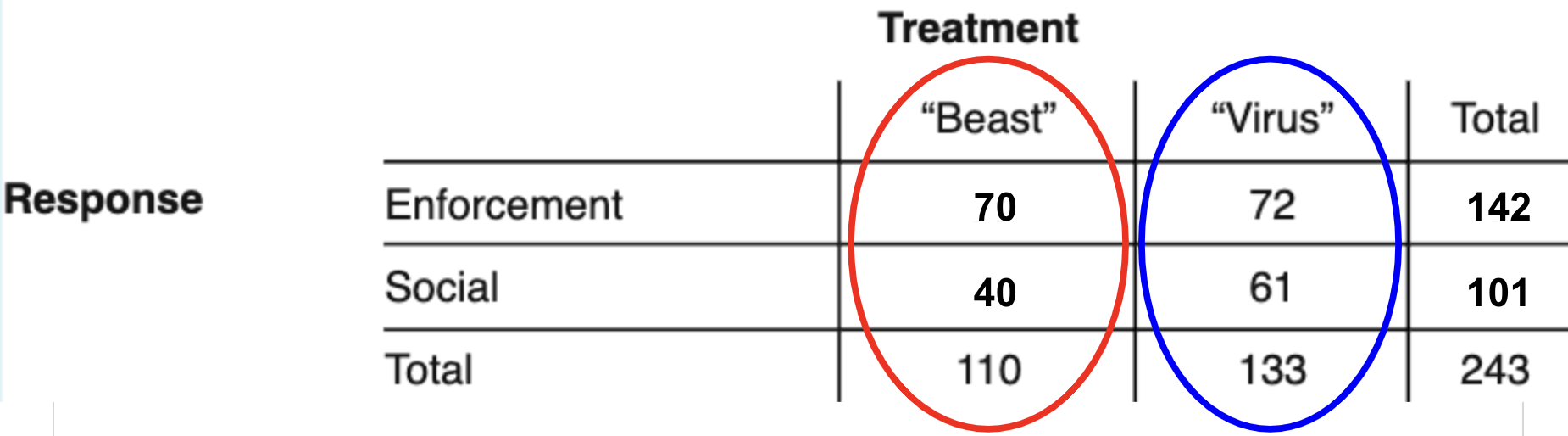

Remember: proportion = part/whole
Calculate the proportion of subjects who suggested “enforcement” in the 'Beast' group.
Calculate the proportion of subjects who suggested 'enforcement' in the 'Virus' group.
Then calculate the difference in proportions (Beast – Virus).
Do not change answers to a percent.

1. Calculate the proportion of subjects who suggested 'enforcement' in the 'Beast' group. Keep it as a decimal, round to three places. Do not change it to a percent.
_______

2. Calculate the proportion of subjects who suggested 'enforcement' in the 'Virus' group. Keep it as a decimal, round to three places.
_______

3. Calculate the difference in proportions (Beast - Virus).
_______
Required
1

Use the study:
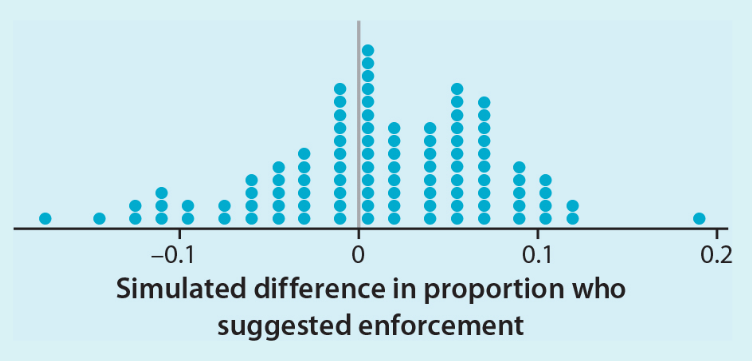
One hundred trials of a simulation were performed to see what differences in proportions are likely to occur due only to chance variation in the random assignment, assuming that the type of metaphor didn’t matter.
The simulation results are shown below:


Is the difference between the two proportions statistically significant?
(did changing the crime metaphor cause a significant change in the proportion of people who recommended 'enforcement'?)
Use the results of the simulation above to determine if the difference in proportions from #12 is statistically significant.
Check our Lesson 3.8.
Explain your reasoning using the % and what it means regarding if it is likely or unusual to happen just by chance due to sampling variability.

Required
1

The National Health and Nutrition Examination Survey is a long-term research program that uses random sampling methods to examine the health and nutrition among adults and children in the United States.
One study of 2400 young adults found that subjects who consumed sugary foods at least 5 times per week had a 73% higher risk of developing periodontal (gum) disease in at least two teeth than those who never ate such foods.

Is this an experiment or an observational study?
How do you know? Select two answers.

Required
2

Use the information from #14:
Can the results of this study be generalized to all young adults in the United States?
Explain.

Required
4

Based on the study, is it reasonable to conclude that consuming sugary foods at least 5 times per week causes periodontal(gum) disease? Explain.
Select four true answers.

Required
1

Are people who report being cheerful and happy less likely to get sick than people who report being sad and angry?
Yes, according to a study where researchers exposed 193 healthy volunteers aged 21–55 to a cold virus and recorded who got sick. They noted who was cheerful and who was sad with a questionnaire and then recorded who got a cold.
Cheerful people also had milder symptoms when they did get sick.

Based on this study, is it appropriate to conclude that being happy and cheerful causes the risk of catching a cold to decrease?
Explain what, if any, inference can be made.
Check if the two types of randomization are present.

Required
2

A study of strength training and memory randomly assigned 46 young adults to two groups. After both groups were shown 90 pictures, one group had to bend and extend one leg against heavy resistance 60 times.
The other group stayed relaxed, while the researchers used the same exercise machine to bend and extend their legs with no resistance 60 times.
Two days later, each subject was shown 180 pictures—the original 90 pictures plus 90 new pictures and asked to identify which pictures were shown two days earlier.
The resistance group had significantly more success identifying these pictures than the relaxed group.
Where is the randomization in this study.
What conclusions(inferences) can we draw from this study?
Select BOTH answers.